
Home Gymnasium: How to Plan, Equip and Set Up a Home Gym
Quick answer: A home gymnasium is a dedicated training space in your house, garage or apartment with enough home gym equipment to train your whole body. To set one up, define your training goals, measure your available space, set a budget, then choose a main station: a power rack with barbells and weights, an all-in-one home gym system with a weight stack, a functional trainer, or a Smith machine. Add flooring, a bench and a few accessories, and you can replace most of what a commercial gym offers in about 50–100 square feet.
Key takeaways
- Start with goals and space, not with a shopping list.
- One versatile main station beats several single-purpose machines.
- A power rack with integrated cable stations gives the most exercise variety per square foot.
- Protect the floor first.
- Buy for long term value: equipment you can expand, not replace.
Why build a home gymnasium?
| Advantage | What it means day to day |
|---|---|
| No commute | Train in the time you would spend driving |
| Your schedule | Early, late or in short breaks; the gym is always open |
| No waiting | Every machine is free when you walk in |
| Privacy and freedom | Your music, your pace, your training style |
| Long term value | After the initial investment you stop paying monthly fees |
| Easier to stay consistent | A fitness routine is simpler to keep when the gym is ten steps away |
Full cost comparison: home gym vs gym membership.
Step 1: Define your training goals
| Goal | What you need most |
|---|---|
| Build strength and muscle | Power rack or squat racks, barbells, weights, adjustable bench, cables |
| General fitness and toning | Home gym system or functional trainer, dumbbells or kettlebells, mat |
| Fat loss and conditioning | Open floor space, mat, kettlebells, a cardio machine if you enjoy it |
| Mobility, yoga and Pilates | Large mat, light weights, foam roller |
| Whole family, mixed levels | Rack with cables plus light free weights, so beginners and experienced lifters can both train |
Step 2: How much space do you need?
| Setup | Floor space | Ceiling height |
|---|---|---|
| Mat and free weights | About 6 × 6 ft | Standard |
| Compact weight-stack machine | About 6 × 8 ft | 7 ft or more |
| Power rack with a 7 ft barbell | About 8 × 8 ft | 8 ft for pull-ups |
| All-in-one rack with cable crossover | About 8 × 10 ft | 8 ft |
| Rack plus cardio machine | About 10 × 12 ft | 8 ft |
- Measure the room and check product dimensions, including the space to load plates and walk around the machine.
- Smaller rooms: choose a space saving footprint and wall-side storage.
- Garage: plenty of room and a strong floor, but plan for cold and heat.
- Upstairs: check the floor first.
Guides: how much space a power rack needs, can your floor hold a home gym? and the cold garage gym guide.
Step 3: Choose your main station
| Type | How it works | Best for | Limits |
|---|---|---|---|
| Power rack with barbell and plates | Four-post cage with safety arms; you lift free weights inside it | Strength, muscle, long term progress | Needs a bar, plates and a bench |
| Rack with integrated cable stations | Power rack plus pulleys for pulldowns, rows and cable work | The most versatility in one footprint | Larger and heavier than a basic rack |
| Weight-stack home gym system | Guided stations (press, pulldown, leg extension, sometimes leg press) on one weight stack | Beginners; quick pin changes; quiet workouts | Fixed movement paths; limited maximum resistance |
| Functional trainers | Two adjustable pulleys, usually with dual weight stacks | Cable exercise variety, rehab, sport movements | No heavy squats or bench presses without a rack |
| Smith machines | Barbell on fixed vertical rails | Lifting alone on a guided path | Less natural movement; the bar path is fixed |
| Smart home gyms | Motor or digital resistance with a screen and guided workouts | Very small spaces; people who like coaching | Highest price per pound of resistance; often a subscription |
For most people who want to train legs, chest, back, shoulders and arms on the same machine, a rack that combines free weights and cables is the most complete answer. Comparison: power rack vs squat rack vs Smith machine.
Step 4: Add the essentials
| Priority | Equipment | Why |
|---|---|---|
| 1 | Flooring | Protects floors, cuts noise, gives grip |
| 2 | Main station (rack or system) | Where most of your training happens |
| 3 | Barbell, plates and collars | Progressive resistance for every muscle group |
| 4 | Adjustable benches | Flat, incline and seated exercises |
| 5 | Dumbbells or kettlebells | Single-arm work, conditioning, warm-ups |
| 6 | Accessories | Cable handles, storage, foam roller, gloves |
Step 5: Set a budget
| Level | What you get | Typical price range |
|---|---|---|
| Starter | Large mat, kettlebells or dumbbells | A few hundred dollars |
| Core strength setup | Power rack, barbell, plates, mat | Roughly $1,200–$2,500 |
| Complete home gymnasium | Rack with cables, bar, plates, bench, mat, accessories | Roughly $2,000–$4,000 |
| With cardio | Add a bike, rower or treadmill | Add $500–$2,000+ |
Start with the pieces you'll use every week, and expand later. Paying for quality once is cheaper than replacing light, wobbly gear. Bundles usually cost less than purchasing each item separately.
Step 6: Plan the layout
- Rack against a wall, with at least 2 ft clear on each side to load plates.
- Leave an open area of about 6 × 6 ft for floor exercise, stretching and kettlebells.
- Store weights low and close to where you use them.
- Good light, a fan and a mirror make the room somewhere you want to be.
- Keep it quiet for the rest of the house: mats under everything and bumper plates for lifts from the floor. See quiet workouts.
A complete home gymnasium with GXMMAT equipment
| Need | GXMMAT option |
|---|---|
| Compact first rack | G5 power rack: about 12 sq ft, with pull-up bar, lat pulldown, low row, dip bars and landmine |
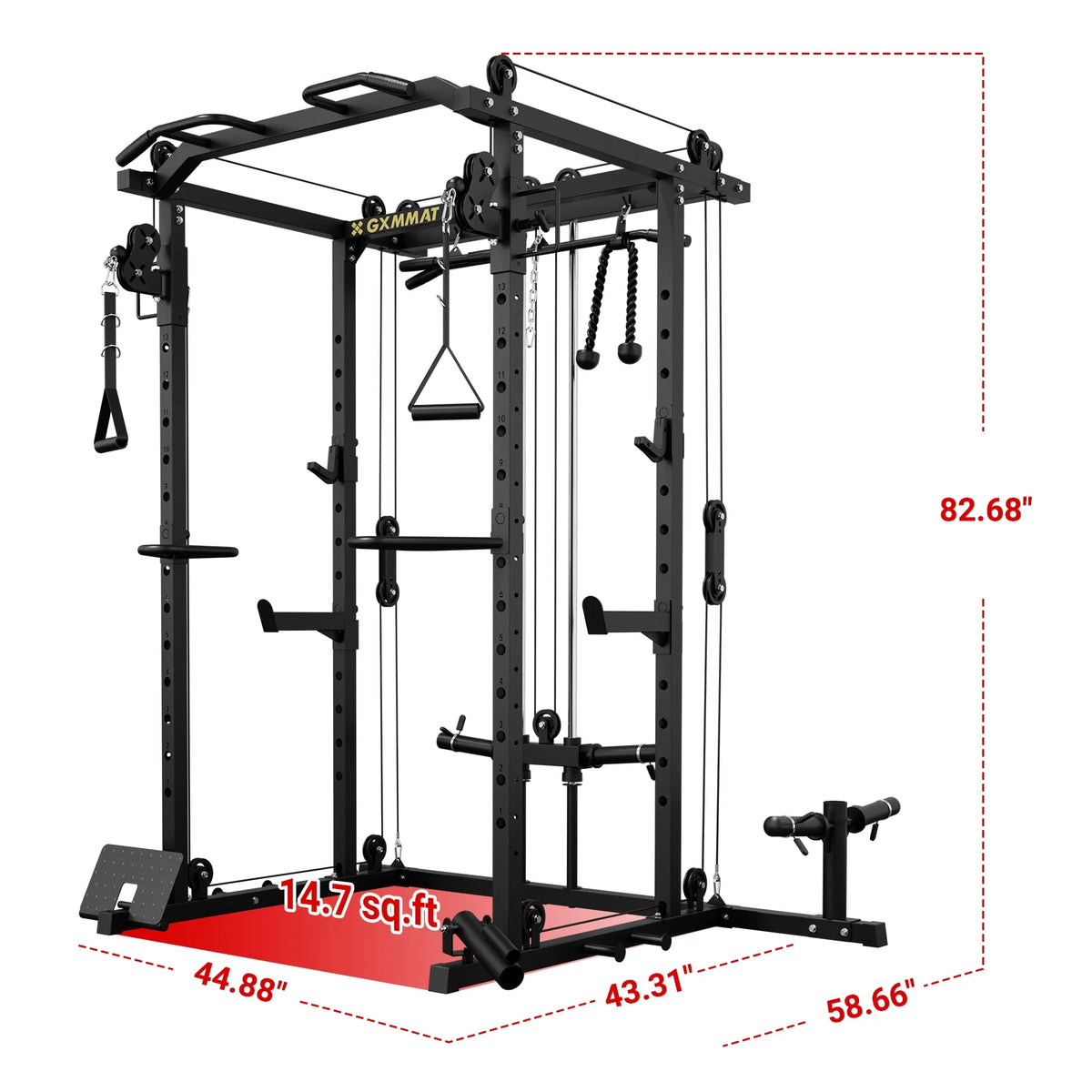
| All-in-one in a small footprint | V6 power rack: about 14.7 sq ft with dual 2:1 cables |
| Most complete setup | X6 power rack: dual independent cables, 2,200 lb capacity, band pegs and foot plate |
| Bar and weights | 20 kg Olympic bar, bumper plate sets, change plates, collars |
| Flooring | 7 mm large exercise mats from 6'×4' to 6'×16' |
| Free weights and extras | Soft kettlebells, plate rack, foam rollers |
| Everything together | Home gym packages with rack, bench, bar and plates |
Not sure which rack? See the X6 vs V6 vs G5 comparison and the package buying guide.
Your first workouts
Three effective workouts a week are enough to see results. Beginners can start with the 3-day full-body power rack plan and add weight gradually with progressive overload. Always set the safety arms before heavy lifts to reduce injury risk: safety arm height guide.
Common mistakes
| Mistake | Better approach |
|---|---|
| Buying before measuring | Measure floor space and ceiling height first |
| Several single-use machines | One versatile station plus free weights |
| Skipping flooring | Mat first; it protects the floor and your joints |
| Choosing by lowest price alone | Check capacity, steel, features and whether you can expand it |
| No plan | Follow a simple program from day one |
FAQ
What is a home gymnasium?
A dedicated space at home equipped for exercise, from a mat and a few weights to a full power rack and cable setup.
How much does it cost to set up a home gym?
Home gyms usually cost from a few hundred dollars for a mat and free weights to roughly $2,000–$4,000 for a complete rack, barbell, plates and bench setup. These are typical ranges, not quotes.
What is the best complete home gym system?
It depends on your goals and space. For strength and versatility, a power rack with integrated cable stations, a barbell and plates covers the most exercises in one footprint.
How much space do I need for a home gym?
About 6 × 6 ft for mat and free-weight training, and about 8 × 8 ft with an 8 ft ceiling for a power rack.
What is the 3-3-3 rule in the gym?
There's no single official definition. It most often means three strength workouts, three cardio sessions and three recovery or mobility sessions spread through the week, or simply three exercises for three sets.
Written by Yuvien Royer for GXMMAT. Prices in this article are typical ranges for general guidance; check current prices before purchasing. This is general fitness information, not medical advice.


