Power Rack vs Squat Rack vs Smith Machine: Which Is Best for Your Home Gym?
Quick answer: For most home gyms, a power rack is the best choice. Its four or six posts and safety arms let you squat, bench and press heavy weights safely on your own, and many models add a cable system. A squat rack (half rack) is smaller and cheaper but less safe for solo training. A Smith machine guides the bar on fixed rails. It's beginner-friendly but limits natural movement.
Key takeaways
- Power rack: the safest option for lifting heavy free weights alone, and the most versatile.
- Squat rack / half rack: compact and affordable, with less protection if you fail a rep.
- Smith machine: a fixed bar path. Good for beginners and isolation work, but your stabilizer muscles do less.
- Power rack with cables: combines a cage and a functional trainer in one footprint, which is ideal when space is limited.
What is a power rack?
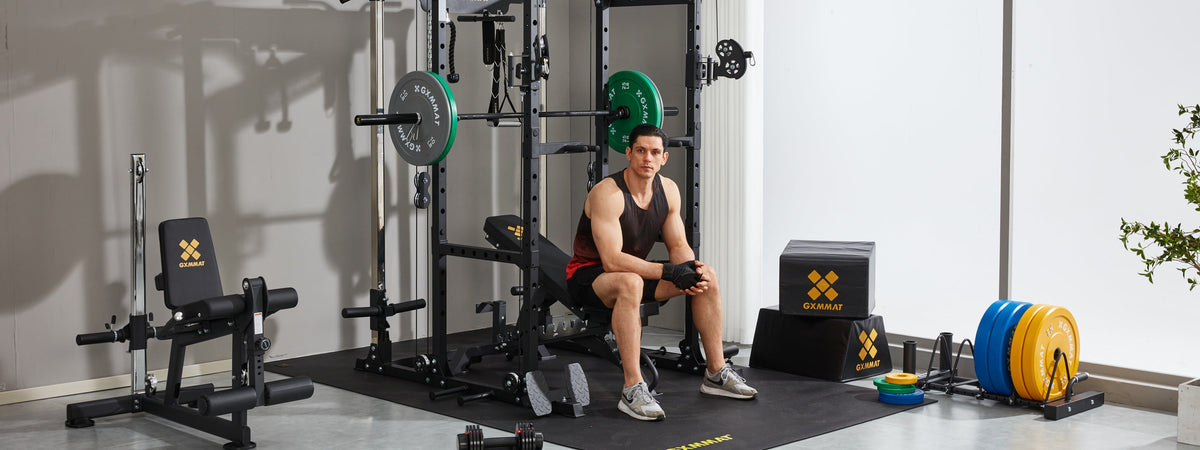
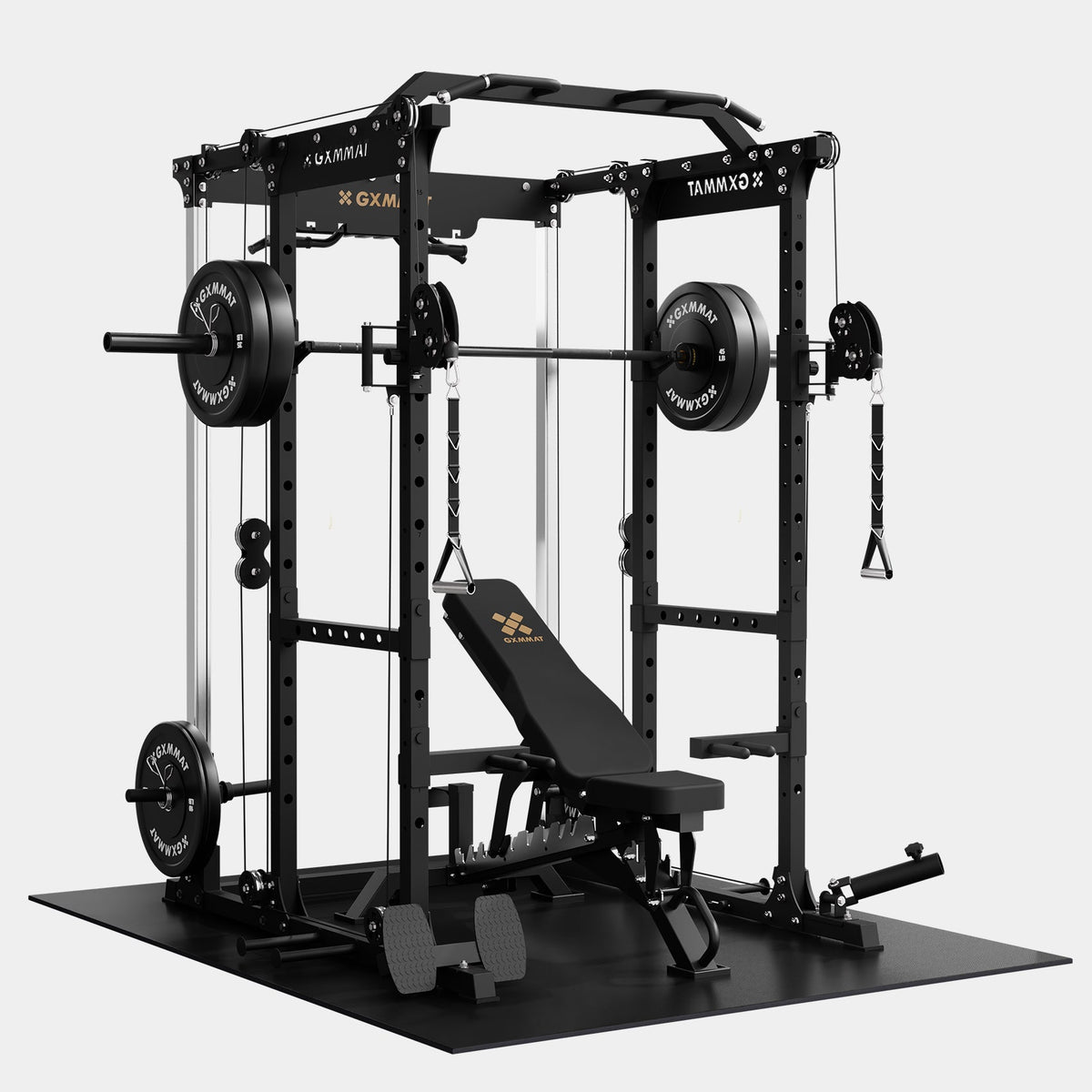
A power rack (also called a power cage) is an open steel frame with four or six vertical posts. Adjustable J-hooks hold the barbell, and safety arms or spotter bars catch it if you can't finish a rep. You lift inside the cage, so a failed squat or bench press lands on the safeties instead of on you.
Because the bar moves freely, a power rack trains the stabilizing muscles that free-weight lifts depend on. Most racks also have a pull-up bar, and many accept add-ons like dip bars, a landmine and cable pulleys.
What is a squat rack?
A squat rack ranges from two separate squat stands to a half rack: a two-post frame, sometimes with short rear posts. You lift in front of it rather than inside it. Squat racks take up less floor space and cost less. Their spotter arms are usually shorter, though, so there's less margin for error when you train alone.
What is a Smith machine?
A Smith machine locks the barbell onto vertical (or slightly angled) steel rails. You rotate the bar to hook or unhook it at any height. The fixed path makes balancing easy, which helps beginners and people rehabbing an injury. It also means the machine decides your bar path rather than your body, so the movement doesn't carry over to free-weight lifts as well.
Power rack vs squat rack vs Smith machine: comparison table
| Power rack | Squat rack / half rack | Smith machine | |
|---|---|---|---|
| Solo-training safety | Excellent (lift inside the cage) | Fair (short spotter arms) | Good (lock the bar at any height) |
| Bar path | Free | Free | Fixed rails |
| Exercise variety | Very high, especially with cables | Moderate | Moderate |
| Stabilizer muscle work | High | High | Low |
| Footprint | Largest | Smallest | Large |
| Relative cost | $$–$$$ | $–$$ | $$–$$$ |
| Best for | Serious home lifters, solo training | Small spaces, tight budgets | Beginners, rehab, isolation work |
Which is safer for training alone?
A power rack. Set the safety arms 1–2 inches below the lowest point of the lift (the bottom of your squat, or just above your chest on the bench). If you fail a rep, lower the bar onto the safeties and step or slide out. On a squat rack, the spotter arms may not reach far enough to catch a bench press. A Smith machine is safe too, but only for the movements its fixed path allows.
Which builds more strength and muscle?
Any of the three builds muscle if you train hard and add weight over time. For strength in free-weight lifts such as the back squat, bench press and overhead press, a power rack or squat rack carries over better. The free bar path makes you control balance and bar position yourself. A Smith machine is useful for hypertrophy work like Smith squats, split squats and incline presses, where you want to focus purely on the target muscle.
What about a power rack with a cable system?
A power rack with built-in pulleys merges two machines: a cage for barbell lifts and a functional trainer for cable work like lat pulldowns, seated rows, face pulls, triceps pushdowns, cable flys and lateral raises. Cables give you constant tension through the whole range of motion, which free weights can't.
When comparing cable racks, check the pulley ratio. With a 1:1 ratio, the resistance you feel equals the weight you load. With 2:1, the cable travels twice as far and feels about half as heavy. If strength is your goal, 1:1 is the better choice.
The GXMMAT X6 Power Rack is a 6-post cage with a dual independent 1:1 cable system and 20 aluminum pulleys, rated to 2,200 lb. If space is tighter, the GXMMAT G5 Power Rack starts from a traditional squat rack design and adds a rear cable pulley and built-in plate storage.
Squat stands vs power rack: which should you buy?
Choose squat stands or a half rack if you have a very small space or a low budget, and you mostly squat and bench with a spotter or with light weights. Choose a power rack if you train alone, plan to lift heavy, or want one station that grows with you through pull-ups, dips, landmine work and cables.
How to choose: a 4-question decision guide
- Do you train alone? If yes, get a power rack.
- Do you want cable exercises without buying a second machine? If yes, get a power rack with a 1:1 pulley system.
- Is your ceiling under 7.5 ft or your space under about 6 × 6 ft? If yes, consider a compact squat rack and check the rack's height carefully.
- Are you a complete beginner, or recovering from an injury? A Smith machine can be a good starting point, but most people outgrow it.
Ready to plan your space? Read How Much Space Do You Need for a Home Gym?
FAQ
Is a power rack better than a squat rack?
For most home gyms, yes. A power rack is safer for solo lifting because you train inside the cage with full-length safety arms, and it supports more exercises. A squat rack is better only when space or budget is very limited.
Is a Smith machine as good as a power rack?
Not for free-weight strength. A Smith machine locks the bar onto rails, so your stabilizing muscles work less and the movement carries over less to free-weight lifts. It's useful for beginners, rehab and targeted muscle-building work.
Can you bench press in a squat rack?
Yes, if the rack has spotter arms long enough to catch the bar over a bench. Many squat stands don't, which makes heavy solo bench pressing risky. A power rack with adjustable safeties is the safer option.
What is a 1:1 pulley ratio?
With a 1:1 pulley ratio, the cable and the weight move the same distance, so the resistance you feel equals the weight loaded. With a 2:1 ratio, you feel roughly half the loaded weight.
Is a 6-post power rack better than a 4-post rack?
A 6-post rack adds extra uprights, which gives more stability, more attachment points and room for storage or a cable system. A 4-post rack is simpler and slightly smaller.
Written by Yuvien Royer for GXMMAT. GXMMAT has made home workout mats since 2017 and launched its home strength equipment line in 2025.