How to Work Out in an Apartment Without Disturbing Your Neighbors
Quick answer: To work out in an apartment without disturbing your neighbors, focus on impact noise, the vibration that travels through floors. Train on a thick, high-density exercise mat, swap jumping moves for low-impact versions, lower weights under control instead of dropping them, use rubber plates or cables, and keep workouts outside quiet hours.
Key takeaways
- Impact noise is the real problem. Jumps, heavy footsteps and dropped weights travel through the floor into the unit below.
- A large high-density mat absorbs impact and stops equipment from sliding. Thickness and density both matter.
- Low-impact training still works. Tempo strength work, step-back versions of jumps and cable exercises get you just as fit.
- Timing and placement matter. Respect quiet hours and train near load-bearing walls, away from shared walls.
Why do home workouts disturb neighbors?
Building noise comes in two types:
- Airborne noise: music, voices, coaching videos. Headphones and closed doors handle this.
- Impact (structure-borne) noise: jumping, running in place, dropped dumbbells, a bench scraping the floor. The energy goes straight into the floor and the building's structure and comes out as thuds in the unit below. This is what neighbors complain about.
Soundproofing an apartment for airborne noise is hard. Reducing impact noise is easy: soften the contact between you, your equipment and the floor.
1. Put a thick, high-density mat under everything
A mat is the most effective single fix. Two properties matter:
- Thickness spreads and absorbs impact. 7–9 mm high-density foam is a good range for mixed workouts. Much thicker soft foam feels unstable for standing exercises.
- Density and hardness keep the mat from bottoming out under your heel or a dumbbell. Soft, cheap foam compresses to nothing on impact. Learn more in our guide to shore hardness.
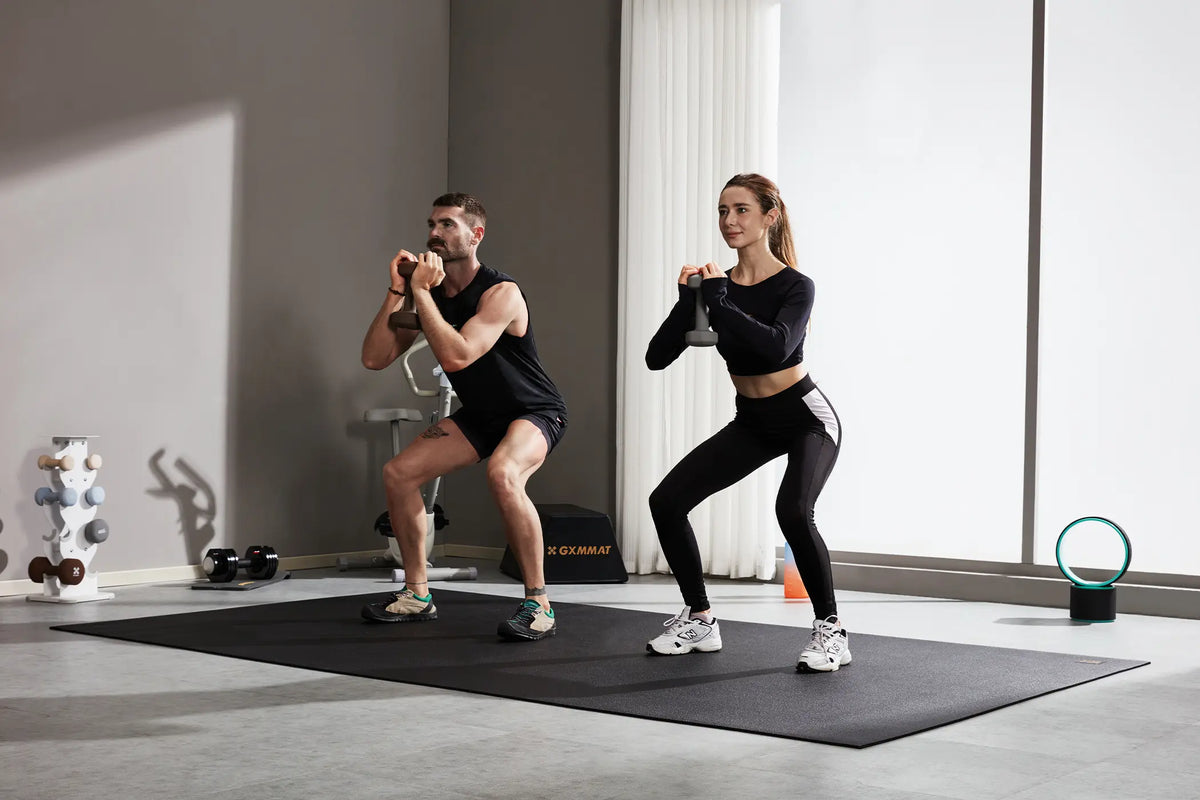
Size matters too. On a small yoga mat you'll step off it during lunges or jumps. A 6 × 8 ft or 6 × 10 ft mat gives you a full zone where every footstep lands on cushioning. GXMMAT large exercise mats are 7 mm high-density foam with a mesh-textured top and dotted bottom. They grip the floor and your feet, so the mat and your equipment don't shift. For stretching and yoga, the large yoga mats also come in 9 mm.
Extra tip: On hard floors, layering a large mat over a rug or carpet pad adds another layer of decoupling.
2. Swap high-impact moves for quiet versions
You don't have to give up intensity, just the landings.
| Loud exercise | Quiet alternative | Why it works |
|---|---|---|
| Burpees | Step-back burpees (no jump) | Same full-body effort, no landing |
| Jump squats | Tempo squats (3 sec down) or squat pulses | Time under tension replaces explosiveness |
| Jumping jacks | Step jacks / low-impact jacks | Keeps your heart rate up |
| High knees | Fast standing knee drives | One foot always on the floor |
| Jump lunges | Reverse lunges with a knee drive | Controlled single-leg work |
| Jump rope | Mountain climbers or shadow boxing | Hands-and-feet cardio without jumping |
A 20-minute quiet full-body workout
Do 40 seconds of work and 20 seconds of rest. Repeat the circuit 4 times.
- Tempo bodyweight squat (3 seconds down)
- Push-up (or incline push-up)
- Reverse lunge with knee drive (alternate legs)
- Step-back burpee
- Glute bridge with 2-second hold
3. Lift weights quietly
- Never drop weights. Lower dumbbells to your knees, then to the mat.
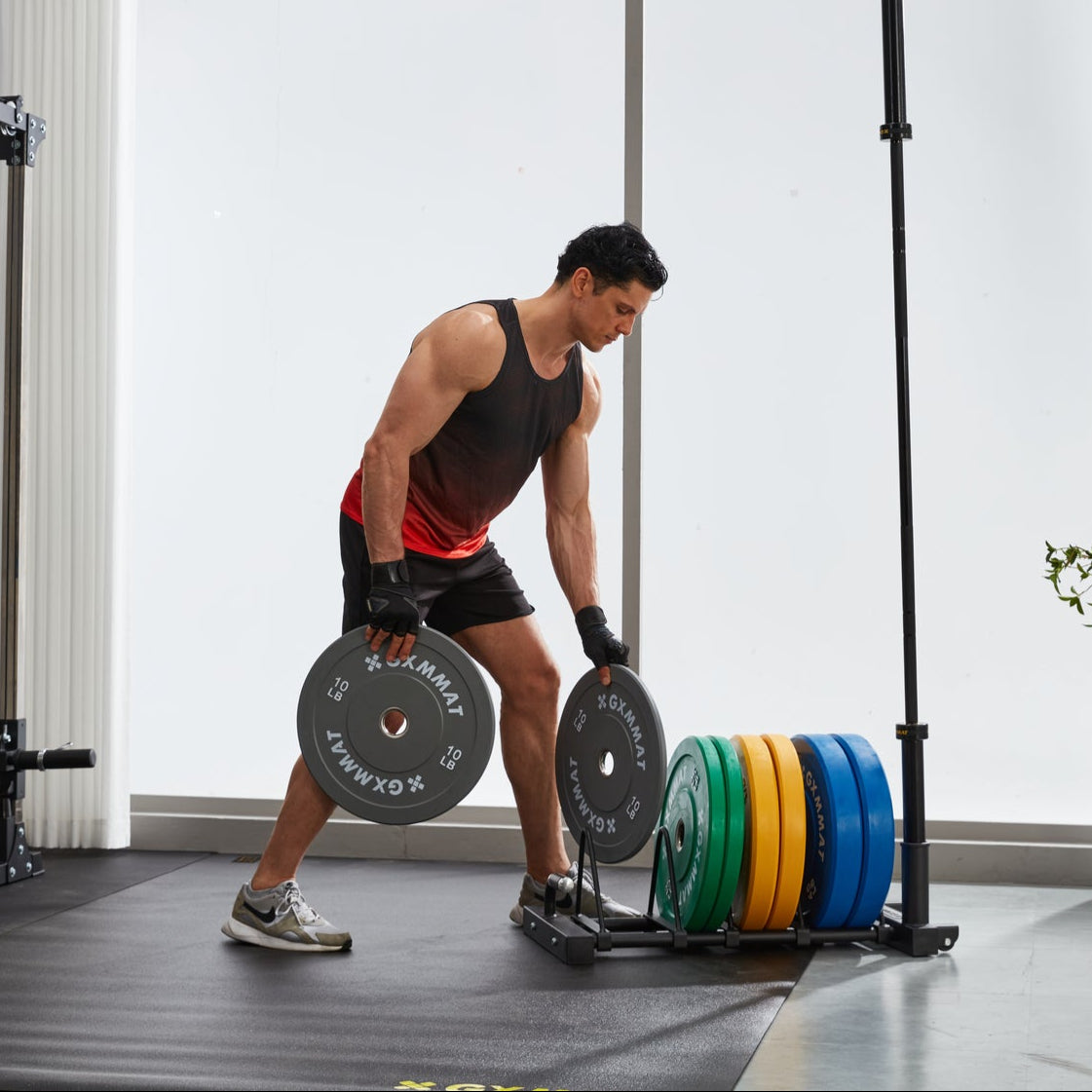
- Use rubber. Rubber bumper plates are much quieter than iron, whether on the barbell or set down on a rack's storage pegs.
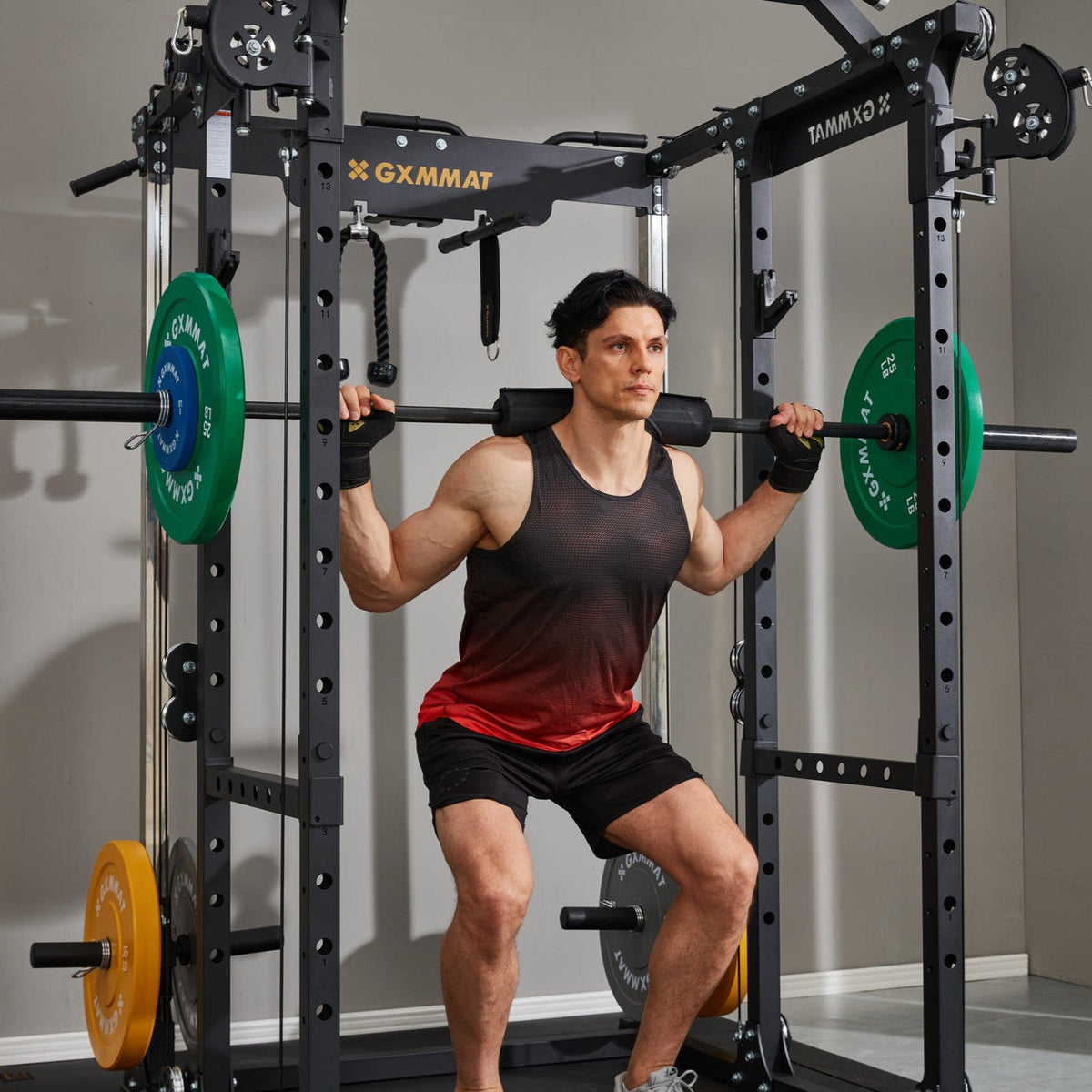
- Choose cables for volume work. Cable machines are naturally smooth and quiet. A rack with a 1:1 pulley system, like the GXMMAT X6, covers rows, pulldowns, presses and raises without any dropping.
- Slow the lowering phase. A 2–3 second eccentric is quieter and also builds more muscle.
- Keep equipment on the mat so bench feet and rack bases never sit on bare hardwood or tile.
4. Pick the right spot and the right time
- Placement: Train in a room above a non-living space if possible (a garage or lobby), and near a load-bearing wall or corner, where the floor flexes least. Avoid the middle of a room and shared walls.
- Timing: Many leases and local ordinances set quiet hours, often around 10 pm–7 am or 8 am. Check yours and save any louder sessions for mid-day.
- Talk to your neighbor. Ask what they actually hear. Often it's only one move, like a dropped weight or a jump, and you can simply switch it.
How much weight can an apartment floor hold?
US residential building codes typically design living-area floors for a live load of 40 lb per sq ft, with a large safety margin. Home equipment spread over a large footprint is usually well within that. For example, the GXMMAT X6 Power Rack weighs 261 lb over 28.77 sq ft, about 9 lb per sq ft before plates. Older buildings vary, so for heavy setups on upper floors, ask your landlord or a structural engineer.
Quiet apartment workout checklist
- ☐ Large 7–9 mm high-density mat covering your whole workout area
- ☐ Low-impact alternatives for every jump
- ☐ Rubber plates or cable work instead of iron
- ☐ Controlled lowering, no dropping
- ☐ Trained near a load-bearing wall, away from shared walls
- ☐ Outside quiet hours
- ☐ Headphones instead of speakers
FAQ
What is the best mat for apartment workouts?
A large (6 × 8 ft or bigger), high-density foam mat around 7–9 mm thick with an anti-slip bottom. Large size keeps every step on cushioning, and high density stops the mat bottoming out on impact.
Can downstairs neighbors hear me working out?
They usually hear impact noise such as jumping, heavy steps and dropped weights, not normal movement. A thick, dense mat and low-impact exercises remove most of it.
Do exercise mats really reduce noise?
Yes. A high-density mat absorbs and spreads impact energy before it reaches the floor, which reduces the thuds that travel to the unit below. Thicker and denser mats work better than thin yoga mats.
Can I use a power rack in an apartment?
Often, yes. Spread the rack's weight across a large mat, use rubber plates, never drop the bar, and use the cable system for most volume work. Check your lease and ask your landlord about heavy equipment on upper floors.
Is jump rope OK in an apartment?
Jump rope is high-impact and often bothers downstairs neighbors. If you do it, use a thick high-density mat, land softly on the balls of your feet, and avoid quiet hours. Or swap it for mountain climbers or shadow boxing.
Written by Yuvien Royer for GXMMAT. GXMMAT has designed high-density workout mats for quiet home training since 2017.