Bumper Plates vs Iron Plates: Which Should You Buy for a Home Gym?
Quick answer: For most home gyms, bumper plates are the better choice. They're solid rubber, so they're quieter, safe to drop and kind to your floor, and every bumper shares the same 450 mm diameter, so the bar always starts at the same height. Iron plates are thinner and cheaper per pound, which makes sense if you lift very heavy and never drop the bar.
Key takeaways
- Bumper plates: quiet, drop-safe, floor-friendly, and a consistent 450 mm diameter at every weight.
- Iron plates: thinner (more weight fits on the bar) and usually cheaper, but loud and hard on floors.
- Home gym verdict: bumpers plus a set of small change plates for gradual progress.
- Always check the collar opening: Olympic plates need a ~50 mm hole to fit a 2" Olympic sleeve.
What are bumper plates?
Bumper plates are weight plates made of dense rubber, usually with a steel or stainless-steel center insert. They were designed for Olympic weightlifting, where lifters drop the bar from overhead. Standard full-size bumpers are 450 mm (17.7") in diameter regardless of weight, so lighter plates are simply thinner.
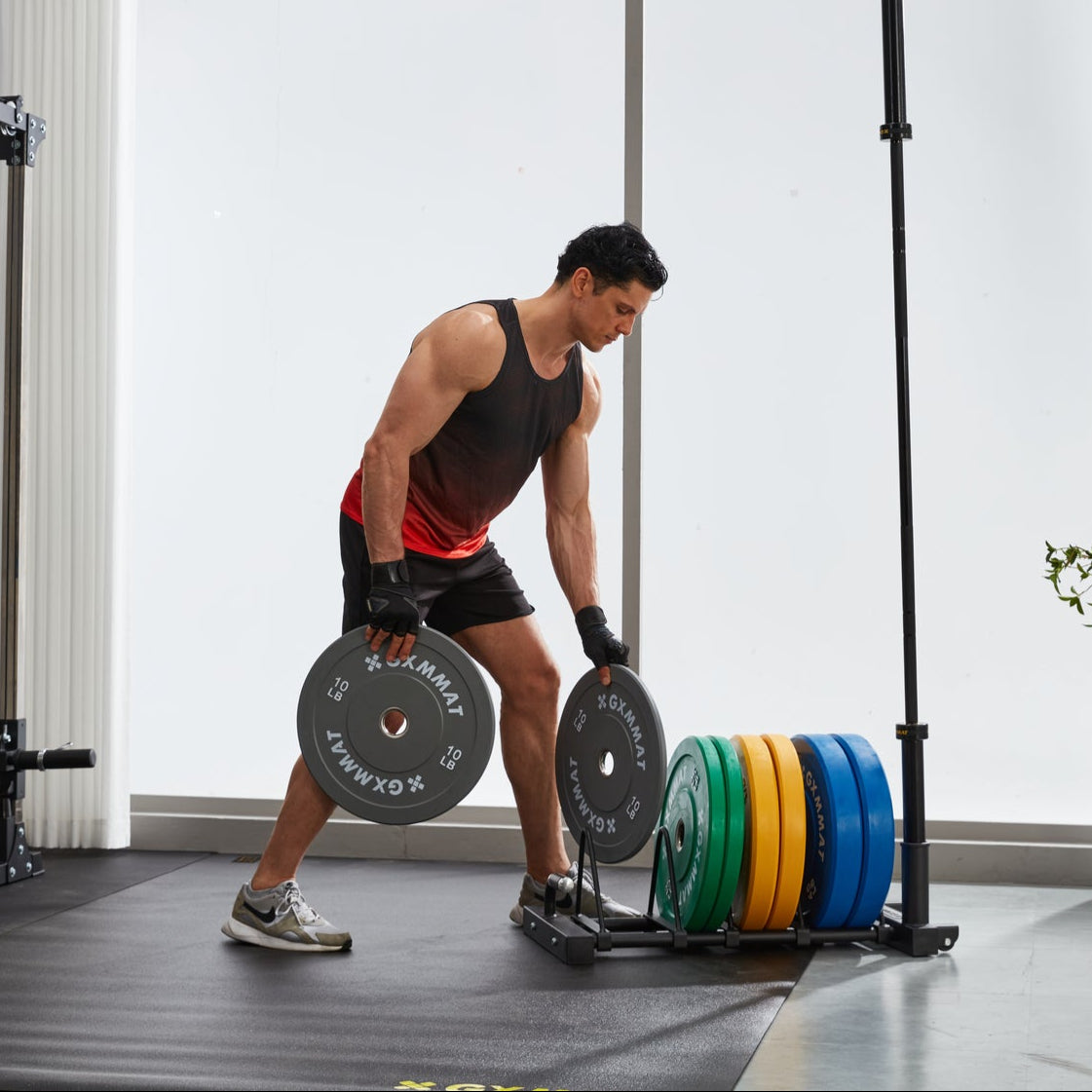
The GXMMAT Bumper Plate Set is one-piece rubber with a stainless-steel center, a 50.40 mm collar opening and ±1% weight tolerance. The 230 lb set includes:
| Plate | Color | Diameter | Thickness | Qty |
|---|---|---|---|---|
| 10 lb | Gray | 450 mm | 20 mm | 2 |
| 25 lb | Green | 450 mm | 41 mm | 2 |
| 35 lb | Yellow | 450 mm | 55 mm | 2 |
| 45 lb | Blue | 450 mm | 72 mm | 2 |
What are iron plates?
Iron plates are cast iron, sometimes coated in paint, enamel or a thin layer of rubber or urethane. They're much denser than rubber, so a 45 lb iron plate is typically about half as thick as a 45 lb bumper. Lighter iron plates are also smaller in diameter, so the bar sits closer to the floor when you load small plates.
Bumper plates vs iron plates: comparison
| Bumper plates | Iron plates | |
|---|---|---|
| Noise | Low (rubber absorbs impact) | Loud clanging and impact noise |
| Safe to drop | Yes, designed for it (on a mat or platform) | No, can crack plates and floors |
| Floor protection | Good | Poor without heavy flooring |
| Diameter | Same 450 mm at every weight | Smaller for lighter plates |
| Thickness | Thicker | Thinner, so more fits on the bar |
| Price per pound | Higher | Usually lower |
| Best for | Home gyms, deadlifts, Olympic lifts, beginners | Very heavy powerlifting, gyms with platforms |
Why bumper plates are better for a home gym
1. They're much quieter
Steel on steel and iron on concrete are loud, and the noise carries through walls and floors. Rubber bumpers make a dull thud instead, especially on a high-density gym mat. That matters in apartments, shared houses and garages close to neighbors.
2. The bar always starts at the right height
Because every full-size bumper is 450 mm, the bar sits about 8.9" off the floor whether you load 10s or 45s. Beginners can deadlift from the correct starting height with a light weight. With iron, a bar loaded with 10s sits much lower.
3. Dropping is safe
Failed a heavy deadlift, or finishing a clean and jerk? You can lower or drop bumpers onto a mat without damaging the bar, plates or floor. Never drop iron plates.
4. Less damage to equipment
Rubber protects the barbell sleeves, the rack's storage pegs and your walls from dents and chips.
When iron plates make sense
- You regularly lift more than about 500 lb and need to fit more weight on the sleeve.
- You train only powerlifting movements (squat, bench, controlled deadlifts) and never drop the bar.
- Your budget is the top priority and you already have a thick lifting platform.
How much weight fits on a barbell with bumper plates?
Bumpers are thick, but they still fit plenty for most home lifters. The GXMMAT Olympic bar has a 16.1" (409 mm) loadable sleeve. The full 230 lb bumper set takes up 188 mm per sleeve (20 + 41 + 55 + 72 mm), leaving about 221 mm, enough for roughly three more 45 lb bumpers per side. That's about 540 lb on the bar including the 44 lb bar itself, before collars, and well beyond what most home lifters need. The bar is rated to 1,500 lb.
Don't forget change plates
Strength improves through progressive overload: adding small amounts of weight over time. Jumping 10 lb at once (a 5 lb plate on each side) is often too much for presses. GXMMAT change plates come in 1.25, 2.5 and 5 lb (rubber-coated steel, 50.40 mm opening), so you can add as little as 2.5 lb per session.
FAQ
Are bumper plates worth it for a home gym?
Yes. Bumper plates are quieter, protect your floor and equipment, and are safe to drop. Their consistent 450 mm diameter also puts the bar at the right deadlift height at any weight.
Can you use bumper plates on any barbell?
Olympic bumper plates fit any 2" Olympic barbell. Check the collar opening: GXMMAT plates use a 50.40 mm opening for 50 mm sleeves. They won't fit standard 1" bars.
Can you drop bumper plates on concrete?
Drop them on a rubber or high-density foam mat, not bare concrete. A mat protects the plates and the floor and reduces noise and bounce.
Why are bumper plates all the same size?
Olympic standards set bumper diameter at 450 mm, so the bar sits at the same height no matter the weight. Lighter plates are thinner rather than smaller.
Do bumper plates bounce?
Some do. Look for a low-bounce design. GXMMAT bumpers use a low bounce rate for a controlled, stable landing.
Written by Yuvien Royer for GXMMAT. Plate and barbell measurements come from the official GXMMAT product specifications.