Beginner Power Rack Workout Plan: A 3-Day Full-Body Program
Quick answer: A good beginner power rack plan is three full-body workouts per week (for example Monday, Wednesday and Friday), alternating Workout A and Workout B. Each one pairs 2–3 barbell lifts with 2–3 cable or bodyweight exercises. Start light, set the safety arms on every barbell set, and add 2.5–5 lb whenever you complete all your reps with good form.
Key takeaways
- Frequency: 3 days a week, full body. Each muscle gets trained 1–2 times a week with rest days in between.
- Structure: alternate Workout A and Workout B (A-B-A one week, B-A-B the next).
- Safety first: set the safety arms 1–2" below the bottom of every barbell lift.
- Progress: add a small amount of weight when you hit the top of the rep range on every set.
- Rest: 2–3 minutes between heavy compound sets, 60–90 seconds for cable work.
Why a full-body plan for beginners?
The U.S. Physical Activity Guidelines recommend muscle-strengthening activity for all major muscle groups on at least 2 days a week. A three-day full-body plan covers that with room to spare. Beginners also gain strength quickly from practicing the main lifts often, and training each movement two or three times every two weeks builds skill faster than a once-a-week "body part" split.
Before you start: set up your rack safely
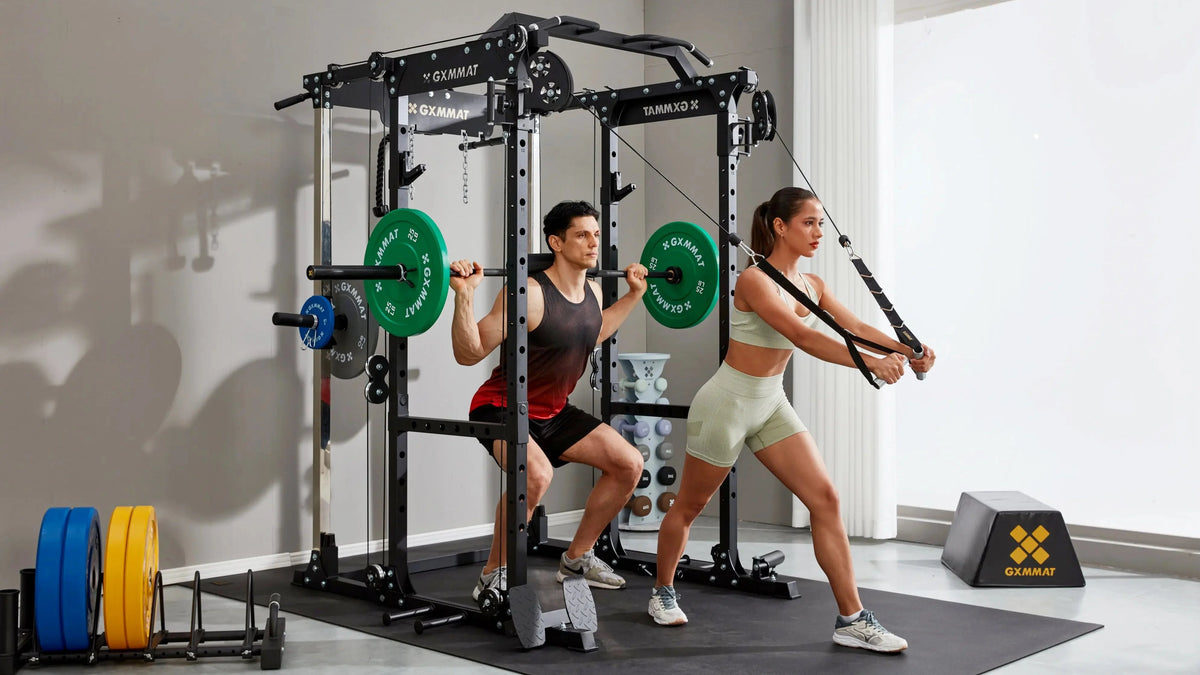
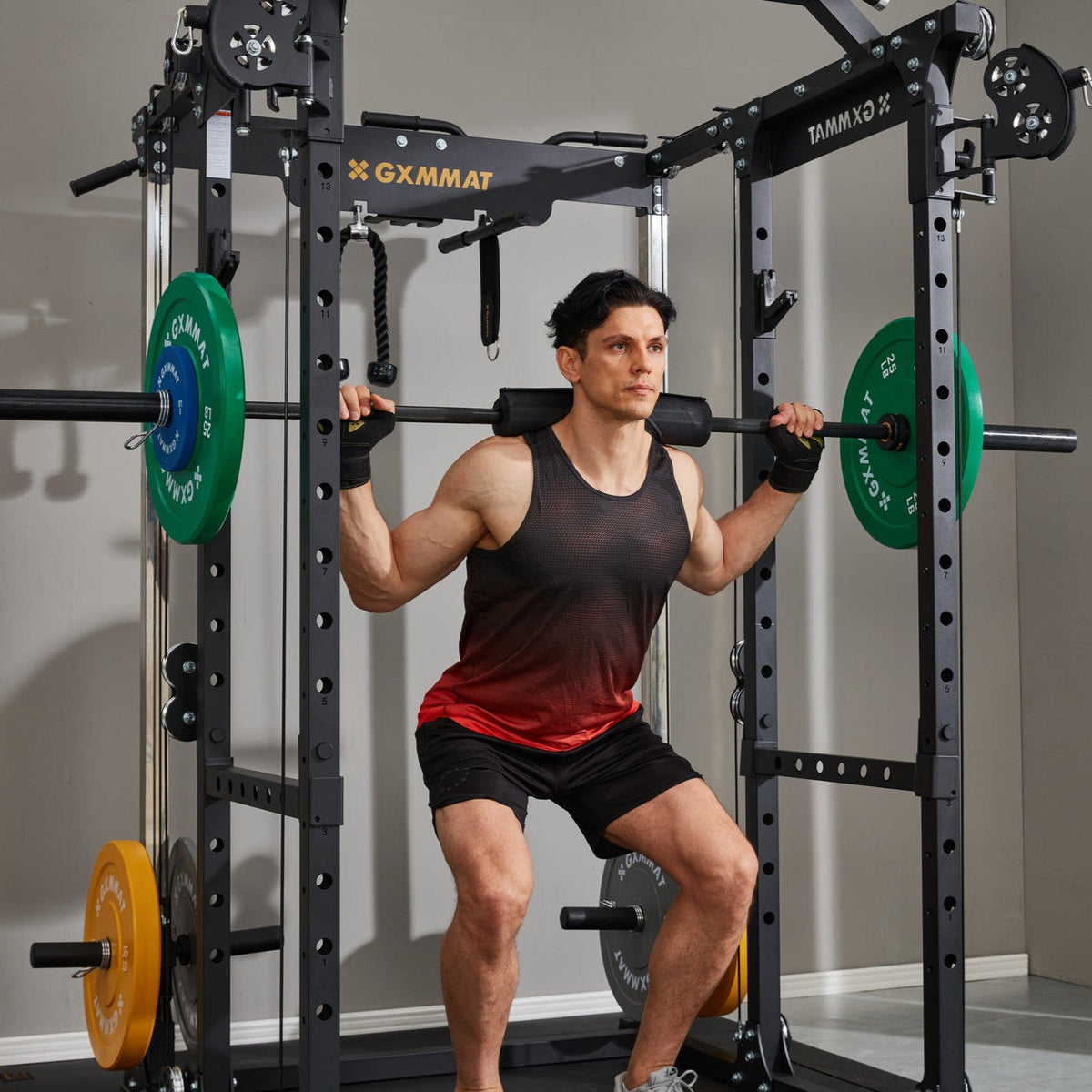
- J-hooks: For squats, set them at about mid-chest height so you unrack the bar with a slight knee bend. For bench press, set them where you can reach the bar with your arms almost straight.
- Safety arms: For squats, set them just below the bar at the bottom of your squat. For bench press, set them just below your chest at the bottom of the press. If you fail a rep, lower the bar onto them.
- Flooring: Lift on a stable, non-slip gym mat so your feet and the bench don't move.
- Collars: Always clip plates on.
On the GXMMAT X6, the uprights have 15 height levels with 3.94" spacing, so it's easy to fine-tune hook and safety heights for your body.
The 3-day beginner power rack plan
Workout A
| Exercise | Sets × reps | Rest | Equipment |
|---|---|---|---|
| Back squat | 3 × 5–8 | 2–3 min | Barbell, J-hooks, safeties |
| Bench press | 3 × 6–8 | 2–3 min | Barbell, bench, safeties |
| Seated cable row | 3 × 10–12 | 90 sec | Low pulley, V-bar |
| Cable lateral raise | 2 × 12–15 each side | 60 sec | Low pulley, handle |
| Plank | 3 × 30–45 sec | 60 sec | Mat |
Workout B
| Exercise | Sets × reps | Rest | Equipment |
|---|---|---|---|
| Romanian deadlift | 3 × 8 | 2–3 min | Barbell (from J-hooks) |
| Overhead press (or landmine press) | 3 × 6–8 | 2–3 min | Barbell or landmine |
| Lat pulldown | 3 × 10–12 | 90 sec | High pulley, long bar |
| Cable face pull | 2 × 15 | 60 sec | High pulley |
| Hanging knee raise (or assisted dip) | 3 × 8–12 | 60 sec | Pull-up bar or dip bars |
Weekly schedule
| Mon | Tue | Wed | Thu | Fri | Sat / Sun | |
|---|---|---|---|---|---|---|
| Week 1 | A | Rest / walk | B | Rest / walk | A | Rest |
| Week 2 | B | Rest / walk | A | Rest / walk | B | Rest |
How much weight should a beginner start with?
Start with a weight you can lift for every set with 2–3 reps left in the tank. For many beginners, that's the empty 44 lb (20 kg) Olympic bar for squats, bench press and overhead press. Romanian deadlifts often start around 65–95 lb. Your first two weeks are about learning the movements, not testing your limits.
How to progress: the double progression method
- Pick a rep range (for example 3 × 6–8).
- Stay at the same weight until you get the top of the range on every set (3 × 8).
- Then add weight: +5 lb for lower-body lifts and +2.5 lb for upper-body lifts.
- Drop back to the bottom of the range and build up again.
Small jumps keep you progressing for months. Change plates make this possible: a pair of 1.25 lb plates adds just 2.5 lb to the bar. GXMMAT change plates come in 1.25, 2.5 and 5 lb pairs and fit any 2" Olympic bar. Shop GXMMAT change plates.
Exercise technique cues
Back squat
Bar on your upper back, feet about shoulder-width apart, toes slightly out. Brace your core, sit down between your hips until your thighs are at least parallel, and drive up keeping your chest proud and knees tracking over your toes.
Bench press
Eyes under the bar, shoulder blades squeezed together, feet planted. Lower the bar under control to your lower chest, then press up and slightly back toward your face.
Romanian deadlift
Unrack the bar from hip-height J-hooks. With soft knees, push your hips back and slide the bar down your thighs until you feel a strong hamstring stretch (usually just below the knees), then squeeze your glutes to stand up.
Lat pulldown
Grip slightly wider than your shoulders, lean back a little, and pull the bar to your upper chest by driving your elbows down. Control the bar back up.
Cable lateral raise
Stand side-on to the low pulley and keep a slight bend in your elbow. Lift your arm out to shoulder height without shrugging, pause, and lower slowly. With a 1:1 pulley ratio, the cable weight equals the resistance you feel, so start light.
Warm-up (5–8 minutes)
- 3 minutes of easy cardio or brisk marching
- 10 bodyweight squats, 10 glute bridges, 10 band pull-aparts or arm circles
- 2–3 lighter warm-up sets of your first barbell lift (empty bar × 8, about 50% × 5, about 75% × 3)
When to change the program
Most beginners can follow this plan for 8–12 weeks. If you stall at the same weight for 2–3 sessions in a row, take a lighter "deload" week (about 60% of your normal weights), then build back up. Once progress slows for good, move to an upper/lower split four days a week.
FAQ
How many days a week should a beginner use a power rack?
Three days a week of full-body training, with at least one rest day between sessions, is ideal for most beginners. It meets the guideline of strength training all major muscle groups at least twice a week.
Can you work out alone with a power rack?
Yes. That's the main benefit of a power rack. Set the safety arms just below the bottom of each lift so a failed rep lands on the safeties instead of on you.
What exercises can you do on a power rack with cables?
Barbell squats, bench presses, overhead presses, Romanian deadlifts, rack pulls and pull-ups, plus cable exercises like lat pulldowns, seated rows, face pulls, triceps pushdowns, cable flys, biceps curls and lateral raises.
How long should I rest between sets?
Rest 2–3 minutes between heavy compound sets like squats and bench press so your energy systems recover, and 60–90 seconds for lighter cable and accessory work.
How fast should I add weight?
Add weight when you complete the top of your rep range on every set with good form. That's typically +5 lb for squats and deadlifts and +2.5 lb for presses.
Written by Yuvien Royer for GXMMAT. This plan is general fitness information, not medical advice. Check with a healthcare professional before starting a new exercise program if you have an injury or health condition.