
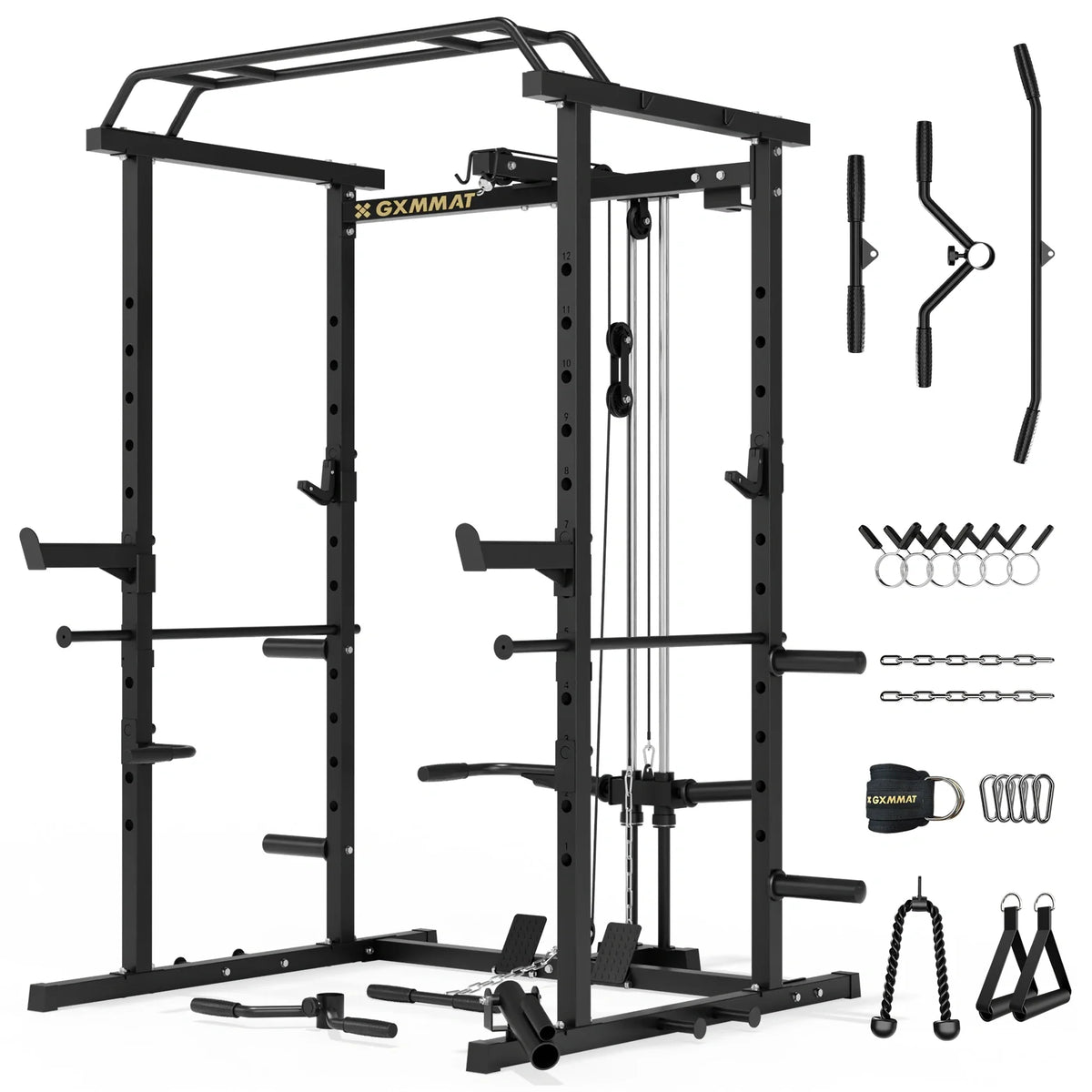
Squat Rack with Pull-Up Bar: How to Choose One for Your Home Gym
Quick answer: A squat rack with a pull-up bar lets you squat, bench, press and do pull-ups in one footprint. When choosing one, check five things: ceiling height (you need about 10–12 inches of clearance above the bar), stability for pull-ups, safety arms for lifting alone, weight capacity, and whether it includes cables. A four-post power rack is the most stable choice for a home gym. With a standard 8-foot ceiling, look for a rack about 82–85 inches tall.
Key takeaways
- Measure your ceiling first: rack height + 10–12" of headroom.
- Four-post power racks are steadier for pull-ups than two-post stands.
- Safety arms matter more than any other feature when you train alone.
- Cable systems add lat pulldowns and rows, which help you build up to pull-ups.
- Plan the floor space: rack footprint plus room for a 7-foot bar and plates.
Types of squat racks with a pull-up bar
| Type | Pull-up stability | Safety when lifting alone | Best for |
|---|---|---|---|
| Squat stand with pull-up bar (2 posts) | Fair; can rock | Short spotter arms | Very tight spaces, lighter lifting |
| Half rack | Good | Spotter arms outside the rack | Medium spaces |
| Power rack (4 posts) | Very good | Safety arms inside the cage | Most home gyms |
| Power rack with cables | Very good | Safety arms plus cable station | All-in-one home gyms |
More detail: power rack vs squat rack vs Smith machine.
What to look for
1. Ceiling height and pull-up clearance
Your head rises above the bar at the top of a pull-up, so you need about 10–12 inches between the bar and the ceiling.
| Ceiling height | Maximum rack height for full pull-ups |
|---|---|
| 7 ft (84") | About 72–74"; most full-size racks are too tall |
| 7.5 ft (90") | About 78–80" |
| 8 ft (96") | About 84–86" |
| 9 ft (108")+ | Any standard rack |
Full room planning: how much space you need for a power rack.
2. Stability
Pull-ups put a moving load at the very top of the rack. A wider base, heavier frame, and plates stored low on the rack all help. Strict pull-ups are fine on a well-built free-standing rack; kipping or swinging needs a bolted rack. See do you need to bolt down a power rack?
3. Safety arms
Adjustable safety arms catch the bar on a failed squat or bench press. Learn to set them in the safety arm height guide.
4. Pull-up bar grips
A bar that allows wide, shoulder-width and neutral or angled grips lets you vary pull-ups and chin-ups and is easier on the elbows and shoulders. See chin-ups vs pull-ups.
5. Cables and attachments
A lat pulldown is the best way to build toward your first pull-up, and a cable station adds dozens of exercises. Dip bars, a landmine and plate storage are useful extras.
GXMMAT power racks with pull-up bars compared
| G5 | V6 | X6 | |
|---|---|---|---|
| Height | 83.5" | 82.68" | 85.04" |
| Footprint | About 12 sq ft | About 14.7 sq ft | About 28.8 sq ft |
| Pull-up bar | Yes | Yes | Yes |
| Cable system | Lat pulldown and low row | Dual 2:1 cables | Dual independent 1:1 cables |
| Included extras | J-hooks, dip bars, landmine, cable handles | J-hooks, dip bars, landmine, cable handles | J-hooks, dip bar, landmine, band pegs, foot plate, cable handles |
| Best for | Small rooms and first racks | Compact all-in-one training | The most complete setup; rated to 2,200 lb |
All three fit under a standard 8-foot ceiling; the G5 and V6 leave the most headroom for pull-ups. Full breakdown: X6 vs V6 vs G5 comparison.
Can't do a pull-up yet?
- Lat pulldowns on the rack's cable: lat pulldown form.
- Inverted rows with the bar set low on the J-hooks: inverted row guide.
- Negatives and dead hangs: follow the pull-up progression for beginners.
What you can do with a rack and pull-up bar
| Area | Exercises |
|---|---|
| Legs | Back squat, front squat, lunges, good mornings |
| Push | Bench press, overhead press, dips |
| Pull | Pull-ups, chin-ups, inverted rows, rack pulls |
| Core | Hanging knee raises, hanging leg raises, landmine rotations |
| Cables | Lat pulldown, seated row, pushdowns, curls |
Ready-made plan: 3-day beginner power rack workout.
Complete the setup
- Barbell: 20 kg Olympic bar.
- Plates: bumper plate sets and magnetic collars.
- Flooring: a large exercise mat under the rack protects the floor and reduces noise.
- Grip: workout gloves for high-rep pull-ups.
- Bundle: home gym packages combine a rack with a bar, plates and more.
FAQ
Are pull-ups safe on a squat rack?
Yes, on a rack designed with a pull-up bar. Use strict, controlled reps on a free-standing rack and bolt it down for kipping or swinging movements.
How tall should a squat rack with a pull-up bar be?
For an 8-foot ceiling, about 82–85 inches leaves enough room for your head to clear the bar.
Do I need to bolt down a squat rack to do pull-ups?
Not for strict pull-ups on a stable four-post rack. Follow the manufacturer's manual, and add weight low on the rack for extra stability.
Is a power rack better than a squat stand for pull-ups?
Yes. Four posts and a larger base make a power rack steadier, and the safety arms sit inside the cage.
How much ceiling clearance do I need for pull-ups?
About 10–12 inches above the pull-up bar.
Written by Yuvien Royer for GXMMAT. This article is general information, not professional installation advice. Measure your space and follow your rack's manual for assembly, anchoring and weight limits.


