
AMRAP Workout: What It Means and 5 Workouts to Try at Home
Quick answer: AMRAP stands for "as many rounds (or reps) as possible." In an AMRAP workout, you set a time limit, such as 10 or 20 minutes, and complete as many rounds of a short circuit as you can with good form, then record your score. For example: in 12 minutes, do as many rounds as possible of 10 kettlebell swings, 10 goblet squats and 10 push-ups. AMRAPs build conditioning and muscular endurance, are easy to track over time, and work well at home with minimal equipment.
Key takeaways
- Fixed time, variable work: you try to beat your round count.
- Pace yourself; don't sprint the first round.
- Form first, especially when tired.
- Record your score (rounds + reps) to track progress.
- Choose moves that stay safe under fatigue.
AMRAP vs EMOM vs circuits
| Format | How it works | Best for |
|---|---|---|
| AMRAP | Max rounds in a set time | Conditioning, tracking progress |
| EMOM | Set work at the start of every minute | Pacing, skill, density |
| Circuit | Set rounds, rest as needed | General fitness |
| Reps AMRAP | Max reps of one move in a set | Testing endurance |
How to build an AMRAP
- Pick a time: 8–20 minutes.
- Pick 3–5 exercises covering different movements (squat, hinge, push, pull, core).
- Choose reps that take 30–60 seconds per exercise.
- Pick a weight you can move with good form when tired.
- Start the timer and go at a steady pace.
- Record rounds and extra reps.
5 AMRAP workouts to try at home
1. Beginner bodyweight AMRAP (10 minutes)
- 10 bodyweight squats
- 8 push-ups (knees if needed)
- 10 mountain climbers per side
2. Kettlebell AMRAP (12 minutes)
- 10 kettlebell swings
- 10 goblet squats
- 8 kettlebell rows per side
3. Power rack AMRAP (15 minutes)
- 5 pull-ups (or 8 inverted rows)
- 10 push-ups
- 15 air squats
4. Cable AMRAP (12 minutes)
- 12 cable rows
- 12 cable front squats
- 12 face pulls
5. Core finisher AMRAP (6 minutes)
- 10 dead bugs
- 10 kettlebell sit ups
- 20-second plank
How to score and progress
| Method | Example |
|---|---|
| Beat your rounds | Week 1: 5 rounds + 6 reps → Week 3: 6 rounds |
| Add load | Move from a 15 lb to a 20 lb kettlebell |
| Add time | 10 minutes → 14 minutes |
| Harder moves | Knee push-ups → full push-ups |
Progress gradually; see progressive overload.
Common mistakes
| Mistake | Fix |
|---|---|
| Starting too fast | Hold a pace you can keep |
| Sloppy reps | Count only good reps |
| Too technical moves | Avoid heavy Olympic lifts in long AMRAPs |
| Too heavy | Choose a weight you can use for every round |
| Doing AMRAPs every day | 2–3 times a week, alongside strength training |
Who should be careful
- Beginners: start with 8–10 minutes and simple moves.
- Heart conditions or high blood pressure: check with your doctor before high-intensity workouts.
Equipment for home AMRAPs
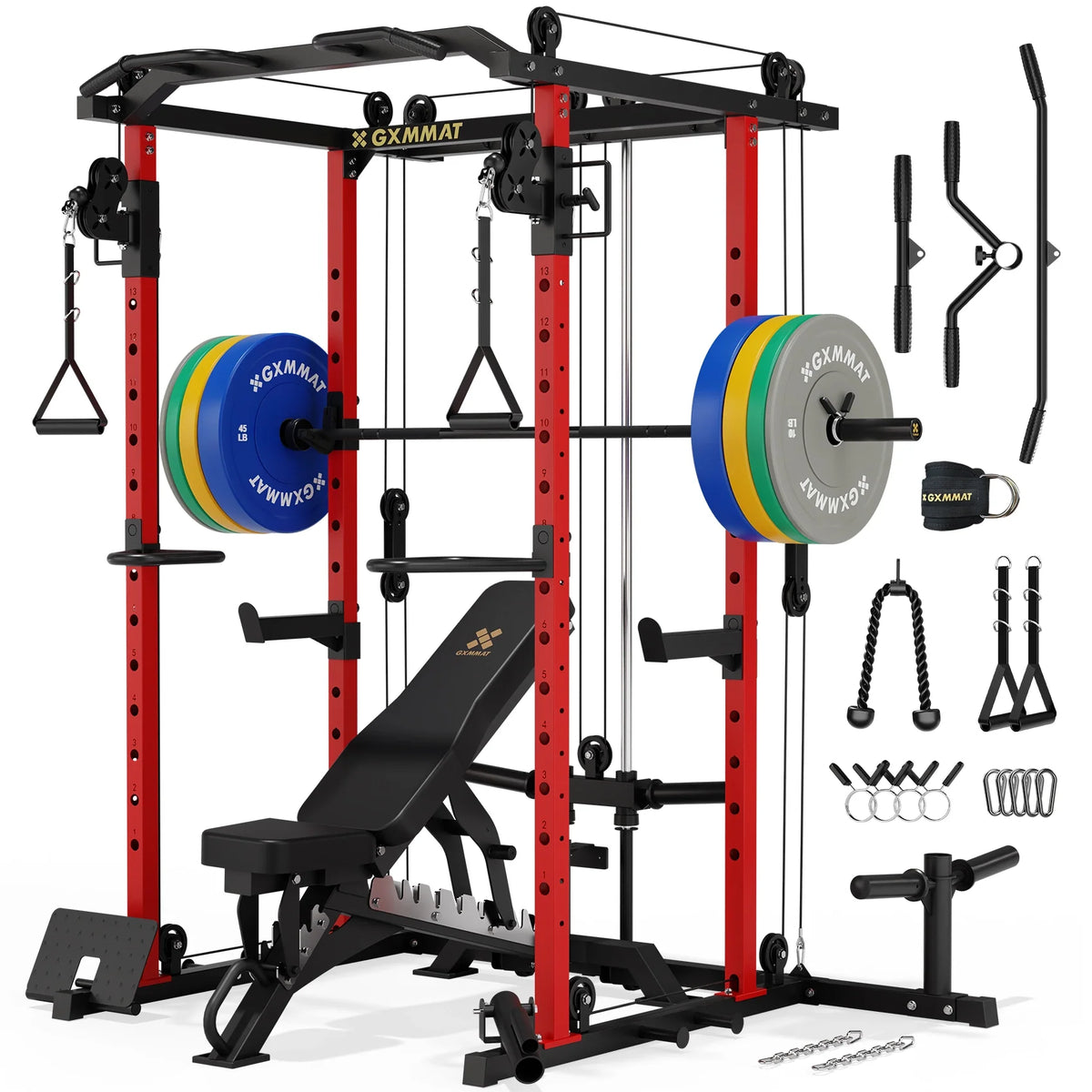
AMRAPs need little gear. A GXMMAT soft kettlebell (10–25 lb) covers swings, squats and rows; a large exercise mat gives you room to move between exercises and reduces noise; and a power rack like the G5, V6 or X6 adds pull-ups, dips and cable moves. Cool down afterward with cool down exercises.
FAQ
What does AMRAP mean?
As many rounds (or reps) as possible in a set time.
How long should an AMRAP be?
Most are 8–20 minutes.
Are AMRAPs good for beginners?
Yes, with simple exercises, a short time limit and a steady pace.
Do AMRAPs build muscle?
They mainly build conditioning and endurance; pair them with strength training for muscle.
How often should I do AMRAPs?
2–3 times a week.
Written by Yuvien Royer for GXMMAT. This article is general fitness information, not medical advice.


