Cable Front Squat: How to Do It for Stronger Quads
Quick answer: To do a cable front squat, attach a rope or two single handles to a low pulley, face the machine and bring the handles up to your shoulders, elbows pointing forward. Step back so the cable has tension, set your feet shoulder width apart and squat down by bending your hips and knees, keeping your chest tall and elbows up, until your thighs are about parallel. Drive back up through your whole foot. Do 3–4 sets of 10–15 reps. The cable front squat trains the quads and glutes with an upright torso, and the forward pull of the cable teaches you to stay tall without a heavy barbell on your shoulders.
Key takeaways
- Face the stack with handles at shoulder height.
- Elbows up and chest tall; the cable tries to pull you forward.
- Sit down between the hips, knees tracking over the toes.
- Constant tension from top to bottom.
- Great for learning front squat posture and for high-rep quad work.
Muscles worked
| Muscle | Role |
|---|---|
| Quadriceps | Primary mover; upright torso shifts more work to the quads |
| Glutes | Hip extension out of the bottom |
| Adductors | Stabilize and assist |
| Upper back and core | Resist the forward pull and keep you upright |
Benefits
- Upright squat pattern that carries over to barbell front squats and goblet squats.
- No bar on the shoulders or wrist strain from a front rack.
- Constant tension for quad growth with moderate loads.
- Core and upper back work to stay tall.
- Quick to set up on a cable rack.
How to do a cable front squat
- Set up: rope or two D-handles on the lowest pulley.
- Pick up: face the stack, grab the handles and bring them to the front of your shoulders.
- Step back: 2–3 steps until the cable pulls slightly forward and down.
- Stance: feet shoulder width, toes slightly out, elbows high.
- Squat: sit down between your hips, chest up, until thighs reach parallel or slightly below.
- Stand: drive through mid-foot, keeping the elbows up.
Variations
| Variation | How | Why |
|---|---|---|
| Rope cable front squat | Hold the rope ends at the chest | Comfortable grip |
| Dual cable front squat | Two low pulleys, handle in each hand | More load, balanced |
| Heels-elevated cable squat | Small plates under the heels | More quad, easier depth |
| Cable squat to press | Press the handles up as you stand | Full-body conditioning |
Common mistakes
| Mistake | Fix |
|---|---|
| Elbows dropping | Keep the elbows high and pointing forward |
| Leaning toward the stack | Brace the core; sit straight down |
| Heels lifting | Work on ankle mobility or elevate the heels |
| Knees caving | Push the knees out over the toes |
| Standing too close | Step back for tension at the top |
Sample cable leg workout
| Exercise | Sets × reps |
|---|---|
| Cable front squat | 4 × 12 |
| Cable Romanian deadlift | 3 × 12 |
| Cable lunge | 3 × 10 per leg |
| Cable leg curl | 3 × 12 per leg |
| Cable hip abduction | 2 × 15 per leg |
Who should be careful
- Knee pain: squat to a comfortable depth and see a professional if pain persists.
- Lower back pain: keep the load moderate and the torso upright.
Cable front squats at home
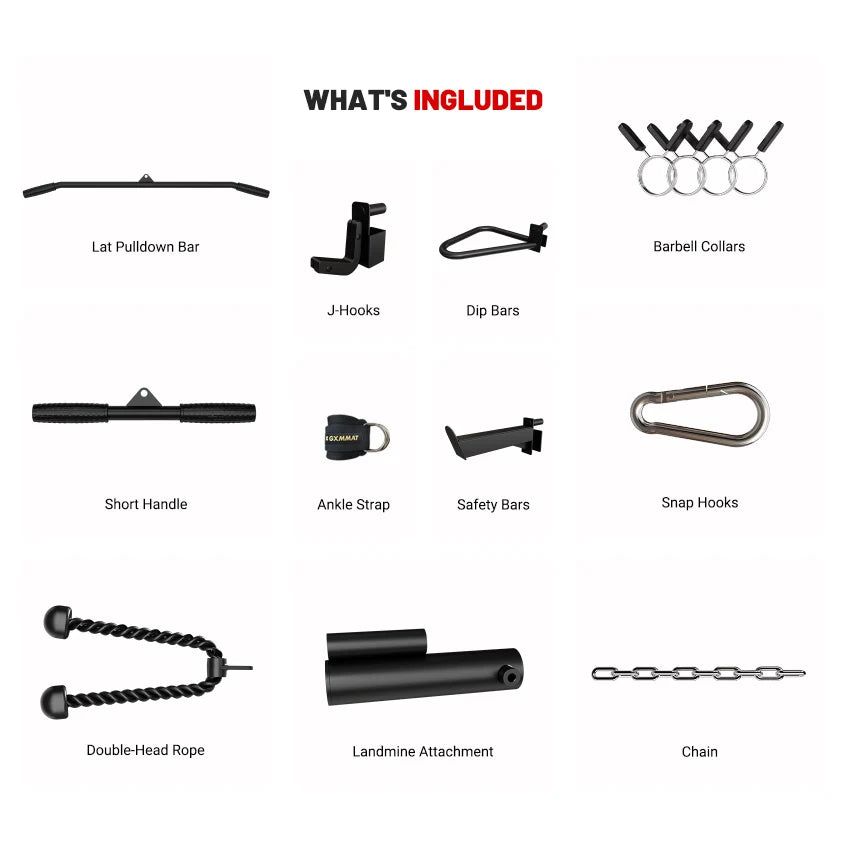
You need a low pulley and a rope or handles. The GXMMAT G5 includes a double-head rope and handles for its low pulley, while the V6 and X6 have dual cables for the two-handle version. Because they're full power racks, you can move straight on to barbell squats with the safety arms set; see safety arm height. A large exercise mat under the rack keeps your feet planted.
FAQ
What does the cable front squat work?
Mainly the quads and glutes, with the upper back and core working to keep you upright.
Is the cable front squat good for beginners?
Yes. It teaches an upright squat without the challenge of a barbell front rack.
How heavy should I go?
Moderate weight for 10–15 controlled reps with good depth.
Rope or handles?
Both work. Many people find the rope comfortable at the chest; two handles allow more load on a dual cable rack.
Can cable squats replace barbell squats?
They're a great accessory or beginner option, but barbell squats allow much heavier loading for strength.
Written by Yuvien Royer for GXMMAT. This article is general fitness information, not medical advice.