
Cable Leg Curl: How to Do It With an Ankle Strap
Quick answer: To do a cable leg curl (standing cable hamstring curl), attach an ankle strap to a low pulley and fasten it around one ankle. Face the machine, hold the frame for balance and keep your thighs in line. Bend the strapped knee to curl your heel toward your glutes, keeping your hips still, then lower slowly until the leg is almost straight. Do 3 sets of 10–15 reps per leg. Cable leg curls isolate the hamstrings with constant tension and are a great home alternative to a leg curl machine.
Key takeaways
- Face the stack, strap on the working ankle.
- Thighs stay in line; only the knee bends.
- Squeeze at the top, lower slowly.
- Light to moderate weight with full range.
- Lying version on a mat or bench for a stable alternative.
Muscles worked
| Muscle | Role |
|---|---|
| Hamstrings (biceps femoris, semitendinosus, semimembranosus) | Bend the knee |
| Calves (gastrocnemius) | Assist knee flexion |
| Glutes and core (standing leg) | Balance and stability |
Benefits
- Hamstring isolation without a leg curl machine.
- Knee-bending strength to balance hip-hinge moves like deadlifts and RDLs.
- One leg at a time to fix imbalances.
- Constant tension through the whole curl.
- Supports running and sprinting strength as part of a full program.
How to do a standing cable leg curl
- Set up: ankle strap on the lowest pulley, around your right ankle.
- Position: face the stack, step back slightly so the cable has tension, hold the frame.
- Start: right leg slightly in front, knee nearly straight, thighs in line.
- Curl: bend the knee and pull the heel up toward the glutes without moving the thigh.
- Squeeze: pause 1 second at the top.
- Lower: 2–3 seconds back to the start. Finish the set, then switch legs.
Variations
| Variation | How | Why |
|---|---|---|
| Lying cable leg curl | Lie face down on a mat facing the stack, curl one or both legs | More stable; easier to isolate |
| Kneeling cable leg curl | Kneel on a pad on one knee | Removes balance demand |
| Nordic hamstring curl | Bodyweight, anchored feet | Very challenging eccentric strength |
| Cable Romanian deadlift | Hip hinge | Trains hamstrings at the hip |
For a balanced hamstring program, include both a knee-bending move (leg curl) and a hip-hinge move (RDL).
Common mistakes
| Mistake | Fix |
|---|---|
| Swinging the thigh forward | Keep the thighs in line; lighten the weight |
| Arching the lower back | Brace the core; slight forward lean is fine |
| Dropping the weight | Lower slowly |
| Half reps | Curl fully and straighten almost fully |
Sample hamstring workout
| Exercise | Sets × reps |
|---|---|
| Romanian or stiff leg deadlift | 3 × 8 |
| Cable leg curl | 3 × 12 per leg |
| Good mornings | 2 × 10 |
| Kettlebell swings | 3 × 15 |
Finish with hamstring stretches.
Who should be careful
- Hamstring strain: wait until healed and start light.
- Knee pain: reduce the range and weight; see a professional if pain persists.
- Cramping: common at first; lower the weight and warm up well.
Cable leg curls at home
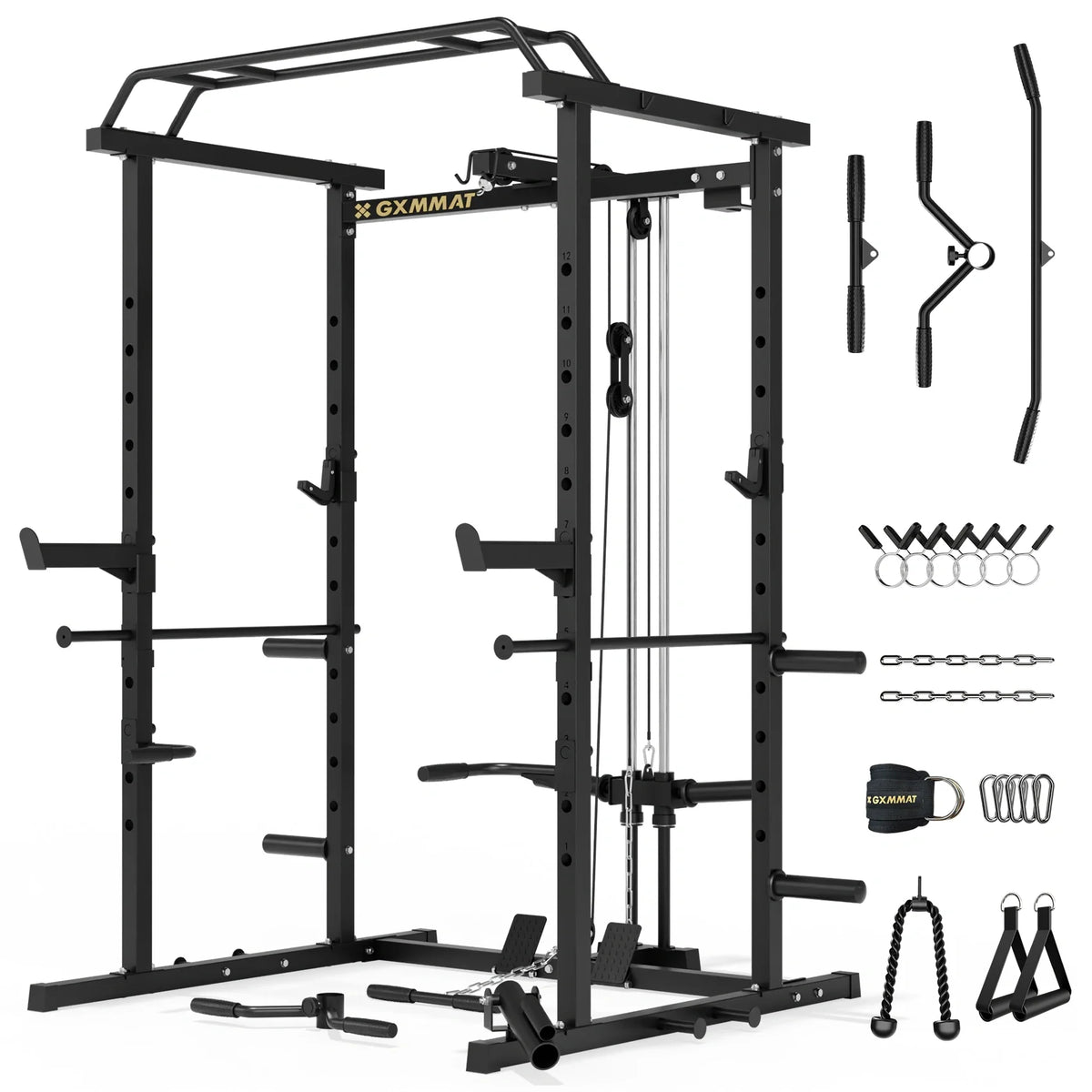
All you need is a low pulley and an ankle strap. The GXMMAT G5 and V6 power racks include an ankle strap, and the X6's adjustable-height dual cables work for standing and lying versions. For lying leg curls, a large exercise mat in front of the rack keeps you comfortable, and a kneeling pad helps with the kneeling version. See cable ankle strap exercises for more.
FAQ
What does a cable leg curl work?
The hamstrings, with the calves assisting.
Can cable leg curls replace a leg curl machine?
For most home gyms, yes. They train the same knee-bending action.
How heavy should cable leg curls be?
Light to moderate, enough for 10–15 slow reps per leg.
Standing or lying?
Standing adds balance work; lying is more stable and easier to isolate. Both work.
How often should I train hamstrings?
2 times a week, combining curls and hip hinges.
Written by Yuvien Royer for GXMMAT. This article is general fitness information, not medical advice.


