Cable Lunge: How to Do It and 5 Variations
Quick answer: To do a cable lunge, set a pulley at the lowest position with a single handle (or two low pulleys with a handle in each hand). Face away from the machine holding the handle at your side, step forward into a split stance, then lower until both knees bend to about 90 degrees. Drive through the front heel to rise. Do 3 sets of 10–12 reps per leg. Cable lunges load the quads and glutes with smooth, constant tension, and the cable's angle adds a core and balance challenge.
Key takeaways
- Split squat style (feet stay in place) is easiest to learn with cables.
- Hold the handle on the same side as the back leg for more core work, or both sides for balance.
- Front knee over the middle toes, torso tall.
- Constant tension from the cable through the whole rep.
- Moderate weight with full range.
Muscles worked
| Muscle | Role |
|---|---|
| Quadriceps | Straighten the front knee |
| Glutes | Extend the hip |
| Hamstrings and adductors | Assist and stabilize |
| Core and obliques | Resist the cable pulling you off balance |
Benefits
- Single-leg strength with smooth resistance.
- Core anti-rotation when holding one handle.
- Easy to adjust the weight in seconds.
- Joint friendly: no heavy bar on the back.
- Great for home gyms with a cable rack.
How to do a cable split squat lunge
- Set up: low pulley, single D-handle.
- Grip: hold the handle in your right hand and face away from the stack.
- Stance: step your right foot back into a split stance, left foot forward, feet hip width apart.
- Lower: bend both knees until the back knee is just above the floor.
- Drive: push through the front heel to rise without locking out hard.
- Repeat all reps, then switch sides.
Cable lunge variations
| Variation | Setup | Focus |
|---|---|---|
| Cable reverse lunge | Face the machine, step back | Glutes; easier on the knees |
| Dual cable split squat | Two low pulleys, handle in each hand | More total load, balanced |
| Cable front squat lunge | Handles at shoulders, cables behind | Upright torso, quads |
| Cable lateral lunge | Side-on, step away | Inner thighs and hips |
| Cable split squat with rope | Rope held at chest, pulley low behind | Core and quads |
Compare with other lunge guides: split squats, reverse lunges, barbell lunges and kettlebell lunges.
Common mistakes
| Mistake | Fix |
|---|---|
| Standing too close to the stack | Step out so there's tension at the top |
| Twisting toward the cable | Brace the core; square the hips |
| Front knee caving | Push the knee out over the toes |
| Short range | Lower until the back knee is near the floor |
Sample cable leg workout
| Exercise | Sets × reps |
|---|---|
| Back squat or goblet squat | 4 × 8 |
| Cable lunge | 3 × 10 per leg |
| Cable Romanian deadlift | 3 × 12 |
| Cable hip abduction | 3 × 15 per leg |
| Calf raises | 3 × 15 |
Who should be careful
- Knee pain: use the reverse lunge version and a shorter range.
- Balance issues: hold a rack upright with the free hand.
Cable lunges at home
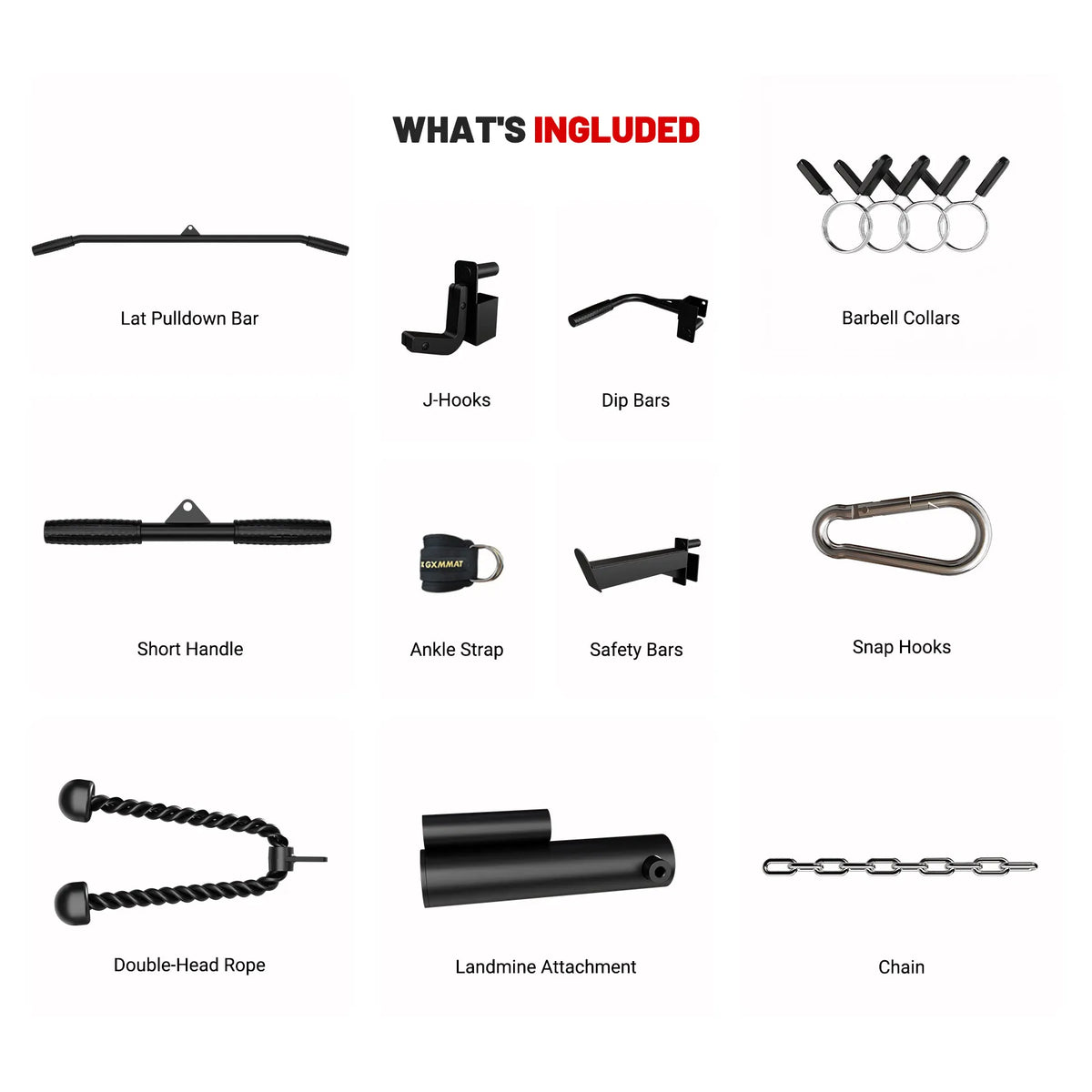
The GXMMAT X6 and V6 have dual cables, so you can do single-handle and dual-handle cable lunges, while the G5's low row pulley works for single-handle versions. Put a large exercise mat under the rack for grip and to cushion the back knee. Compare racks in the X6 vs V6 vs G5 guide.
FAQ
What do cable lunges work?
The quads, glutes, hamstrings, adductors and core.
Are cable lunges better than dumbbell or barbell lunges?
They're different. Cables give constant tension and a core challenge; free weights allow heavier loading.
Which hand should hold the cable?
Holding it on the same side as the back leg adds core work; holding one in each hand is more stable.
How heavy should cable lunges be?
Heavy enough for 10–12 controlled reps per leg with good balance.
Can beginners do cable lunges?
Yes. Start with the split squat version and a light weight.
Written by Yuvien Royer for GXMMAT. This article is general fitness information, not medical advice.