Seated Cable Row: Proper Form, Muscles Worked and Variations
Quick answer: To do a seated cable row, sit facing the low pulley with your feet braced and knees slightly bent. Grab the handle with straight arms and sit tall with your chest up. Pull the handle to your lower ribs, driving your elbows back and squeezing your shoulder blades together, then let your arms extend slowly while keeping your torso still. Beginners can start with 3 sets of 10–12 reps, using a weight that lets you pause briefly at the end of each pull without leaning back.
Key takeaways
- Torso stays tall and still; the arms and shoulder blades do the work.
- Pull to the lower ribs and squeeze for a second.
- Control the return; let the shoulder blades stretch forward without rounding your back.
- Handles change the focus: close grip for lats, wide grip for upper back.
- Great for home gyms: constant tension with no lower-back fatigue.
Muscles worked
| Muscle | Role |
|---|---|
| Lats | Pull the elbows back toward the hips |
| Rhomboids and middle traps | Squeeze the shoulder blades together |
| Rear delts | Help pull the arms back, especially with a wide grip |
| Biceps and forearms | Bend the elbows and hold the handle |
| Core and spinal erectors | Keep the torso upright |
How to do a seated cable row: step by step
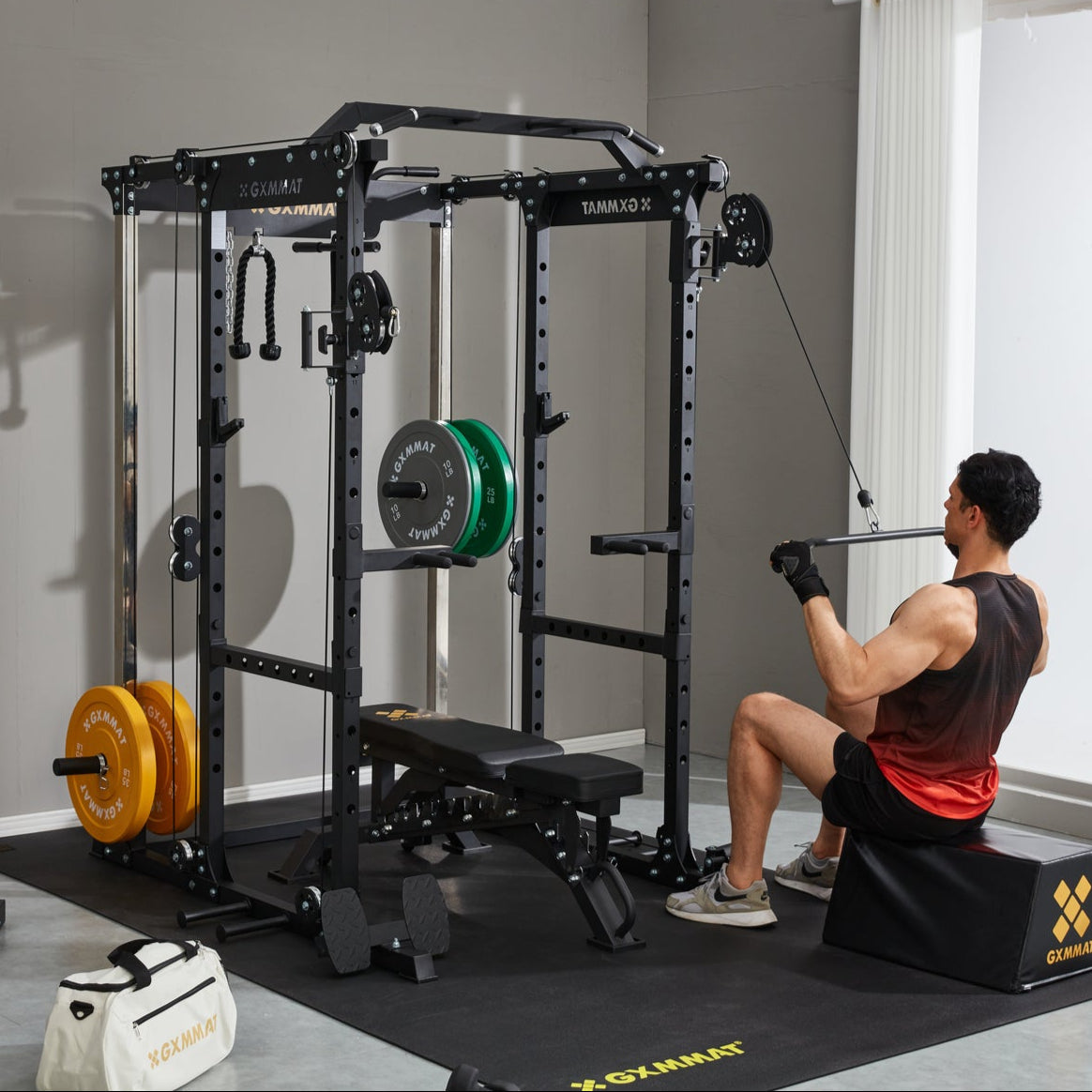
- Set up: attach a V-handle (or a straight bar) to the low pulley. Sit facing it with your feet on the foot plate or braced against a stable surface.
- Grip: reach forward with a flat back and grab the handle. Sit back until your torso is upright and your arms are straight.
- Brace: chest up, shoulders down and away from your ears, knees slightly bent.
- Pull: drive your elbows back close to your sides and bring the handle to your lower ribs.
- Squeeze: pinch your shoulder blades together for a one-second pause.
- Return: extend your arms slowly and let your shoulder blades move forward, keeping your torso still.
Common mistakes
| Mistake | Fix |
|---|---|
| Rocking back and forth | Lower the weight; keep your torso within a few degrees of vertical |
| Shrugging the shoulders up | Think "shoulders in back pockets" before each rep |
| Rounding the back on the return | Let only your arms and shoulder blades move forward |
| Pulling with the biceps only | Lead with the elbows; imagine your hands are hooks |
| Rushing the reps | Pause at the end of each pull, 2–3 seconds back |
Grip and handle variations
| Attachment | Grip | Main focus |
|---|---|---|
| V-handle (close grip) | Neutral, palms facing | Lats, middle back |
| Straight bar, wide | Overhand | Upper back, rear delts |
| Straight bar, underhand | Palms up | Lats, biceps |
| Single handle | One arm at a time | Fixing side-to-side imbalances |
| Rope | Neutral, pull to the face | Rear delts, upper back (face-pull style) |
Sets, reps and where it fits
| Goal | Sets × reps | Rest |
|---|---|---|
| Beginners | 3 × 10–12 | 60–90 seconds |
| Muscle building | 3–4 × 8–15 | 60–120 seconds |
| Posture and upper back | 2–3 × 15 | 60 seconds |
- Back day: pair with pull-ups or lat pulldowns. See how to do a pull-up.
- Upper-body day: superset with bench press or push-ups. See rest between sets.
- After heavy barbell rows as a lighter, stricter follow-up. See barbell row form.
Seated cable row at home
You don't need a separate row machine. Many power racks have a low pulley you can row from:
- GXMMAT G5: compact rack with a lat pulldown and low-row station and a 1:1 pulley.
- GXMMAT V6: dual 2:1 cables. A 2:1 ratio makes each plate feel about half as heavy, so it's easy to make small jumps.
- GXMMAT X6: dual independent 1:1 cables on 20 aluminum pulleys, for smooth rows and single-arm work.
Compare them in X6 vs V6 vs G5. Load the cable with bumper plates or change plates for small increases, and put a large exercise mat under your seat area to protect the floor.
Alternatives without a cable
- Barbell row: heavier, but more lower-back demand.
- Landmine T-bar row: see landmine exercises.
- Single-arm kettlebell row: one hand braced on a bench, using a soft kettlebell.
- Resistance band row: anchor a band at chest height.
FAQ
What muscles does the seated cable row work?
Mainly the lats, rhomboids, middle traps and rear delts, with help from the biceps, forearms and core.
Should you lean back on seated cable rows?
Only slightly, if at all. A small lean is fine, but rocking back and forth shifts work away from your back muscles.
Is a close grip or wide grip better?
Close grip targets more lats; wide grip targets more upper back and rear delts. Using both over a training week is ideal.
Is the seated cable row good for posture?
It strengthens the upper back muscles that help hold your shoulders back, which can support better posture alongside regular movement.
Seated cable row vs barbell row: which is better?
Barbell rows allow heavier loads; seated cable rows offer constant tension with less lower-back stress. Most programs benefit from both.
Written by Yuvien Royer for GXMMAT. This article is general fitness information, not medical advice. Follow your rack's manual for cable and pulley setup.