Why I Treat Every Legs and Workout Session Like an Abs Day
I’ve spent years in a garage gym trying to make 50-pound dumbbells feel like 300-pound barbells. The biggest bottleneck isn’t my quad strength; it’s my spine folding like a lawn chair. If your legs and workout routine feels more like a lower back torture session, you’re not alone. I’ve been there, sweating through sets of goblet squats only to have my upper back quit before my legs even got warm.
The problem with most workouts legs enthusiasts follow is that we rely on front-loaded positions. Your legs can handle the weight, but your midsection gives up. To fix this, I stopped treating leg day as just a lower-body session and started treating it like a heavy core day. When your bracing is bulletproof, your leg strength finally has a chance to show up.
- Core First: Bracing is the secret to moving heavy weight without injury.
- Stability Matters: A reliable gym flooring for home workout prevents energy leaks through your feet.
- Unilateral Focus: Single-leg movements double the load on your quads without doubling the load on your spine.
- CNS Priming: Short high-intensity bursts before lifting improve muscle recruitment.
Why Your Lower Back Always Gives Out Before Your Quads Do
When you perform muscle leg workouts at home, you probably reach for a pair of dumbbells. The issue is mechanical leverage. Holding two 50-pounders at your sides or one 80-pounder at your chest places a massive shearing force on your lumbar spine. Your quads are barely getting started, but your erectors are screaming for mercy. It is a frustrating plateau where your cardiovascular system and your back are the limiting factors, not your actual muscle capacity.
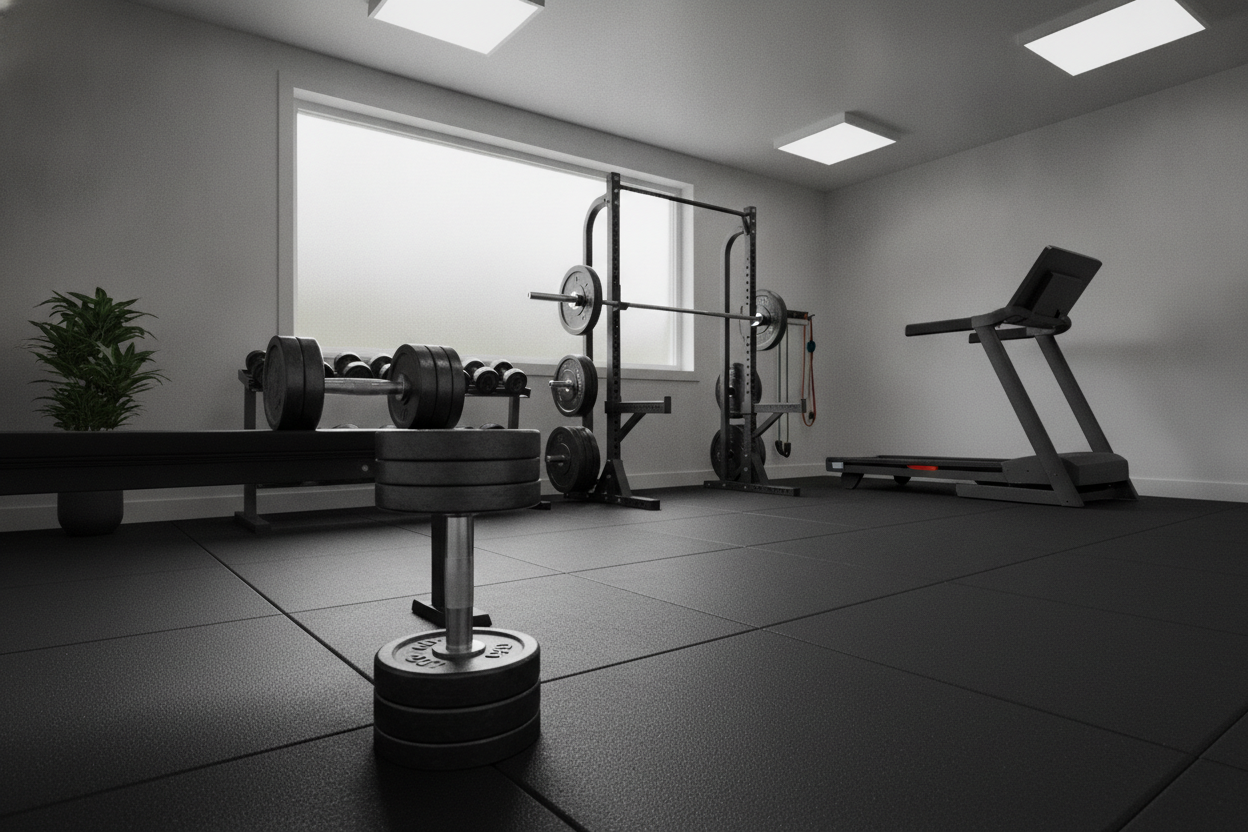
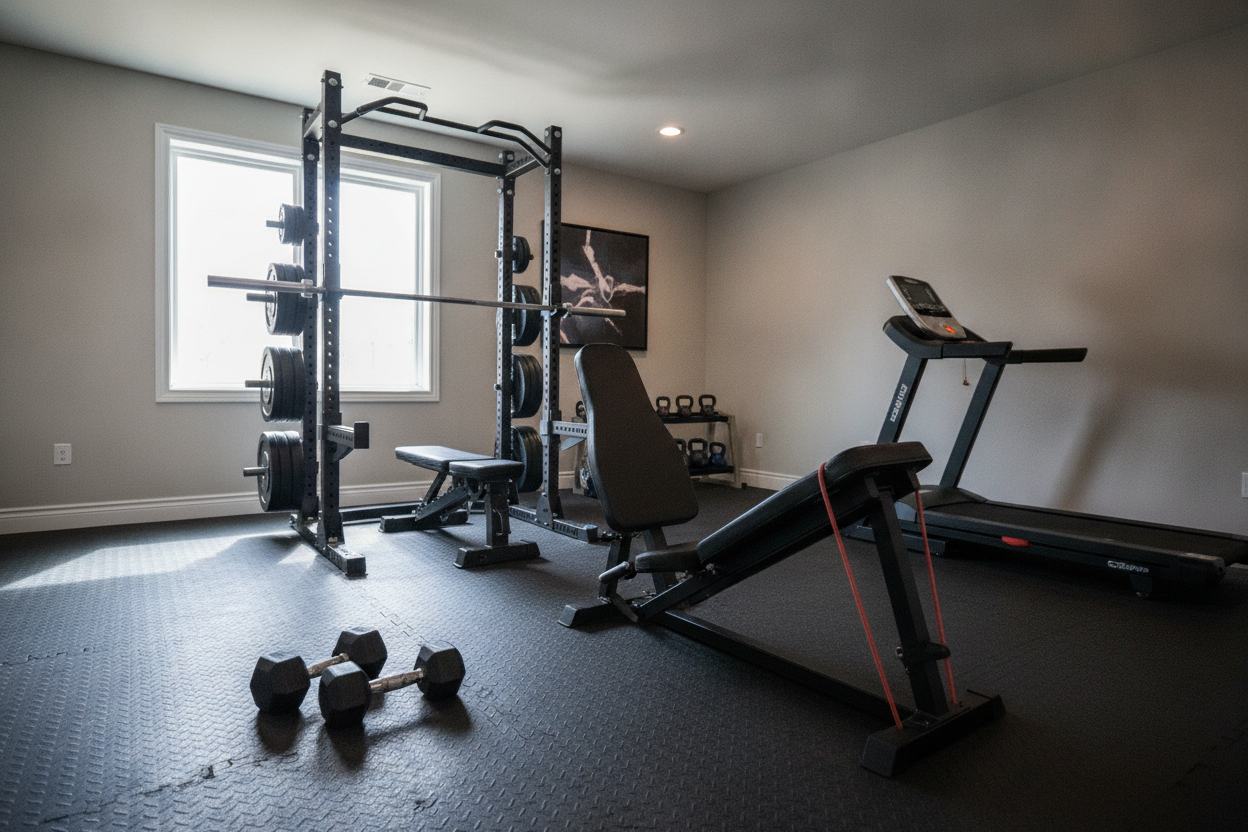
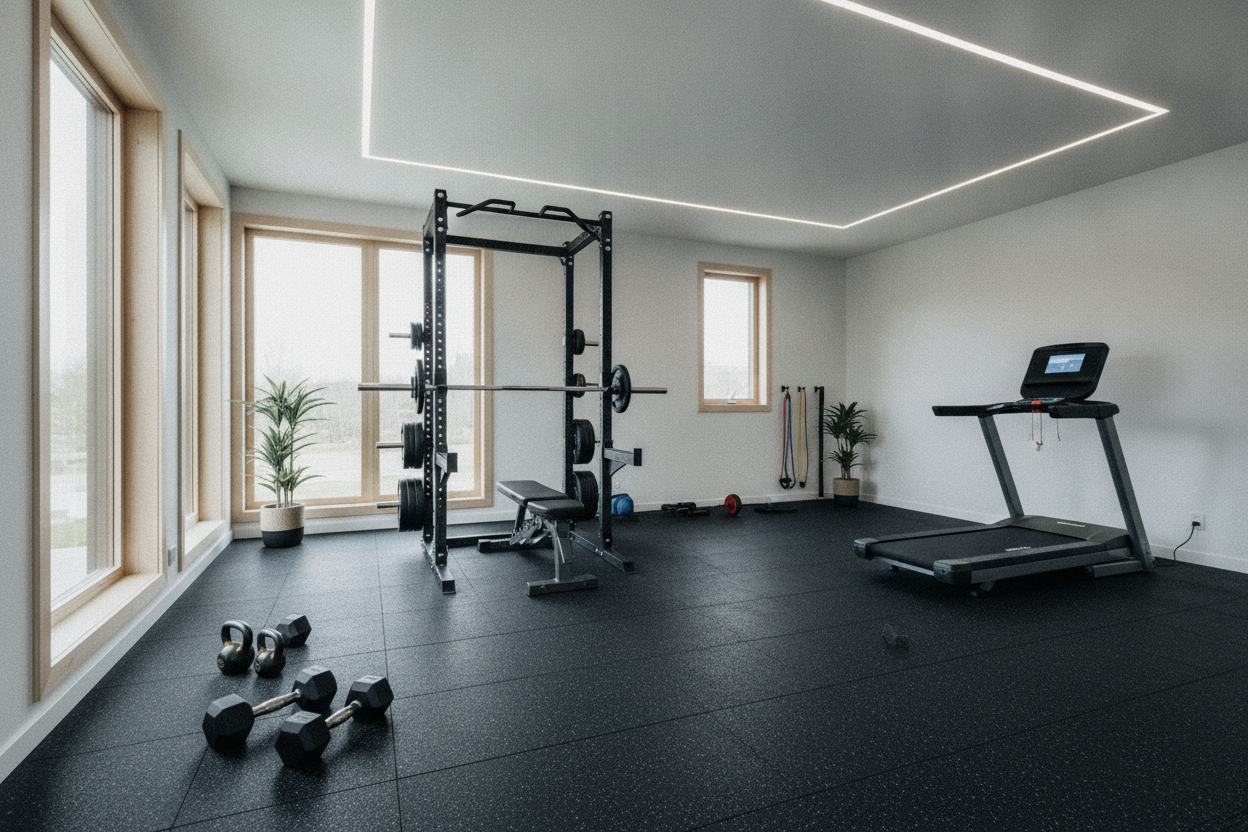
This is why a workout for leg growth often stalls. You end the set because your back is tired, not because your legs hit failure. To prevent this, you need a rock-solid foundation. I’ve found that using reliable gym flooring for home workout is non-negotiable. If your feet are shifting even a millimeter on a slick garage floor or a soft carpet, your core has to work double-time to stabilize your entire skeleton. That extra tax on your nervous system is what causes your back to give out early.
By securing your feet on a high-density surface, you can focus on the legs fitness goals you actually care about. You want the tension in your glutes and quads, not your lower vertebrae. If you can’t stay upright with the weight you’re using, you aren’t having a bad leg day; you’re having a core failure. Fix the base, fix the bracing, and your legs will finally start growing again without the nagging back pain the next morning.
The Weird Reason I Thrash My Abs Before Picking Up Weights
It sounds like a recipe for disaster. Why would you fatigue your abs before trying to squat? Because most people don't actually know how to brace under load. Doing a quick legs and abs HIIT routine or some heavy planks before your main lifts wakes up your midsection. It tells your brain exactly which muscles need to fire to protect your spine when the dumbbells get heavy.
When people ask me what is the best workout for legs, they expect me to say heavy barbell back squats. But in a home gym, the best workout is the one that allows for maximal intensity without a rack. By priming your core, you create a natural lifting belt made of muscle. This allows you to handle heavier leg and thigh exercise loads without that terrifying rounding of the spine that ruins your week. It turns a standard session into a high-output metabolic event.
This CNS priming is the difference between a mediocre leg wo and a session that actually builds slabs of muscle. I usually spend 5 to 10 minutes on high-tension core work. I’m not looking for a deep abdominal burn; I’m looking for activation. Once my abs feel 'on,' I pick up the dumbbells. Suddenly, that 90-pound goblet squat feels lighter because my trunk is actually supporting the weight instead of just letting it hang on my skeleton. You'll find your balance improves instantly, allowing for deeper range of motion.
The Best Exercises for Legs and Thighs That Actually Test Your Spine
If you want good exercises for legs and thighs, you have to look at unilateral movements. The Bulgarian split squat is the undisputed king here. It is arguably the best exercise for hips and thighs because it forces each leg to work independently while your core fights to keep you from tipping over. Because you’re only working one leg at a time, you only need half the total weight to reach failure, which saves your spine from excessive compression while still torching the quads.
Another staple in my leg and thigh workout is the suitcase lunge. Hold a heavy dumbbell in just one hand while you lunge. This creates an asymmetrical load that forces your obliques to fire like crazy to keep you upright. It’s an exercise thighs legs experts use to build stability and power simultaneously. You’ll feel your quads burning, but you’ll also feel your core working harder than it does during a standard crunch. It is the ultimate efficiency move for limited equipment setups.
For those targeting the posterior chain, the staggered-stance RDL is a workout for legs and thighs essential. It bridges the gap between a traditional deadlift and a single-leg movement. You get the heavy loading potential of a bilateral lift with the targeted stimulus of a unilateral one. These movements are the best workout for legs and thighs because they don't just build show muscle; they build the functional strength that keeps you moving well. I prefer these over standard squats any day when training in a tight space.
How to Structure This Core-Heavy Leg and Thigh Workout
To turn this philosophy into a real workout for legs and thighs, you need to sequence your movements correctly. Start with your core activation, move into your heaviest unilateral lift, and finish with high-rep isolation. This ensures your spine is protected when the weights are heaviest and your legs are fully exhausted by the end of the session. You aren't just chasing a pump; you're building a foundation that allows for more weight next month.
A typical leg and thigh workout in my garage looks like this: 3 sets of weighted planks, followed by 4 sets of Bulgarian split squats, and finishing with 3 sets of suitcase lunges. This isn't just about legs fitness; it’s about total body integrity. By the time you reach your final set, your legs should be shaking, but your back should feel perfectly fine. That’s the sign of a well-programmed session that respects your anatomy while pushing your limits.
If you’re looking for more ways to optimize your home training, I highly recommend you explore our workout hub. We’ve got detailed breakdowns on everything from equipment selection to advanced programming for small spaces. Building a serious lower body at home is entirely possible if you stop thinking about your legs in isolation. Treat every leg day like an abs day, and the muscle will follow. Stop letting your grip and your back be the reason your legs stay small.
My Biggest Leg Day Mistake
I used to think I was too strong for dumbbells. I’d try to stack two 100-pound dumbbells on my shoulders for squats. My legs could move the weight, but my breathing was so constricted and my core so unstable that I ended up with a strained lower back that sidelined me for a month. I learned the hard way that intensity isn't just about the number on the weight; it's about how much of that weight your target muscles actually feel. Now, I use less weight, focus on bracing, and my legs have never been bigger or stronger.
FAQ
Can I build big legs without a squat rack?
Absolutely. High-volume unilateral work like split squats and lunges can create enough mechanical tension to trigger massive growth without needing 400 pounds on your back. It is often safer for solo home trainers too.
How often should I do a leg and thigh workout?
Twice a week is the sweet spot for most home athletes. It allows for enough recovery while keeping protein synthesis elevated in the target muscles throughout the week.
Why do my knees hurt during lunges?
It’s often a tracking issue or lack of hip stability. Focus on keeping your front knee aligned with your middle toe and ensure your weight is distributed through your midfoot, not just your toes.