Why I Only Hold One Dumbbell for a Killer Home Leg Workout
I remember the first time I tried to do a killer home leg workout with a pair of 50-pound dumbbells. By the second set of lunges, my forearms were screaming louder than my quads. My grip gave out long before my legs even got warm. It's a common trap: we assume that because we have two hands, we must hold two weights.
The reality is that most home gym setups aren't built for heavy bilateral loading. Unless you have a full rack and a 45-lb barbell, trying to overload your legs with matching dumbbells usually turns into a grip strength challenge rather than a lower body burner. That's why I ditched the pair and started holding just one.
- Offset loading forces your core to stabilize against lateral forces.
- It allows you to use heavier weights without frying your grip.
- Single-sided work identifies and fixes strength imbalances.
- You can achieve higher intensity with less total equipment.
The Problem With Holding Two Dumbbells in Your Living Room
When you hold two dumbbells, you're balanced. That sounds good, but for a killer leg workout at home, it’s actually a disadvantage if your weights are limited. Your body is very efficient at moving balanced loads. To get a real stimulus, you have to go heavy, and that's where the wheels fall off. Your upper back rounds, your palms get sweaty, and your brain starts focusing on not dropping the weights on your toes rather than driving through your heels.
I’ve seen guys try to clench two 40s for high-rep split squats, only to quit at rep 8 because their hands gave out. Their legs could have easily done 15. By holding one heavier dumbbell, you're cutting the grip demand in half while keeping the load on the legs significant. It’s about efficiency, not just aesthetics. You want the failure to happen in your glutes, not your fingers.
Why Offset Loading Changes the Game
Holding a weight on just one side is called asymmetrical or offset loading. It turns a standard leg movement into a full-body stability test. When the weight is only on your right side, your left obliques and glute medius have to fire aggressively to keep you from tipping over. This is how you can actually build serious size without a squat rack.
It’s not just about the legs; it’s about the anti-rotation component. You’re teaching your body to stay rigid under an uneven load. This translates better to real-life movements—like carrying a heavy bag of concrete or a toddler—than a perfectly balanced barbell ever will. You get more value for your time because every rep is a core rep. It turns a simple lunge into a fight for verticality.
The Suitcase Reverse Lunge
This is my staple. Hold one dumbbell in your right hand like a suitcase. Step back with your right leg. This is ipsilateral loading—weight on the same side as the moving leg. The weight wants to pull your torso down and to the right. Your job is to stay perfectly upright. It hits the quads hard but forces the stabilizing muscles around your hip to work overtime to keep your knee from caving in. Keep your chest up and don't let that weight touch your leg.
The Contralateral Bulgarian Split Squat
Now, try holding the weight in the hand opposite to your front leg. If your left foot is forward on the floor and your right foot is back on a bench, hold the dumbbell in your right hand. This contralateral load creates a massive cross-body tension. It pulls your center of mass away from your lead leg, forcing your front glute to stretch and stabilize under a much higher demand. It’s brutal, and it’s the fastest way to find out if your hips are weak. Expect a deep burn in the side of your hip.
Structuring Your Killer Leg Workout at Home
Don't just swing the weight around. For an effective session, focus on time under tension. I like to use a 3-second eccentric phase on every rep. Since you're only working one side at a time, you can keep the rest periods short. While your right leg works, your left leg rests. This keeps your heart rate spiked and turns a strength session into a metabolic powerhouse. You’ll be breathing harder than you do on a treadmill.
I usually recommend starting with your weakest side first. If you're feeling sluggish or short on time, you can always swap in some quick no-equipment routines as a warm-up to get the synovial fluid moving in your knees before you pick up the iron. Aim for 3-4 sets of 10-12 reps per side, resting only 30 seconds between legs. This density is what builds muscle when you don't have a 500-lb rack.
Setting Up Your Floor Space for Heavy Unilateral Work
Stability is everything when you're holding an offset load. If you're training on a slick hardwood floor or a bunch of loose towels, you're asking for a groin strain. I learned this the hard way when I tried to do heavy lunges on a cheap mat that bunched up mid-rep. I ended up doing a split I wasn't prepared for and felt it for a month.
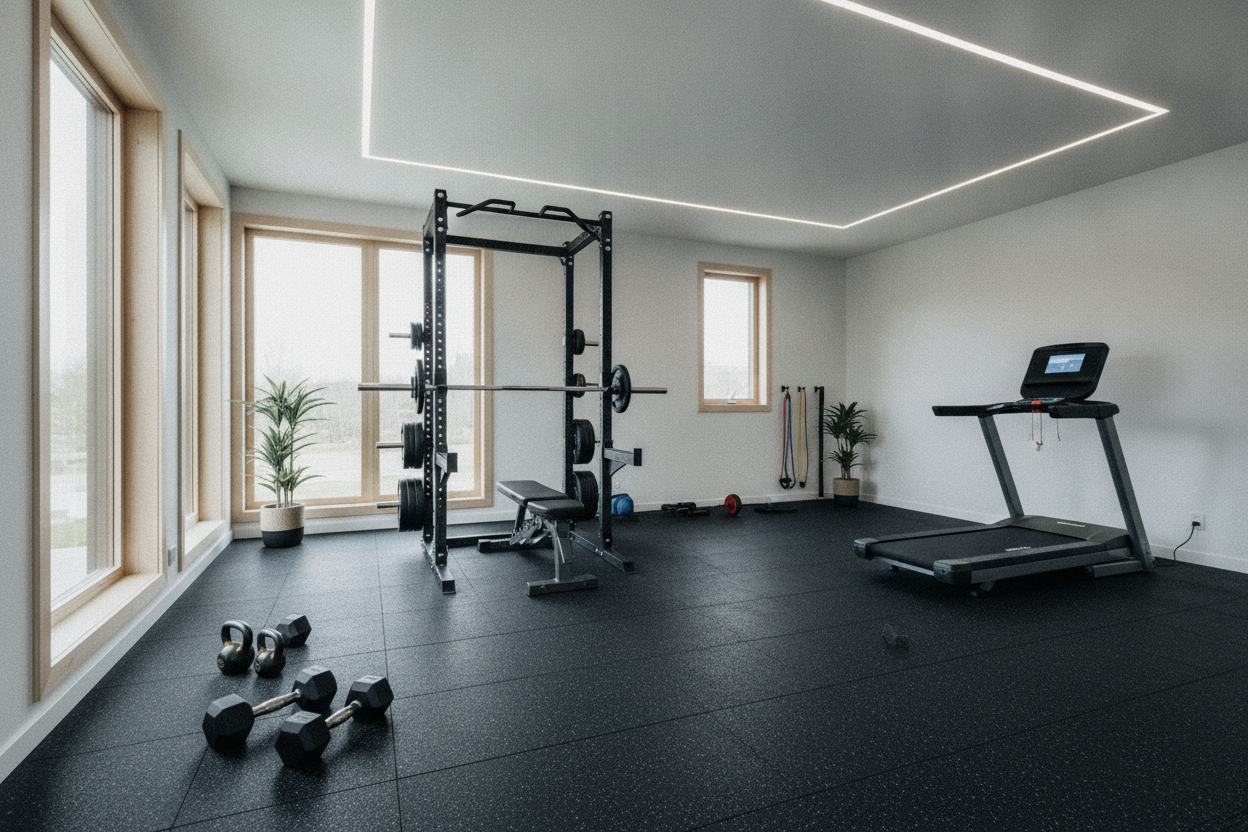
Investing in a large exercise mat is the best move I made for my garage. You need a surface that grips your shoes and stays put on the floor. Plus, if you're pushing to failure and need to bail, having proper gym flooring for home workout spaces will save your subfloor from a 50-lb impact. Your foundation needs to be as solid as your form.
Personal Experience: The 60-Pound Mistake
Last year, I got cocky and tried to suitcase a 60-lb dumbbell for high reps on a day I was already tired. My grip didn't fail, but my core did. I let my shoulder dip, my knee tracked inward, and I felt a sharp pinch in my lower back. It took two weeks of mobility work to feel right again. The lesson? Offset loading is a tool, not a circus act. Keep the weight heavy, but keep your torso vertical. If you start leaning, the set is over. Quality beats weight every single time.
FAQ
Can I build muscle with just one dumbbell?
Yes. By using offset loading and slowing down your reps, you create enough mechanical tension and metabolic stress to trigger growth, even with moderate weights that usually feel easy.
Which side should I hold the weight on?
Switch it up. Holding it on the same side as the working leg targets the quads and lateral stability. Holding it on the opposite side puts more emphasis on the glute and cross-body stabilization.
How do I stop my back from hurting during lunges?
Brace your core like someone is about to punch you. If you can't keep your spine neutral, the weight is too heavy. Drop the weight and finish the set with bodyweight rather than compromising your discs.