How to Build Sculpted Legs With The Best Exercise for Hips and Thighs
Walk into any commercial gym, and you will see rows of machines promising to isolate every inch of your lower body. But if you are looking for efficiency and real results, you don't need a dozen different machines. You need to master the best exercise for hips and thighs: the Squat.
It sounds simple, right? Yet, most people avoid it or do it incorrectly because it is demanding. It requires stability, mobility, and mental grit. However, if your goal is to build strength and aesthetic definition, no other movement offers the same return on investment.
Quick Summary: Mastering Lower Body Development
- The King of Moves: The barbell back squat (and its variations) is the most effective compound movement for hitting the quadriceps, hamstrings, and glutes simultaneously.
- Metabolic Impact: Unlike isolation movements, squats trigger a systemic hormonal response that aids in muscle retention and fat loss.
- Functional Strength: This movement mimics natural human mechanics, improving mobility and reducing injury risk in daily life.
- Versatility: Variations like Goblet and Sumo squats allow you to target specific areas, such as the inner thighs or glute max.
Why the Squat Reigns Supreme
When we talk about exercises for your thighs and hips, we have to look at anatomy. Isolation exercises, like leg extensions or hamstring curls, treat muscles as separate entities. The body doesn't move that way in real life.
The squat forces your hip joint and knee joint to work in unison. This compound action recruits the maximum amount of muscle fibers. You aren't just working the visible muscles; you are engaging the stabilizers deep within the hip complex and the core.
The Metabolic Advantage
There is a reason leg day is exhausting. Because the squat engages the largest muscle groups in the body, it requires a massive amount of energy. This elevates your heart rate and increases calorie burn long after you leave the gym—a phenomenon known as EPOC (Excess Post-exercise Oxygen Consumption).
Executing the Perfect Squat
To get the most out of leg exercises for thighs and hips, form is non-negotiable. Poor mechanics won't just stall your progress; they will hurt your knees and lower back.
The Setup
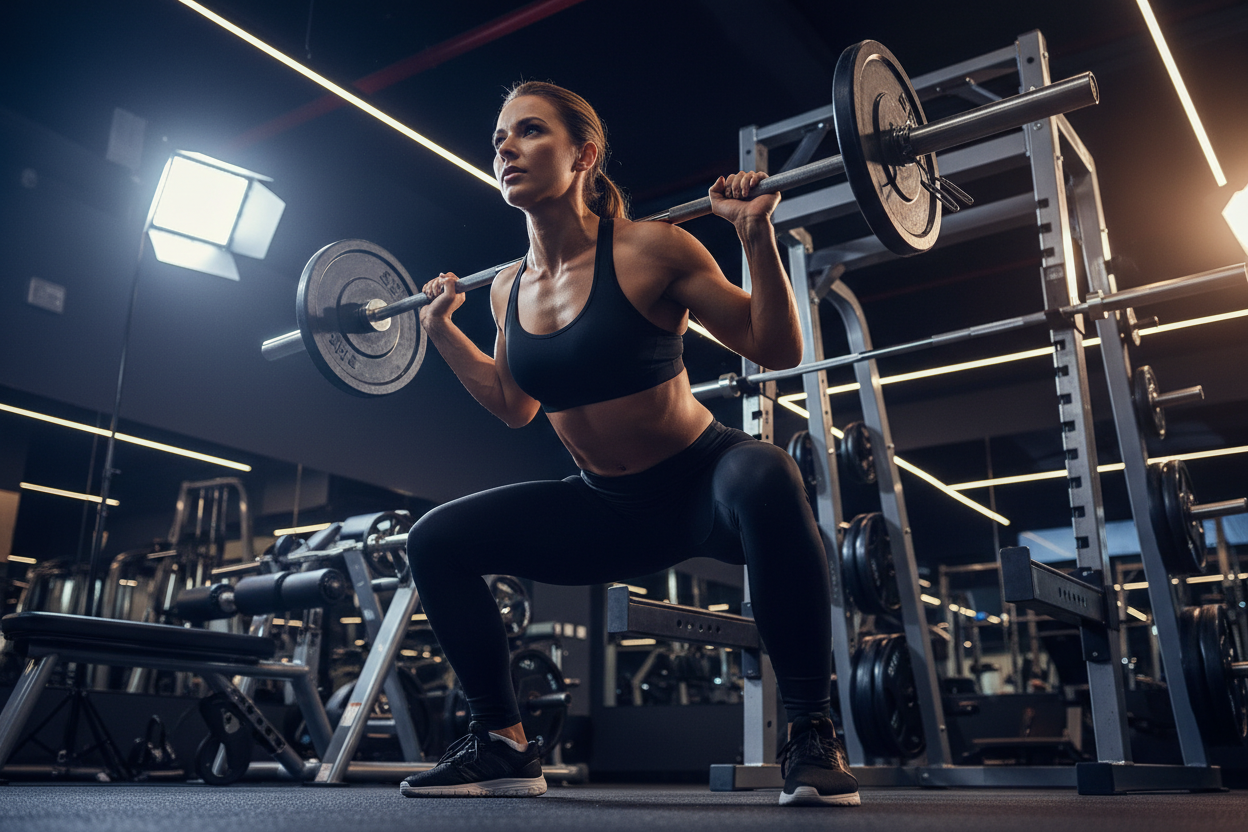
Start with your feet shoulder-width apart. Turn your toes out slightly—about 15 to 30 degrees. This opens up the hips and allows for a deeper range of motion without impingement. Brace your core as if you are about to take a punch.
The Descent
Initiate the movement by pushing your hips back, not by bending your knees. Think of it as sitting into a chair that is slightly too far behind you. As you lower yourself, drive your knees outward. Do not let them collapse inward. Go as deep as your mobility allows while keeping a neutral spine.
Variations to Target Specific Goals
While the standard back squat is the gold standard, varying your stance can change how the muscle is loaded. This is the secret regarding how to tone hips and thighs effectively.
Sumo Squat (Inner Thigh Focus)
By widening your stance significantly and pointing your toes out further, you shift the tension. The Sumo Squat places a much higher demand on the adductors (inner thigh) and the glutes. If you feel your inner thighs are lagging, this is the variation to prioritize.
Goblet Squat (Quad Focus)
Holding a weight in front of your chest forces you to stay upright. This vertical torso angle puts more stress on the quadriceps and less on the lower back. It is arguably the safest variation for beginners learning the movement pattern.
My Training Log: Real Talk
I want to share a specific detail about my personal experience with the best exercise for hips and thighs that usually gets edited out of glossy fitness magazines.
When I first started squatting heavy, I wasn't worried about the weight; I was worried about the balance. I vividly remember the specific, shaky feeling in my ankles at the very bottom of the rep—the "hole." It wasn't a strength issue; it was a proprioception issue. I could feel the outer edge of my shoe digging into the rubber mat, realizing my weight had shifted too far laterally.
It took me three weeks of just sitting in a deep, unweighted squat for five minutes a day to fix that. I learned that the burn isn't just in the big muscles; it's the fatigue in the small stabilizers around the hip socket that usually give out first. If you feel that wobble, don't add weight. Sit in the discomfort until it becomes stability.
Conclusion
Stop overcomplicating your leg training. While accessory work has its place, the foundation of your routine should be the squat. It is challenging, taxing, and uncomfortable, but that is exactly why it works. Prioritize your form, progressively overload the weight, and the definition will follow.
Frequently Asked Questions
How often should I perform squats for maximum results?
For most lifters, squatting twice a week is the sweet spot. This frequency allows you to stimulate the muscles enough for growth while providing adequate recovery time for the central nervous system and joints.
Can I tone my hips and thighs without weights?
Yes, initially. Bodyweight squats are effective for beginners. However, to continue seeing changes in muscle definition and tone, you must eventually introduce resistance (weights) to provide the necessary stimulus for the muscles to adapt.
Why do my knees hurt when I squat?
Knee pain often stems from poor mechanics, specifically the knees caving inward (valgus collapse) or the heels lifting off the ground. Ensure your weight is distributed through the mid-foot and heel, and actively push your knees outward to track over your toes.