Walking Lunges: How to Do Them, Muscles Worked and Variations
Quick answer: To do walking lunges, stand tall with feet hip width apart, step forward with one leg and lower until both knees are bent about 90°, with the back knee hovering just above the floor and your torso upright. Then push through the front heel and bring the back foot forward into the next lunge, alternating legs as you travel across the room. Walking lunges work the quads, glutes and hamstrings, challenge balance, and raise your heart rate. Start with 3 sets of 10–12 steps per leg using body weight.
Key takeaways
- A compound exercise for the whole lower body plus core.
- Long enough steps so both knees reach about 90°.
- Front knee over the foot, torso upright, core engaged.
- Harder than a static lunge because you have to balance on every step.
- Need space: 20–30 feet, or turn around and come back.
Muscles worked
| Muscle | Role |
|---|---|
| Quadriceps | Straighten the front knee |
| Glutes | Drive the hip forward and stabilize the pelvis |
| Hamstrings | Assist hip extension |
| Adductors | Stabilize the knee and hip |
| Calves | Push off and balance |
| Core muscles | Keep the torso upright and stop it from twisting |
Because walking lunges work multiple muscle groups at once and keep you moving, they also raise your heart rate.
How to do walking lunges with proper form
- Stand tall with feet hip width apart, shoulders back, core engaged, eyes straight ahead.
- Step forward with your right foot about 2–3 feet.
- Lower by bending both knees until the front thigh is about parallel to the floor and the back knee is just above it.
- Check the front knee: it stays in line with your toes and doesn't cave in.
- Push through the front heel and midfoot to stand.
- Bring the back leg forward and step straight into the next lunge with your left foot forward.
- Keep alternating legs for the set. Pause briefly at the top if you need to steady yourself.
Common mistakes
| Common mistake | Fix |
|---|---|
| Steps too short | Lengthen the step so the front shin stays near vertical |
| Leaning forward too much | Chest up; a slight forward lean is fine for more glutes |
| Front knee caving in | Push the knee out over the middle toes |
| Slamming the back knee | Lower under control; hover above the floor |
| Feet on a tightrope | Keep feet hip width, like walking on train tracks |
| Losing balance | Slow down; pause between steps; look ahead, not down |
Walking lunges vs other lunge variations
| Variation | Difference | Best for |
|---|---|---|
| Walking lunges | Travel forward, continuous | Balance, conditioning, glutes and quads |
| Forward lunge (static) | Step forward, then back to the start | Deceleration, quad focus |
| Reverse lunge | Step backward | Knee comfort, beginners |
| Split squat | Feet stay planted | Learning the position; heavier loads |
| Lateral lunge | Step to the side | Adductors, side-to-side strength |
Other lunge variations: reverse lunge and lateral lunge and Cossack squat.
Walking lunge variations
| Variation | How | Why |
|---|---|---|
| Bodyweight walking lunge | Hands on hips or arms at your sides | Learn the movement |
| Goblet walking lunge | Hold a kettlebell at your chest | Keeps the torso upright |
| Suitcase walking lunge | A weight in each hand at your sides | Heavier loading; grip |
| Walking lunge with torso twist | Rotate toward the front leg at the bottom, holding a medicine ball or light weight | Core and rotation |
| Overhead walking lunge | Hold a weight overhead | Shoulder stability and core |
| Barbell walking lunge | Bar across the upper back | Advanced strength; needs space and control |
| Walking lunge with knee drive | Drive the back knee up before stepping | Balance and power |
Start with body weight and add load gradually. Each version makes balance a greater challenge.
Sets, reps and where to use them
| Goal | Sets × steps |
|---|---|
| Beginners | 2–3 × 8–10 per leg, body weight |
| Muscle and strength | 3–4 × 8–12 per leg with kettlebells |
| Conditioning | 3–4 × 20 total steps, short rest |
Do them after squats or deadlifts on leg day, or in a circuit. Add load gradually: progressive overload.
Sample lower body workout
| Exercise | Sets × reps |
|---|---|
| Goblet squat or back squat | 4 × 8 |
| Romanian deadlift | 3 × 8–10 |
| Walking lunges | 3 × 10 per leg |
| Wall sit | 2 × 45 sec |
| Calf raises | 3 × 15 |
Guides: goblet squat, back squat and wall sit.
Short on space?
- Turn around at the end of the room and lunge back.
- Alternate forward and reverse lunges in place.
- Do split squats for the same muscles without travelling.
Walking lunges at home
- Room to move: a long large exercise mat (6'×10' up to 6'×16') gives a non-slip runway that protects the floor and cushions the back knee.
- Load: GXMMAT soft kettlebells (10–25 lb) for goblet and suitcase versions; the soft shell is forgiving if you set them down quickly.
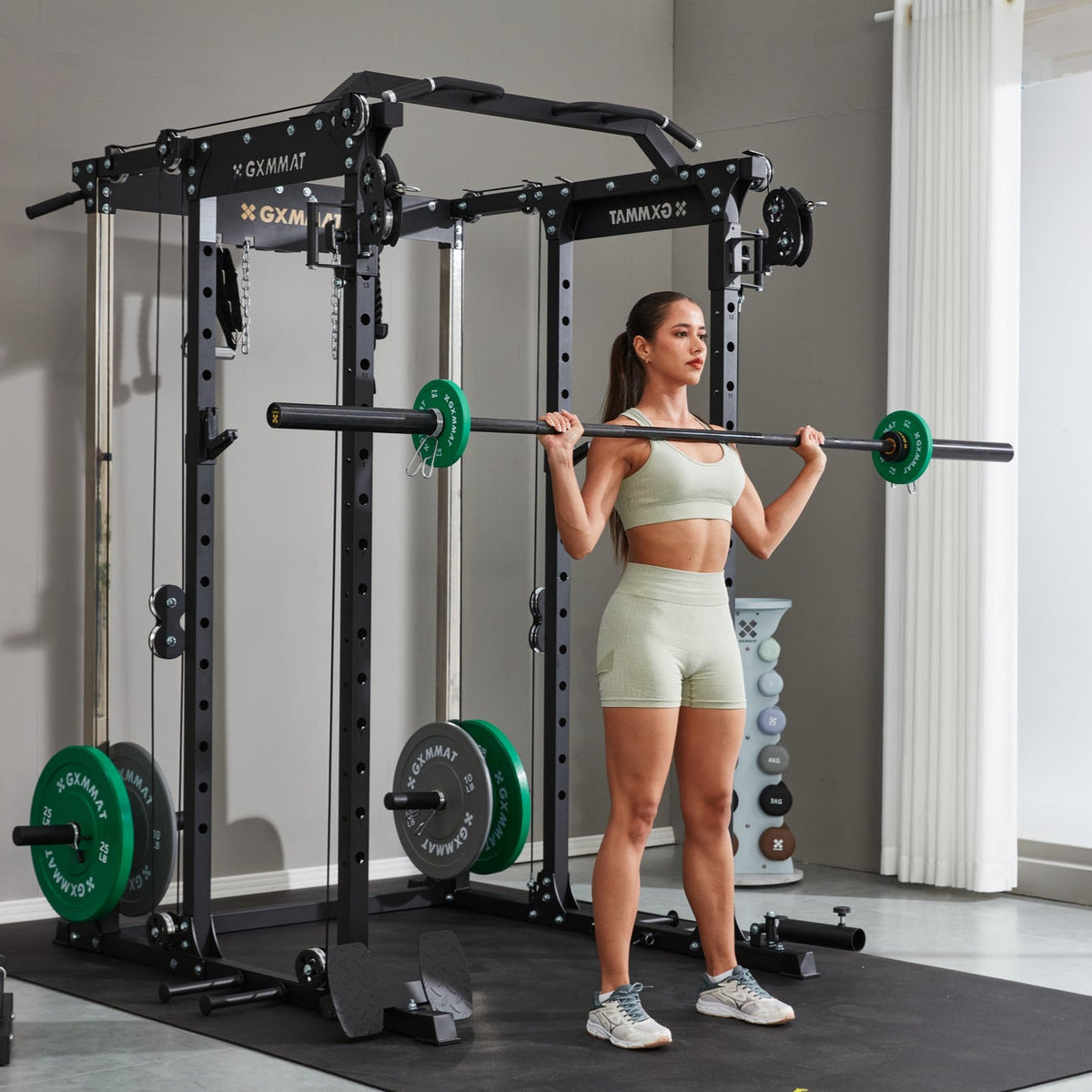
- Barbell version: unrack from the J-hooks of a G5, V6 or X6 power rack with a 20 kg Olympic bar. Start very light.
FAQ
What muscles do walking lunges work?
The quads, glutes and hamstrings, with the adductors, calves and core helping you balance.
Are walking lunges better than regular lunges?
They add a balance and conditioning challenge. Reverse lunges are often easier on the knees. Both are excellent exercises.
How many walking lunges should I do?
Start with 2–3 sets of 8–10 steps per leg and build to 3–4 sets of 12.
Why do I lose balance during walking lunges?
Usually from a narrow stance or rushing. Keep feet hip width apart, slow down, and look straight ahead.
Do walking lunges burn fat?
They raise your heart rate and burn calories, which supports fat loss alongside a calorie deficit.
Written by Yuvien Royer for GXMMAT. This article is general fitness information, not medical advice.