How to Squat With Proper Form: A Beginner’s Guide to the Back Squat
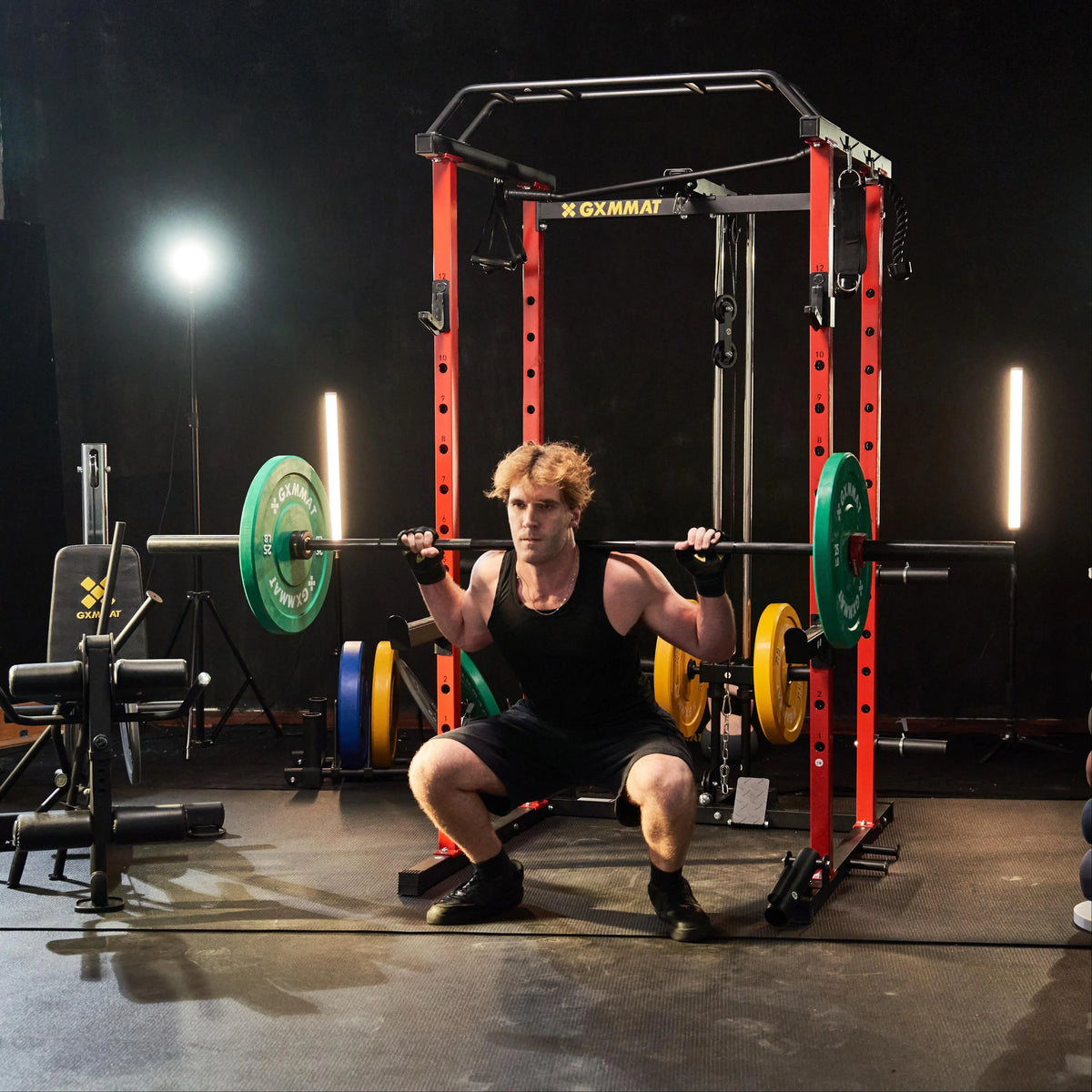
Quick answer: To back squat with good form, set the bar on your upper back (traps), not your neck, and stand with feet about shoulder-width apart, toes turned out 15–30°. Take a big breath and brace your core, then sit down and back between your hips, keeping your knees tracking over your toes and your chest up. Squat until your hip crease is at or below knee level if you can keep your back neutral, then drive up through your whole foot. Beginners can start with 3 sets of 5 reps, 2–3 times a week, inside a power rack with safety arms set just below the bottom position.
Key takeaways
- Brace before every rep: breathe in, tighten your core, then descend.
- Knees follow toes; don't let them cave inward.
- Whole foot stays down, weight over midfoot.
- Depth you can control beats forced depth with a rounded back.
- Always squat in a rack with safety arms when training alone.
Muscles worked
| Muscle | Role |
|---|---|
| Quads | Straighten the knees; main driver out of the bottom |
| Glutes | Extend the hips, especially in deeper squats |
| Adductors (inner thighs) | Help drive out of the hole |
| Hamstrings and calves | Stabilize knees and ankles |
| Core and back | Hold your torso upright under the bar |
How to squat: step by step
- Set the rack: J-hooks at about mid-chest height; safety arms a few inches below your lowest squat position.
- Get under the bar: grip just outside your shoulders, step under and place the bar on your upper traps. Squeeze your shoulder blades to make a "shelf."
- Unrack by standing straight up. Take 2–3 small steps back.
- Stance: feet about shoulder-width, toes out 15–30°.
- Brace: deep breath into your belly, tighten your abs as if bracing for a punch.
- Descend: break at the hips and knees together, knees out over toes, chest up.
- Bottom: hip crease at or just below the top of the knee, back neutral.
- Drive up: push the floor away, hips and chest rising together. Breathe out at the top.
Common squat mistakes
| Mistake | Fix |
|---|---|
| Knees caving in | Push knees out over toes; lighten the load; strengthen glutes |
| Heels lifting | Widen stance slightly, turn toes out more, or work on ankle mobility |
| Hips shooting up first | Lead with your chest out of the bottom; strengthen quads |
| Lower back rounding at the bottom | Squat only as deep as you can keep a neutral back |
| Bar on the neck | Move it down onto the upper traps |
| Holding your breath the whole set | Brace per rep, breathe at the top |
How deep should you squat?
- Parallel or slightly below (hip crease at or under the knee) is the common standard.
- Deeper is fine if your back stays neutral and your knees feel good.
- Limited mobility? Squat to a box at a comfortable height and lower it over time.
- Knees going past toes is normal for most people, especially taller lifters.
Squat variations
| Variation | Why use it |
|---|---|
| Goblet squat | Best for learning; weight held at the chest. Try a soft kettlebell |
| Box squat | Teaches depth and sitting back |
| Front squat | More upright torso, more quads |
| Pause squat | Strength out of the bottom; 2-second pause |
| Landmine squat | Easy on the back; see landmine exercises |
Beginner squat program
| Weeks | Sets × reps | Progression |
|---|---|---|
| 1–2 | Goblet squat 3 × 10 | Learn the pattern |
| 3–8 | Back squat 3 × 5 | Add 5–10 lb per session while form holds |
| 9+ | Back squat 4 × 5 or 5 × 3 | Add 5 lb per week; deload every 4–8 weeks |
Follow the full routine in our 3-day beginner power rack plan, read the progressive overload guide, and rest 2–3 minutes between heavy sets (rest guide).
Squatting safely at home
- Safety arms first: set them a few inches below your bottom position so you can sit down and let the bar rest on them if a rep fails. See how to set safety arms.
- Rack: G5 (12 levels, 4.3" spacing), V6 (14 levels, 3.94" spacing) or X6 (15 levels, 3.94" spacing, 2,200 lb capacity). Compare in X6 vs V6 vs G5.
- Ceiling height: check clearance for the rack and pull-ups. See home gym space guide.
- Bar, plates, collars: Olympic bar, bumper plates and collars.
- Flooring: a stable, non-slip large exercise mat under the rack. Avoid soft, squishy foam that makes your feet unstable.
FAQ
How should a beginner squat?
Start with bodyweight or goblet squats to learn the pattern, then move to the barbell back squat with light weight, 3 sets of 5, inside a rack.
Is it bad if my knees go past my toes when squatting?
No. For most people it's normal and necessary to reach depth. What matters is that your knees track in line with your toes and your heels stay down.
How low should I squat?
Aim for your hip crease at or slightly below your knees, as long as you can keep your back neutral.
How often should I squat?
Beginners can squat 2–3 times a week. Many intermediate lifters squat 1–2 times a week with heavier loads.
Do I need squat shoes?
No. Flat, stable shoes work well. Raised-heel shoes can help if ankle mobility limits your depth.
Written by Yuvien Royer for GXMMAT. This article is general fitness information, not medical advice. Check with a healthcare professional if you have knee, hip or back problems.