Push Press: How to Do It, Muscles Worked and Push Press vs Jerk
Quick answer: To do a push press, unrack a barbell into the front rack position (bar on the front of your shoulders, full grip just outside shoulder width, elbows slightly in front of the bar). Stand with a hip width stance. Keep your torso upright and dip a few inches by bending the knees, then drive hard through your heels and use that leg drive to launch the bar. As the bar leaves your shoulders, press it the rest of the way to full extension overhead, with your head moving slightly forward through your arms. Lower the bar back to your shoulders, absorbing it with your legs, and reset for the next rep. The push press lets you move more weight overhead than a strict press and builds upper body strength and power. Try 3–5 sets of 3–6 reps.
Key takeaways
- Short, straight dip: only 2–4 inches, knees forward, torso vertical.
- Drive through the heels, not the toes.
- Legs start it, arms finish it. Timing matters more than effort.
- No knee re-bend under the bar; that turns it into a push jerk.
- Usually 10–30% more than your strict press.
Muscles worked
| Muscle groups | Role |
|---|---|
| Shoulders (deltoids) | Press the bar overhead |
| Triceps | Lock out the elbows |
| Upper back and traps | Support the bar overhead |
| Quads and glutes | The dip and leg drive |
| Core | Keeps the torso rigid to transfer force from the lower body |
Benefits of the push press
- Heavier overhead loading: the legs help you handle more weight overhead, building shoulder strength and lockout strength.
- Power: trains the fast hip and knee extension used in jumping and sprinting, which is why athletes use it.
- Core strength from bracing under a heavy bar.
- Efficient athletic movement: teaches the lower body and upper body to work together.
- Overload the top of the strict press with heavier weights.
How to do a push press
- Unrack: set the bar at upper-chest height on the J-hooks. Take a full grip just outside your shoulders and step back into a hip width stance.
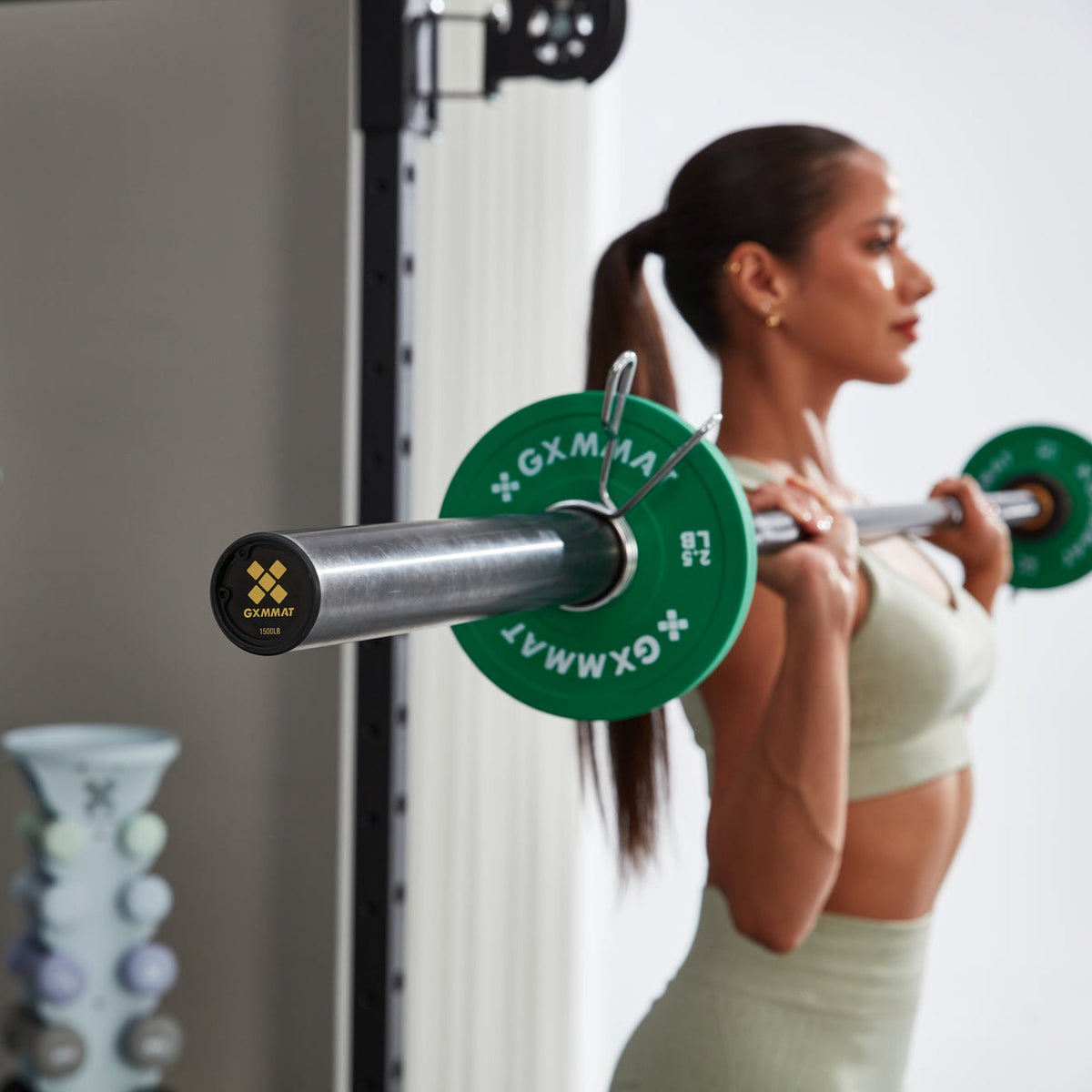
- Front rack position: bar resting on the front deltoids, elbows slightly in front of the bar, chest up.
- Brace: big breath, squeeze the glutes, ribs down.
- Dip: bend the knees forward 2–4 inches. Keep the torso vertical and weight in the heels and mid-foot. Don't let the hips go back.
- Drive: reverse the dip immediately and explode up through the heels. The bar should leave your shoulders from the leg drive alone.
- Press: as the bar rises, press it overhead in a straight line. Move your head back slightly so the bar passes your face, then bring your head through the window of your arms.
- Lock: elbows locked, bar over the back of the neck and mid-foot.
- Lower: bring the bar back to the shoulders, bending the knees slightly to cushion it. Reset and do the next rep.
Strict press vs push press vs push jerk
| Strict press | Push press | Push jerk | |
|---|---|---|---|
| Leg drive | None | Dip and drive | Dip and drive |
| Under the bar | No | No, press to lockout | Re-bend the knees and catch the bar locked out |
| Load | Lightest | Heavier | Heaviest |
| Main purpose | Shoulder strength | Strength and power | Technique for the jerk; maximal overhead weight |
Learn the strict version first with the overhead press guide, and see the benefits of the shoulder press.
Common mistakes
| Mistake | Fix |
|---|---|
| Dipping too deep | Keep the dip short: a quarter squat at most |
| Hips shooting back in the dip | Knees forward, torso vertical |
| Weight on the toes | Stay in the heels and mid-foot |
| Pressing before the legs finish | Let the legs launch the bar, then press. Practice the timing light. |
| Bar drifting forward | Head back, then through; finish with the bar over mid-foot |
| Arching the lower back at lockout | Squeeze glutes; lower the weight |
Push press variations
| Variation | Why |
|---|---|
| Behind-the-neck push press | Straighter bar path; needs good shoulder mobility |
| Kettlebell push press | One or two bells; less load, more stability work |
| Pause push press | Pause in the dip to fix the position |
| Push press with slow lowering | 3-second lowering for more time under load |
For kettlebell work, see the kettlebell clean and press.
Sets, reps and programming
| Goal | Sets × reps | Rest |
|---|---|---|
| Power | 5 × 2–3, moderate weight, fast | 2 min |
| Strength | 4–5 × 3–5 | 2–3 min |
| Muscle | 3 × 6–8 | 90 sec |
Do it early in the workout, after the warm up, 1–2 times per week. A simple session: push press, then rows and face pulls to balance the shoulders.
Who should be careful
- Shoulder or neck injury: start with an empty bar or skip overhead work until cleared by a professional.
- Lower back pain: if you can't lock out without arching, the weight is too heavy.
- Knee pain: keep the dip short and controlled.
Push press at home
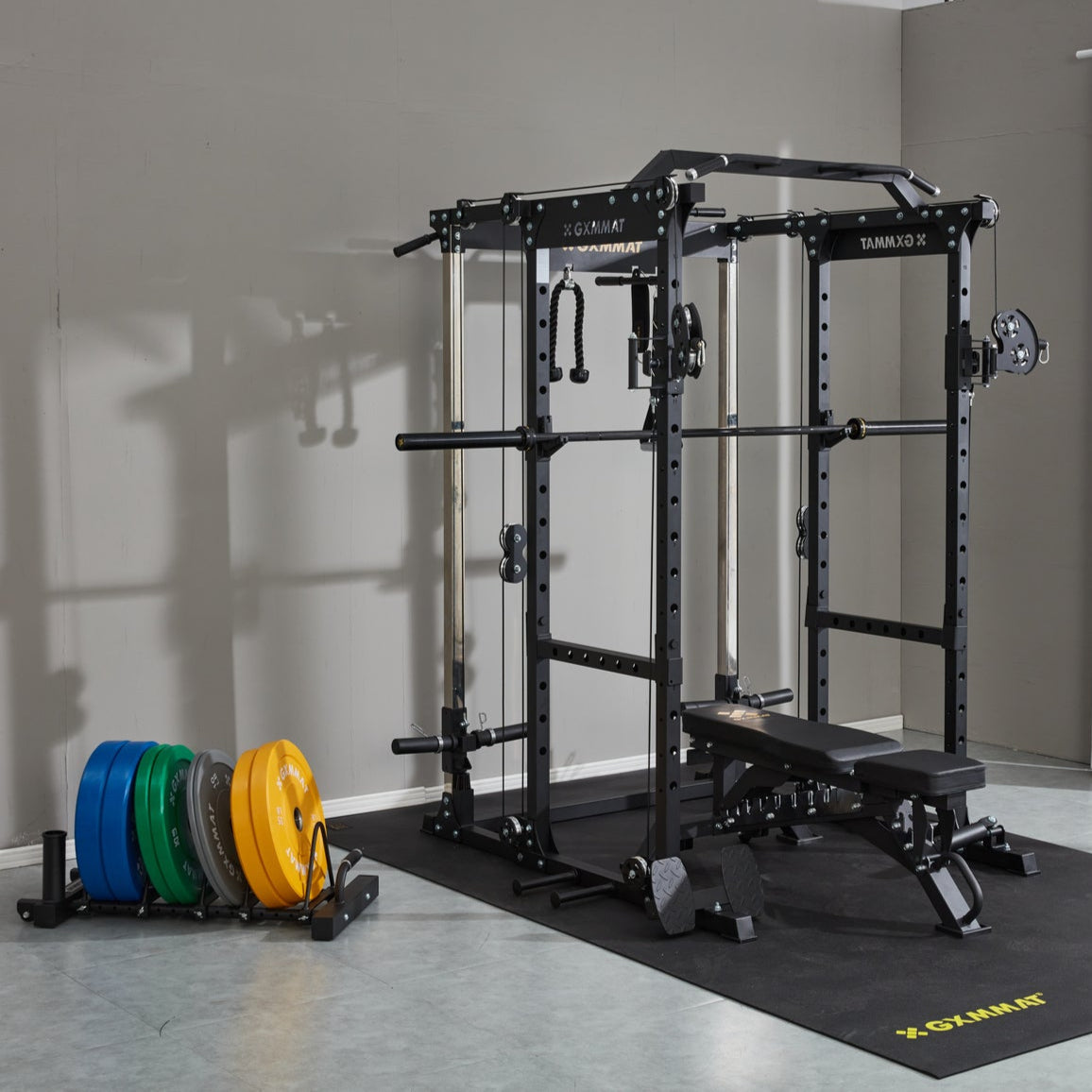
- Rack: a G5, V6 or X6 power rack lets you unrack from the J-hooks at chest height. Compare them in X6 vs V6 vs G5.
- Ceiling: you'll need roughly your standing reach plus a few inches. Check ceiling height for a home gym.
- Bar and plates: 20 kg Olympic bar, bumper plates and change plates for small jumps; collars keep the plates tight.
- Floor: a large exercise mat gives stable footing for the dip and drive.
FAQ
What is a push press?
An overhead barbell press that starts with a short dip and drive from the legs, then finishes with the arms pressing the bar to lockout.
Is the push press better than the strict press?
Neither is better. The strict press builds pure shoulder strength; the push press lets you handle heavier weights and trains power. Many programs use both.
How much more can you push press than strict press?
Often around 10–30% more, depending on how well you use your legs.
What's the difference between a push press and a push jerk?
In a push jerk you re-bend your knees and drop under the bar to catch it locked out. In a push press, you stay tall and press it the rest of the way.
Does the push press build muscle?
Yes, especially the shoulders, triceps and upper back, when you train it for sets of 5–8 reps with enough weekly volume.
Written by Yuvien Royer for GXMMAT. This article is general fitness information, not medical advice.