Negative Pull Ups: How to Do Them to Get Your First Pull Up
Quick answer: Negative pull ups (also called eccentric pull ups) train the lowering part of a pull up, the phase you can handle even before you can pull yourself up. Step or jump up so your chin is above the bar, hold for a second, then lower yourself as slowly as you can, aiming for 3–5 seconds or more until your arms are straight. Step down, reset, and repeat. Do 3–5 sets of 3–5 reps, 2–3 times a week. Negative pull ups build the strength in your lats, upper back and biceps that leads to your first full pull up.
Key takeaways
- Start at the top: use a box, step or jump to get your chin over the bar.
- Lower slowly: 3–5 seconds is the goal; work up to 8–10 seconds.
- Control the whole way down to a full dead hang.
- Low reps, high quality: negatives are demanding and can cause soreness.
- Combine with rows and hangs for faster progress.
Why negative pull ups work
Muscles are stronger in the eccentric (lowering) phase than the concentric (lifting) phase. That means you can lower your body weight under control before you can pull it up. Negative pull ups let you practice the full pull up range with your real body weight, building strength in the lats and biceps and teaching your body the movement pattern. Many beginners find negatives one of the most effective steps toward their first pull up.
Muscles worked
| Muscle | Role |
|---|---|
| Latissimus dorsi | Main muscle controlling the descent |
| Biceps and forearms | Elbow flexion and grip |
| Rhomboids, traps, rear delts | Control the shoulder blades |
| Core | Keeps the body from swinging |
How to do negative pull ups
- Set up: place a sturdy box or step under the pull-up bar so you can reach the top position.
- Get to the top: grab the bar slightly wider than shoulder width, palms facing away, and step or jump up until your chin is over the bar.
- Set the shoulders: pull the shoulder blades down and back, squeeze the glutes and brace the core.
- Hold: 1–2 seconds at the top.
- Lower slowly: take 3–5 seconds to lower until your arms are fully straight. Keep the movement smooth, without dropping.
- Step down and reset for the next rep.
Negative pull up program
| Week | Sets × reps | Lowering time |
|---|---|---|
| 1–2 | 3 × 3 | 3–5 sec |
| 3–4 | 4 × 3 | 5–6 sec |
| 5–6 | 4 × 4 | 6–8 sec |
| 7+ | Test a full pull up | Then add 1–2 negatives after |
Rest 2–3 minutes between sets and at least a day between sessions. Pair them with:
- Scapular pull ups to learn the shoulder blade movement.
- Inverted rows for pulling strength.
- Dead hangs (20–40 seconds) for grip; see grip strength exercises.
- Lat pulldowns if you have a cable station.
For the full plan from zero to pull ups, see the pull up progression guide.
Negative chin ups
The same method works with an underhand grip. Negative chin ups use more biceps and are often slightly easier, so they're a good starting point. See chin up vs pull up.
Common mistakes
| Mistake | Fix |
|---|---|
| Dropping quickly | Count slowly; if you can't control 3 seconds, use a band or lower box |
| Stopping halfway | Lower all the way to straight arms |
| Too many reps | Quality over volume; stop when the descent speeds up |
| Shrugging at the bottom | Keep the shoulders engaged, not hanging in the ears |
| Swinging | Squeeze the glutes and brace the core |
Who should be careful
- Elbow or shoulder pain: negatives load the tendons heavily; start with fewer reps.
- Very sore after the first session: normal for eccentrics; give it 48–72 hours before repeating.
Where to do negative pull ups at home
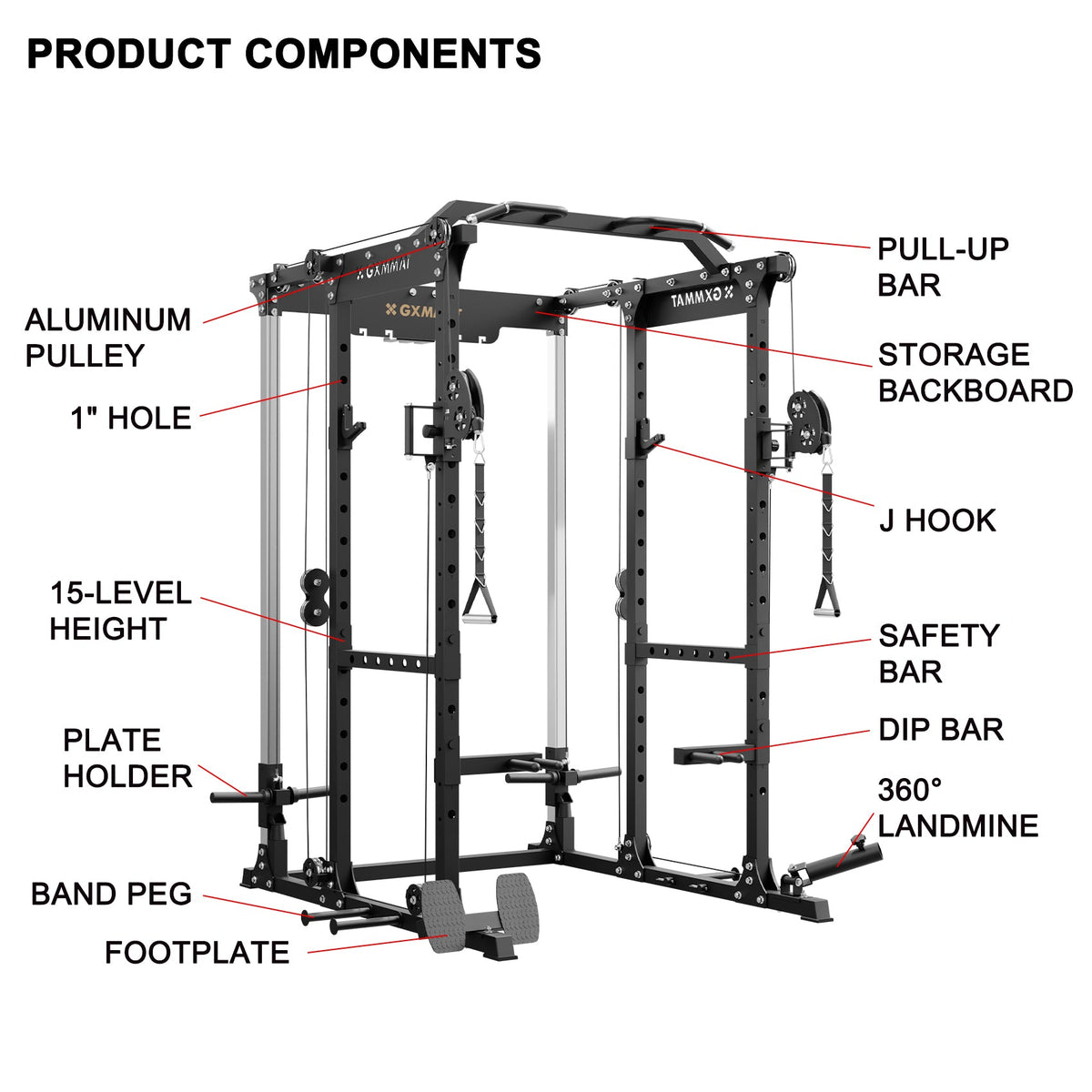
You need a sturdy pull-up bar and something stable to step on. Every GXMMAT power rack, including the G5, V6 and X6, has a built-in pull-up bar, so you can do negatives, chin ups and hangs without a doorframe bar. Check your ceiling height first with our power rack ceiling height guide. Workout gloves help your grip, and a large exercise mat under the rack protects the floor when you step down.
FAQ
Do negative pull ups help you do a pull up?
Yes. They build strength through the full range and are one of the most common steps toward a first pull up.
How slow should negative pull ups be?
Aim for 3–5 seconds to start, and work up to 8–10 seconds.
How many negative pull ups should I do?
3–5 sets of 3–5 reps, 2–3 times a week.
Why are my muscles so sore after negatives?
Eccentric training causes more soreness at first. It usually decreases as your body adapts.
Are negative pull ups better than band-assisted pull ups?
Both help. Negatives build strength in the lowering phase; bands let you practice the full movement. Many people use both.
Written by Yuvien Royer for GXMMAT. This article is general fitness information, not medical advice.