Cable Reverse Fly: How to Do It for Rear Delts
Quick answer: To do a cable reverse fly, set both pulleys at shoulder height and remove the handles (or use single handles). Stand in the middle, grab the left cable with your right hand and the right cable with your left hand so the cables cross in front of you. With a soft bend in the elbows, pull your arms out and back in a wide arc until your hands are in line with your shoulders, squeezing your shoulder blades together. Pause, then return slowly. Do 3–4 sets of 12–20 reps with a light weight. The cable reverse fly targets the rear delts and upper back muscles (rhomboids and middle traps), which support posture and shoulder health.
Key takeaways
- Cross the cables: right hand holds the left cable, left hand the right.
- Pulleys at shoulder height for the standard version.
- Lead with the elbows, not the hands, and keep a soft elbow bend.
- Light weight, high reps: the rear delts are small muscles.
- Constant tension: cables keep the rear delts working through the whole range, unlike free weights.
Muscles worked
| Muscle | Role |
|---|---|
| Rear deltoids | Primary mover: pulls the arms out and back |
| Rhomboids and middle traps | Squeeze the shoulder blades together |
| Rotator cuff (infraspinatus, teres minor) | Stabilize the shoulder |
| Core | Keeps the torso still |
Not sure where rear delts fit in your split? See is rear delt push or pull.
Benefits of the cable reverse fly
- Balanced shoulders: pressing work trains the front delts; reverse flys build the often-neglected rear delts.
- Posture support: strong upper back muscles help counter rounded shoulders from desk work.
- Constant tension through the full range, especially at the start where free-weight reverse flys are easy.
- Joint friendly: light loads and smooth cable resistance.
- 3D shoulder look: rear delts round out the back of the shoulder.
How to do a cable reverse fly
- Set up: both pulleys at shoulder height, no handle attachments or single D-handles.
- Grab crossed: stand centered, right hand takes the left cable, left hand takes the right. Step back so there's tension.
- Start position: arms extended in front of your chest, elbows softly bent, palms facing down or each other.
- Pull: sweep the arms out and back in a wide arc until the hands line up with your shoulders. Lead with the elbows.
- Squeeze: pause for 1 second, shoulder blades pulled together and down.
- Return slowly: 2–3 seconds back to the start.
Cable reverse fly variations
| Variation | How | Why |
|---|---|---|
| Single-arm cable reverse fly | One cable at shoulder height, pull across the body and out | Works with a single cable; fixes side-to-side imbalances |
| Bent-over cable reverse fly | Pulleys low, hinge forward about 45 degrees | Mimics the classic rear delt fly with constant tension |
| High-to-low reverse fly | Pulleys above head, pull down and out | More lower trap involvement |
| Face pulls | Rope at face height, pull toward the forehead | Rear delts plus external rotation |
Common mistakes
| Mistake | Fix |
|---|---|
| Too much weight | Go light; rear delts fatigue fast |
| Shrugging | Keep the shoulders down away from the ears |
| Bending the elbows into a row | Keep a fixed soft bend so the rear delts do the work |
| Arching the lower back | Brace the core and stand tall |
| Rushing the return | Control the cables back for 2–3 seconds |
Sample shoulder and upper back workout
| Exercise | Sets × reps |
|---|---|
| Overhead press | 4 × 6–8 |
| Cable lateral raise | 3 × 12–15 |
| Cable reverse fly | 3 × 15–20 |
| Face pulls | 3 × 15 |
| Barbell shrugs | 3 × 10–12 |
Train rear delts 2–3 times a week; they recover quickly.
Who should be careful
- Shoulder impingement or rotator cuff pain: use very light weights and a pain-free range; see a physical therapist if pain persists.
- Neck tension: lower the weight and focus on keeping the shoulders down.
Cable reverse flys at home
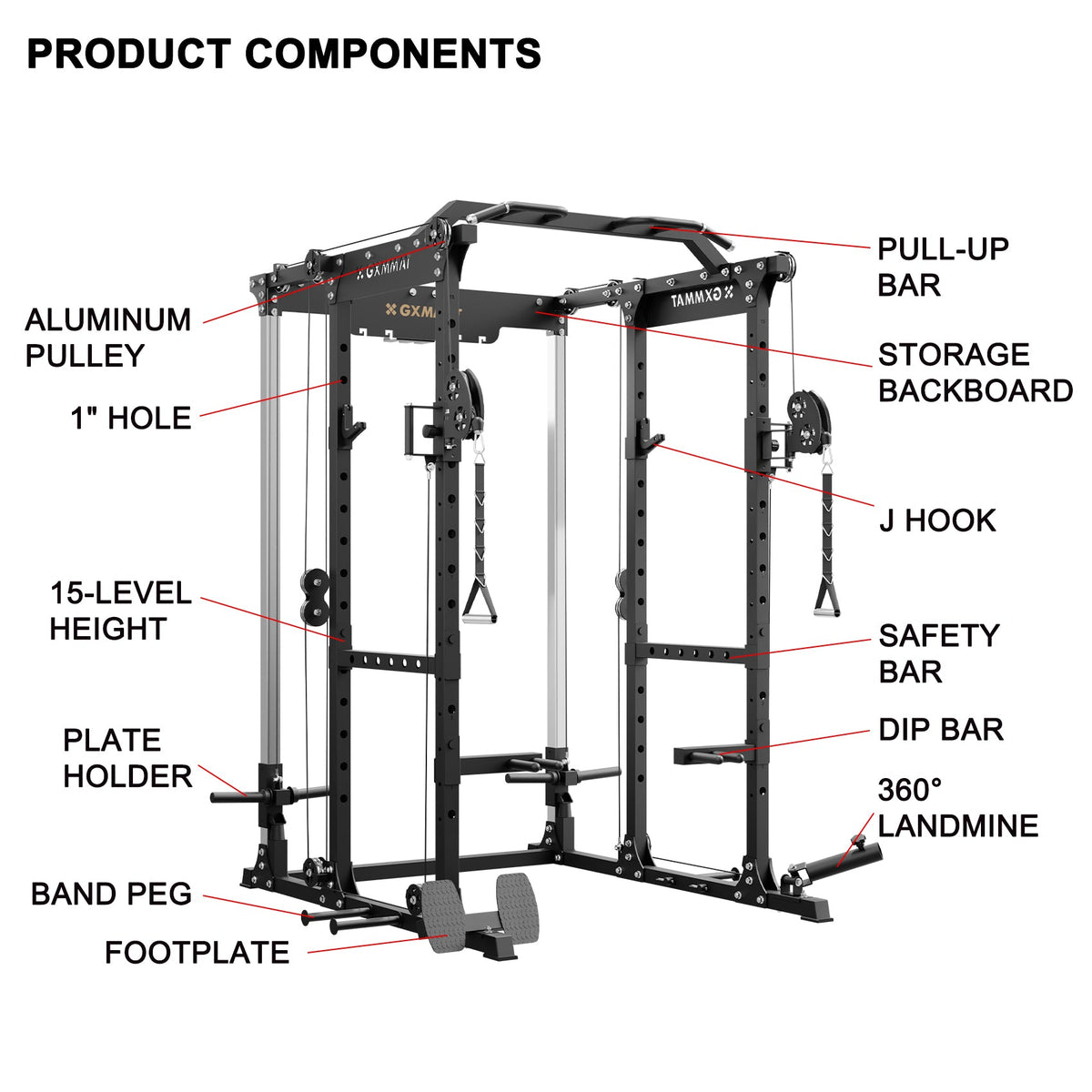
You need two pulleys you can set at shoulder height. The GXMMAT X6 power rack has dual independent cables on adjustable-height pulleys, so you can set both at shoulder height for the standard version or move them high or low for the variations. The V6 also has dual cables for cable work. Compare all three racks in the X6 vs V6 vs G5 guide, and see the cable attachments guide for handles and ropes.
FAQ
What does the cable reverse fly work?
The rear delts, rhomboids and middle traps, with the rotator cuff helping to stabilize the shoulder.
How heavy should cable reverse flys be?
Light. Choose a weight you can control for 12–20 reps with a 1-second squeeze.
Why cross the cables?
Crossing the cables lets your arms start in front of your chest and move through a longer range of motion.
Can I do reverse flys with one cable?
Yes. The single-arm cable reverse fly works well and lets you focus on one side at a time.
Are reverse flys the same as face pulls?
No. Both train the rear delts, but face pulls add external rotation and use a rope to pull toward your face.
Written by Yuvien Royer for GXMMAT. This article is general fitness information, not medical advice.