IT Band Stretches: 7 Stretches Plus Foam Rolling Tips
Quick answer: The most effective IT band stretches target the hip and outer thigh muscles that attach to the IT band. Try the standing cross-leg IT band stretch: stand next to a wall, cross your right leg behind your left, and lean your hips toward the right while reaching your left arm overhead, until you feel a stretch along the outer hip and thigh. Hold 30 seconds, then switch sides. Other good options include the lying cross-over stretch, figure-4, the seated twist and foam rolling the outer hip and thigh. Because the iliotibial band itself is tough connective tissue, pair stretching with hip strengthening exercises for the best results.
Key takeaways
- The IT band is connective tissue, not a muscle; stretches mostly work the hip muscles attached to it.
- Hold 30 seconds, 2–3 times per side.
- Foam roll the outer hip and thigh muscles, gently, not the painful spot over the knee.
- Strengthen the hip abductors and glutes.
- Persistent outer knee pain should be checked by a physical therapist.
What is the IT band?
The iliotibial band (IT band) is a thick band of fascia, a type of connective tissue, that runs down the outer thigh from the hip to just below the knee. At the top it connects to the tensor fasciae latae (TFL) and the gluteus maximus. It helps stabilize the hip and knee during walking, running and daily activities. Because it's so strong, you can't stretch the band itself very much. Most IT band stretches lengthen the TFL, glutes and outer hip muscles that pull on it, which can reduce tension and how tight the outer thigh feels.
Benefits of IT band stretches
- Less outer thigh tightness: IT band stretches relax the TFL and glutes that pull on the band.
- Better hip mobility for running, squatting and side-to-side movement.
- Part of recovery: runners and cyclists often use IT band stretches after training.
- Easy to do anywhere: most IT band stretches need only a wall and the floor.
IT band syndrome and IT band pain
IT band syndrome (iliotibial band syndrome) is a common source of pain on the outside of the knee, especially in runners and cyclists. It usually builds from repetitive knee bending, a sudden increase in training, or weak hip muscles. Symptoms often include a sharp or burning pain on the outer knee that gets worse during a run or going downstairs. Rest, reducing training load, stretching and strengthening are commonly used for IT band issues. See a doctor or physical therapist if you have swelling, pain that lasts more than a couple of weeks, or pain that stops you from performing daily activities.
7 IT band stretches for a tight IT band
Do these IT band stretches after a run or workout, when your muscles are warm. Move slowly, stay just short of discomfort, and stretch both sides even if only one feels tight.
1. Standing cross-leg IT band stretch
Stand next to a wall or sturdy object with your left side toward it. Cross your right leg behind your left leg. Push your hips out toward the wall side while leaning your torso away, reaching your right arm overhead. Hold 30 seconds, then switch sides.
2. Standing forward fold with crossed legs
Cross your left foot in front of your right foot. Keeping the legs straight (a slight knee bend is fine), fold forward and reach your hands toward the right side of the floor. You'll feel it in the outer thigh of the back leg.
3. Lying cross-over stretch
Lie on your back with your legs straight. Bend your right knee and pull it across your body toward the left side with your left hand, keeping your shoulders on the floor. Hold 30 seconds per side. See supine spinal twist.
4. Figure-4 stretch
Lie on your back with knees bent and feet flat. Cross your right ankle over your left knee and pull the left thigh toward your chest. Stretches the glutes that connect to the IT band. See the piriformis stretch.
5. Seated twist
Sit with your legs straight. Cross the right foot over the left knee, foot flat on the floor. Hug the top knee with your left elbow and twist toward the right. Hold 30 seconds.
6. Side-lying leg hang
Lie on your left side on a bench or bed edge. Let the top (right) leg drop behind you off the edge so gravity stretches the outer hip.
7. Pigeon pose
A deeper stretch for the glutes and outer hip. See hip flexor stretches for full instructions.
Foam rolling the IT band area
Foam rolling is popular for IT band tightness, but rolling directly on a sore IT band can be painful and may not change the band itself. A better approach is to roll the muscles around it:
- Outer hip (TFL) and glutes: lie on your side with the foam roller under the front of your hip and roll slowly.
- Quads and outer quad: roll the front and front-outer thigh.
- Pressure: support some body weight on your hands and the other foot; it should feel like moderate pressure, not sharp pain.
See the full foam rolling routine.
Strengthening exercises for IT band issues
IT band stretches alone rarely fix IT band pain. Weak hip abductors and glutes are often linked with iliotibial band syndrome, because the knee drifts inward and the outer hip and fascia take more strain. Strengthening exercises help reduce the risk of IT band injuries coming back. Add these exercises 2–3 times a week:
- Side-lying leg raises: lie on your side, top leg straight, and lift it in a straight line slightly behind the body. 2 × 15 per side.
- Clamshells: side-lying with knees bent, open the top knee while keeping the feet together.
- Side planks and fire hydrants.
- Single-leg work: split squats and curtsy lunges with the knee tracking over the toes.
IT band stretches and exercises routine (10 minutes)
| Exercise | Dose |
|---|---|
| Foam roll outer hip, glutes and quads | 60 sec each side |
| Standing cross-leg stretch | 30 sec per side |
| Figure-4 stretch | 30 sec per side |
| Lying cross-over stretch | 30 sec per side |
| Side-lying leg raises | 2 × 15 per side |
| Clamshells | 2 × 15 per side |
Common mistakes
| Mistake | Fix |
|---|---|
| Rolling hard on a painful spot | Roll the surrounding muscles with moderate pressure |
| Only stretching, never strengthening | Add hip abductor and glute work |
| Running through outer knee pain | Reduce training load and rest |
| Leaning forward in the standing stretch | Keep the body in a straight line, shift the hips sideways |
Stretching and recovery at home
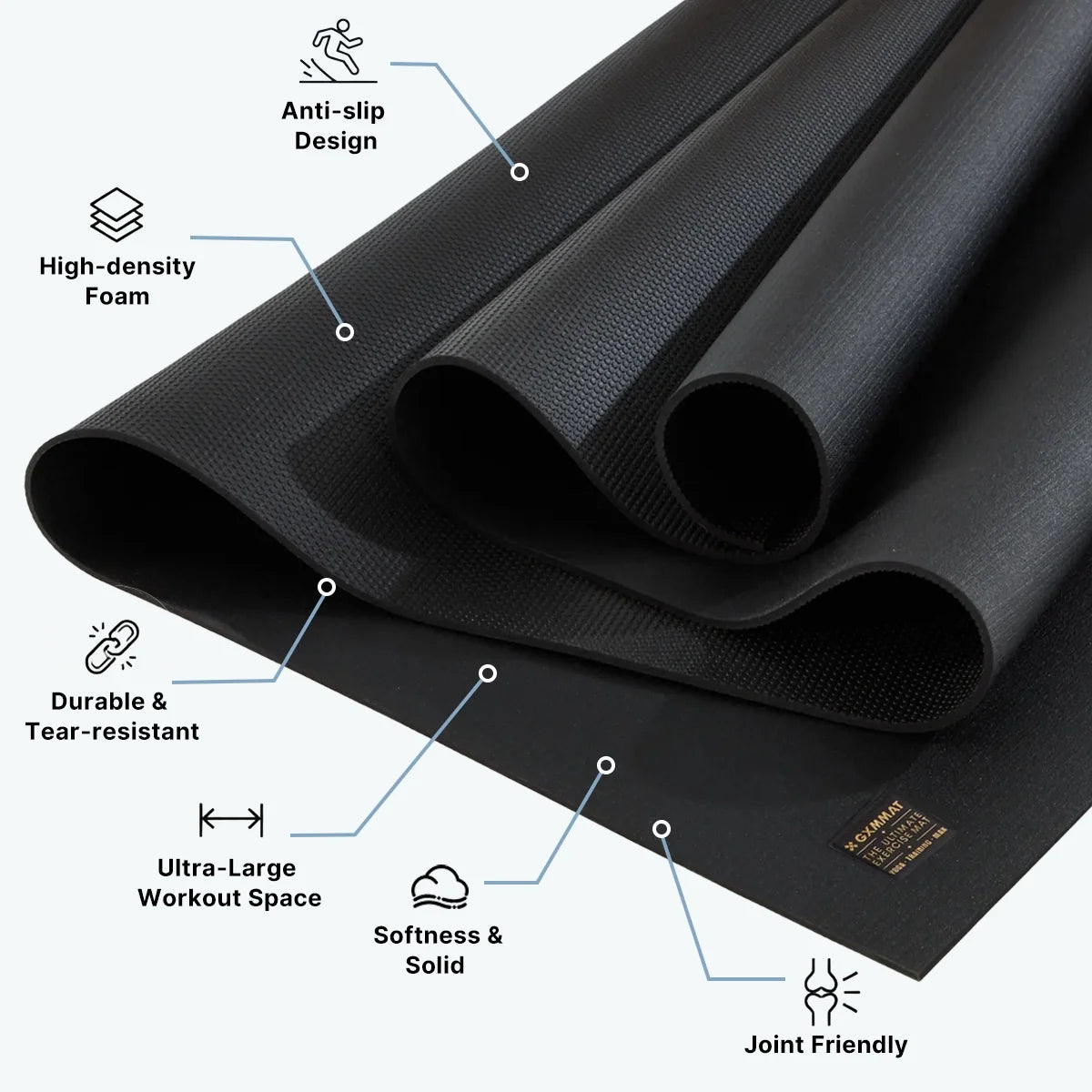
A GXMMAT foam roller is the core tool for IT band work. The 13" solid grid foam roller is a firm, compact option for the outer hip, and the 24" solid grid foam roller is longer for more stability. A massage roller stick lets you control pressure while seated. Do your stretches and side-lying exercises on a large exercise mat for cushioning.
FAQ
Can you actually stretch your IT band?
Not much. The band is very strong connective tissue. IT band stretches work mainly on the hip and glute muscles attached to it, which can still relieve tightness.
Is foam rolling good for the IT band?
Many people find it helpful, but roll the outer hip, glutes and quads with moderate pressure instead of grinding on a painful spot.
How long does IT band syndrome take to heal?
It varies. Many cases improve over several weeks with rest, reduced training, stretching and hip strengthening. A physical therapist can guide recovery.
What causes a tight IT band?
Repetitive running or cycling, sudden training increases and weak hip abductors are common factors.
Should I run with IT band pain?
Reduce or pause running if it causes pain, then build back gradually. See a professional if pain persists.
Written by Yuvien Royer for GXMMAT. This article is general fitness information, not medical advice.