
Best Age to Build Muscle: Lifespan Hypertrophy Guide, Training Adaptations, and Home Floor Staging
When exploring the best age to build muscle, lifters often wonder whether their current life stage offers an advantage or presents unavoidable hurdles. Skeletal muscle adapts to resistance stimulus across the entire lifespan. While physiological baselines, recovery speed, and hormonal balances shift between adolescence, young adulthood, mid-life, and master years, hypertrophy remains accessible at almost every stage. Tailoring workout routines and outfitting a stable training area can help sustain consistent progress over decades.
Understanding Muscle Growth Across the Lifespan
Hypertrophy relies on mechanical tension, metabolic stress, and muscle recovery. How the human body responds to these stimuli evolves over time:
- Tissue Remodeling and Recovery: Younger bodies generally repair connective tissue and muscle fibers rapidly, whereas mature bodies benefit from deliberate pacing and planned rest between strenuous bouts.
- Neuromuscular Coordination: Motor unit recruitment improves with training experience, allowing mature lifters to stimulate target muscle groups with refined control.
- Structural Adaptations: Ligaments, tendons, and cartilage adapt more slowly than muscle fibers, making joint-conscious exercise selection increasingly valuable as training age advances.
Understanding these biological dynamics clarifies that there is no singular expiration date on gaining lean tissue. While young adulthood represents a biological peak for effortless recovery, discovering the best age to build muscle mass ultimately depends on consistency, nutritional adequacy, and sensible load management.
The Peak Hypertrophy Window: Young Adulthood and Early Maturity
Late adolescence through early adulthood is often considered the prime biological window for adding lean mass. During these years, baseline recovery capacity, natural hormone production, and joint resilience are generally at their highest natural levels.
For lifters in this demographic, the primary objective involves establishing foundational movement mechanics. Following a structured beginner exercise plan to build muscle provides a reliable pathway to learn multi-joint patterns like squats, hinges, and presses without overtaxing structural tissues.
Key focus areas during this phase include:
- Learning consistent bar paths and tempo control under moderate loads.
- Developing work capacity across multi-joint compound movements.
- Establishing sustainable recovery habits involving sleep, hydration, and nutrition.
Mid-Life Muscle Building: Prioritizing Recovery and Movement Quality
Entering mid-adulthood often brings shifting daily schedules, increased work or family demands, and accumulated joint wear. While peak hormonal outputs taper gradually, muscle tissue retains strong responsiveness to progressive overload.
Lifters seeking the best age to build muscle mass during mid-life often benefit from blending resistance work with conditioning, such as integrating weights and cardio to build lean muscle while supporting cardiovascular health. At this stage, autoregulation—adjusting daily volume or intensity based on recovery readiness—helps sustain progress without accumulating chronic joint strain.
Master Lifters: Preserving Mass, Joint Integrity, and Neuromuscular Control
For master lifters, resistance training serves as an essential tool for preserving functional strength, balance, and lean tissue. While the rate of muscle synthesis may slow down, consistent resistance work continues to stimulate tissue maintenance and growth.
Training longevity at this stage centers on joint-friendly variations, controlled eccentric tempos, and dedicated stability exercises. Incorporating movements focused on proper quadriceps muscle strengthening helps protect lower-body joint mechanics during everyday movement patterns. Stable surfaces, controlled ranges of motion, and adequate warm-up protocols ensure that training remains productive and sustainable.
Lifespan Programming Frameworks and Movement Blueprints
Structuring a balanced weekly split requires matching exercise selection with current recovery capacity and training goals. Using structured templates, such as a 5 pattern beginner workout to build muscle, establishes balanced physical development across foundational human movement patterns:
- Squat Variations: Goblet squats, front squats, or box squats tailored to individual hip and ankle mobility.
- Hinge Movements: Romanian deadlifts, trap-bar deadlifts, or kettlebell swings to strengthen the posterior chain.
- Upper-Body Pushing: Overhead presses and dedicated exercises for mass and growth like dumbbell bench presses and push-up variations.
- Upper-Body Pulling: Chest-supported rows, lat pulldowns, and inverted rows to build upper-back stability.
- Loaded Carries and Core Bracing: Farmer walks and plank variations to reinforce midline stability and grip strength.
Home Gym Floor Staging and Joint Protection Across Age Groups
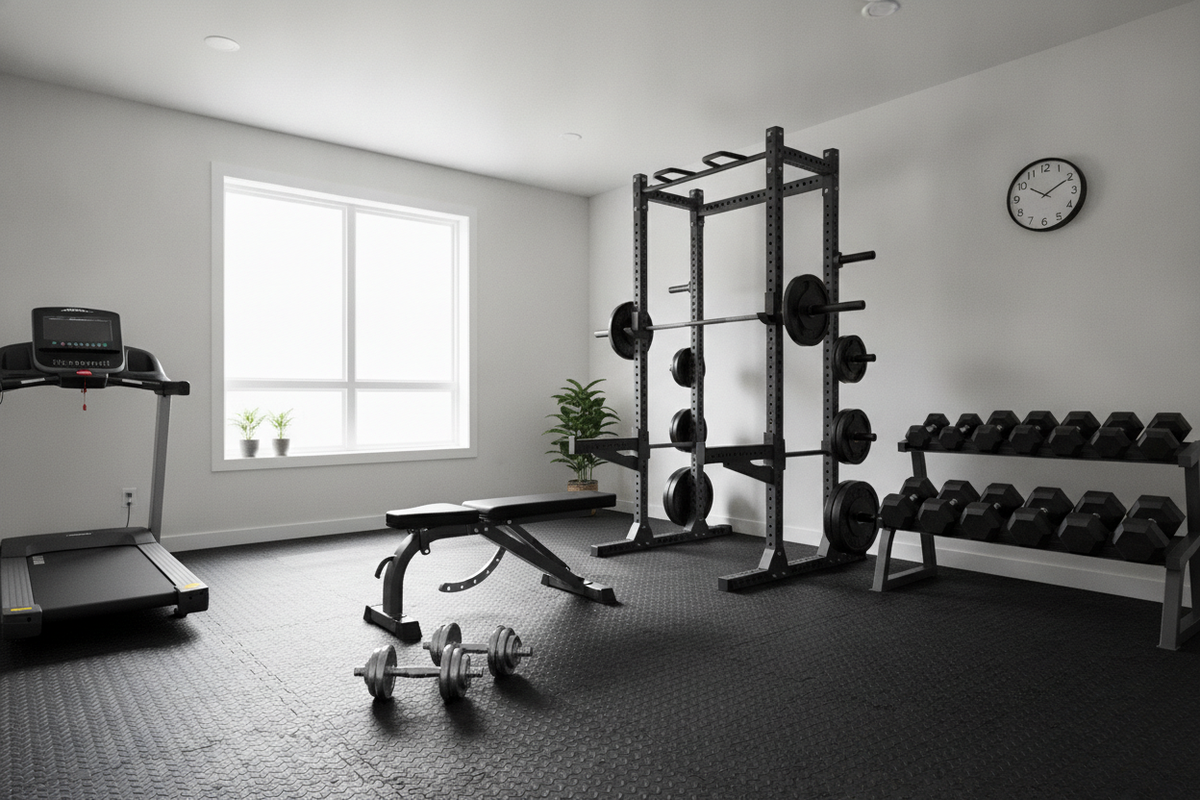
Regardless of chronological age, having an appropriate flooring foundation is essential for home strength training. High-density rubber mats and exercise flooring provide structural benefits that support lifelong lifting:
- Joint Cushioning and Shock Attenuation: Dense mats reduce the impact transmitted through ankles, knees, and hips during dynamic lifts or plyometric work.
- Traction and Surface Stability: Non-slip textures ensure firm foot placement during heavy squats, lunges, and overhead presses, preventing footing shifts under load.
- Subfloor and Equipment Defense: Dropped dumbbells, kettlebells, or plates can crack concrete or damage subflooring without a resilient barrier layer.
- Acoustic and Vibration Dampening: Heavy mats reduce ambient noise and structural vibrations throughout the home during early morning or late evening workouts.
Flooring Maintenance, Equipment Placement, and Safety Zones
Creating an organized workout area supports training efficiency and keeps lifters of all ages safe. Setting up distinct zones for heavy loading, mobility work, and equipment storage prevents clutter and maintains clear pathways:
- Dedicated Lifting Perimeter: Ensure a perimeter around racks and benches free of loose plates or accessories to permit unhindered movement.
- Surface Leveling: Install interlocking tiles or rolled rubber mats over flat, dry subfloors to prevent seam separation or uneven footing.
- Routine Surface Cleaning: Wipe down rubber flooring regularly with mild cleaning solutions to clear dust and sweat without degrading the material grip.
By pairing age-appropriate training programs with a well-designed home gym floor, lifters can build strength, protect joint health, and pursue hypertrophy across every decade of life.


