6 Tips for Body Build Success: Hypertrophy Fundamentals, Movement Execution, and Floor Staging
Introduction: The Structural Foundations of Bodybuilding
Physique development requires more than simply lifting heavy resistance with arbitrary frequency. Building a balanced, muscular physique relies on a methodical application of mechanical tension, joint-friendly movement execution, consistent nutritional habits, and an organized training environment. When lifters shift their focus from moving weight by any means necessary to creating targeted muscular fatigue within stable biomechanical pathways, progress becomes far more predictable.
Whether you train in a commercial facility or a dedicated garage space, establishing structured lifting protocols and preparing your physical environment will safeguard your joints and improve the quality of every repetition. Here are six practical tips for body build success to help guide your training journey.
1. Master Mechanical Tension and Progressive Overload
The primary driver of muscle hypertrophy is mechanical tension. To signal the body to build new muscle tissue, target muscles must experience sufficient tension across a productive range of motion. Progressive overload is the systematic increase of this stimulus over time, which can take the form of adding load, completing additional repetitions with identical form, or increasing training volume across a training block.
Tempo Control and Mind-Muscle Engagement
Rather than letting momentum carry the weight through the eccentric (lowering) phase of a repetition, deliberate tempo control keeps tension focused squarely on the working muscle group. Emphasize a controlled lowering phase, followed by a momentary pause in the stretched position, and an assertive concentric contraction. This tempo discipline limits joint shear, reinforces mind-muscle connection, and maximizes hypertrophic stimulation without requiring excessively dangerous loads.
2. Balance Multi-Joint Compounds with Targeted Isolation
A well-rounded physique demands a strategic blend of compound foundational exercises and single-joint isolation movements. Compound movements recruit multiple muscle groups and allow for greater overall mechanical loading, serving as the cornerstone for overall mass. Isolation exercises, conversely, allow you to direct stimulus toward specific muscle bellies that may lag behind during compound patterns.
Compound Foundation and Accessory Layering
Structure training sessions by placing multi-joint lifts—such as squats, presses, and rows—at the beginning when physical and mental energy levels are highest. Afterward, integrate isolation work like lateral raises, hamstring curls, and triceps extensions to refine symmetry and address individual weak points. Exploring a complete physique machine blueprint can help illustrate how multi-joint stations and cable attachments complement each other for balanced physique development.
3. Perfect Lift Execution and Joint Alignment Cues
Flawless technique is non-negotiable for long-term bodybuilding progress. When form breaks down, the targeted muscular tension shifts away from the prime mover and onto passive joint structures, connective tissues, and surrounding stabilizer muscles. Maintaining joint-stacked alignment ensures that the intended muscle bears the brunt of the load.
For upper-body pressing, retracting and depressing the scapulae creates a stable platform across the bench. For lower-body movements, anchoring the feet firmly and tracking knees in line with toes maintains stability and reduces unnecessary knee shear. Referencing a structured lower body strength routine can provide helpful insights into proper joint alignment and movement control during demanding compound patterns.
4. Stage a Stable Home Gym Training Surface and Equipment Layout
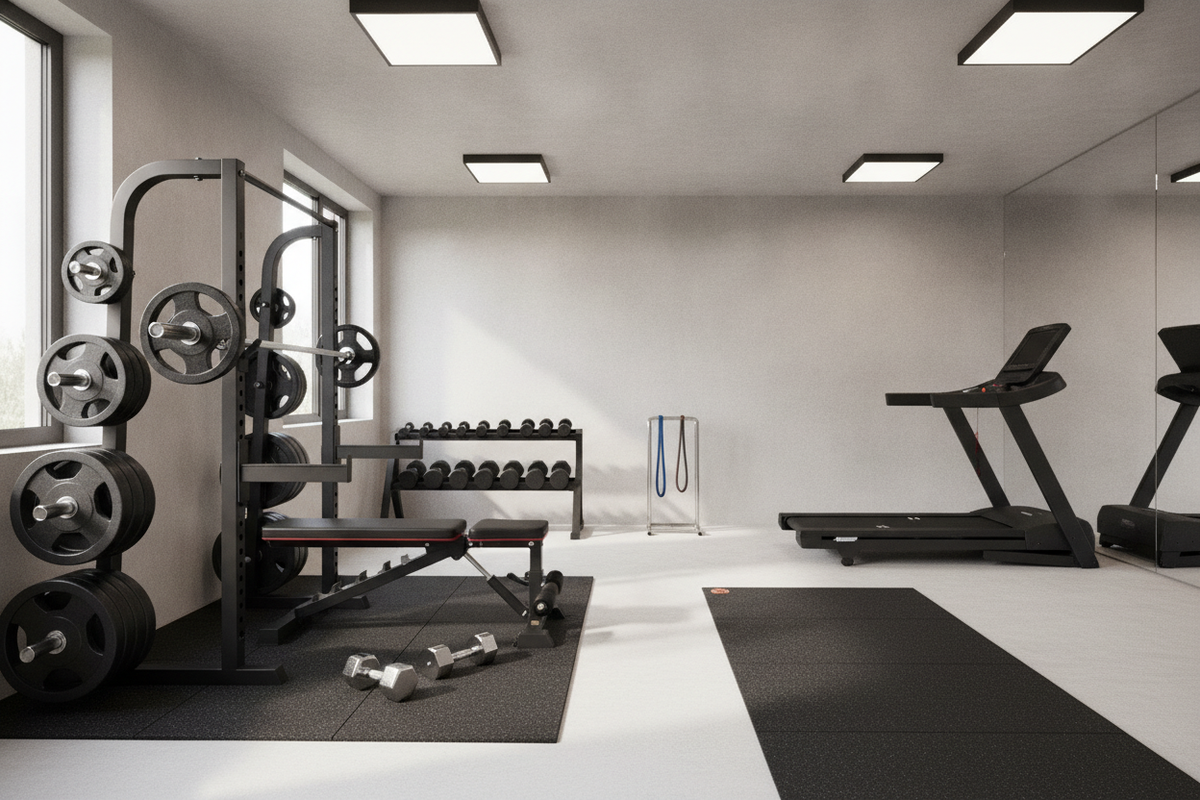
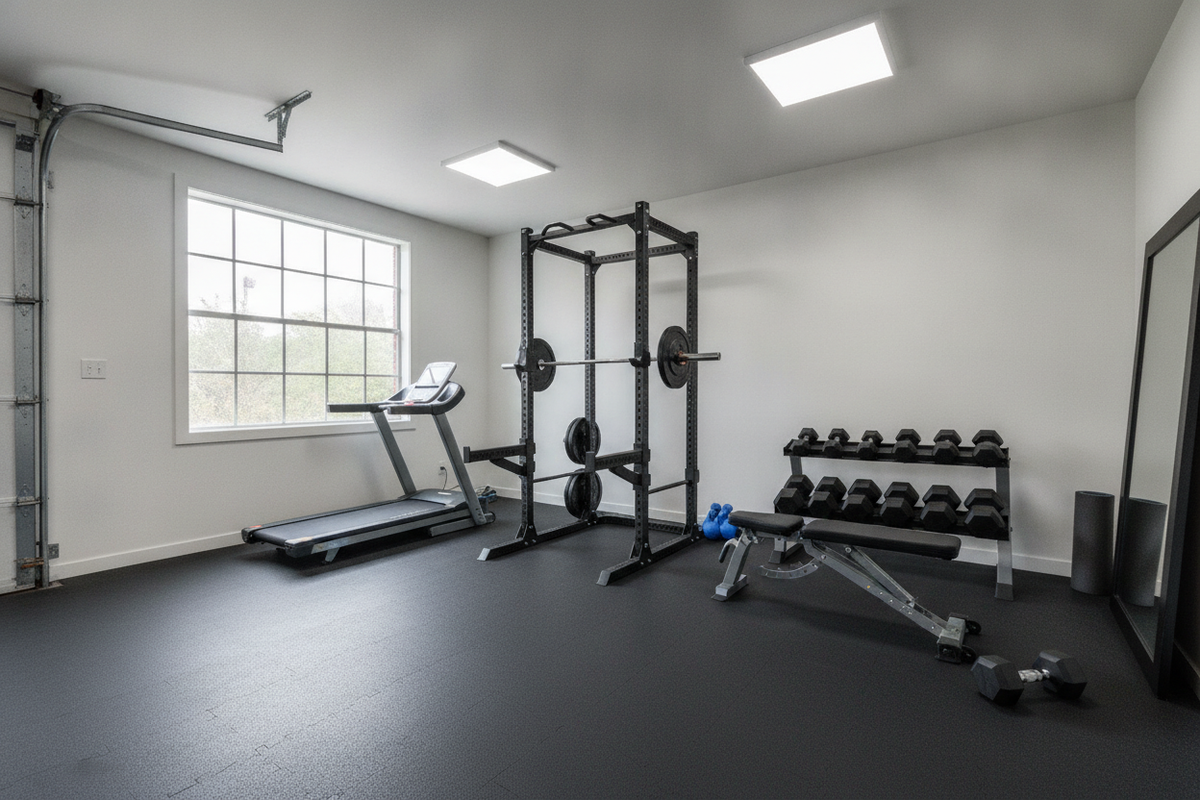
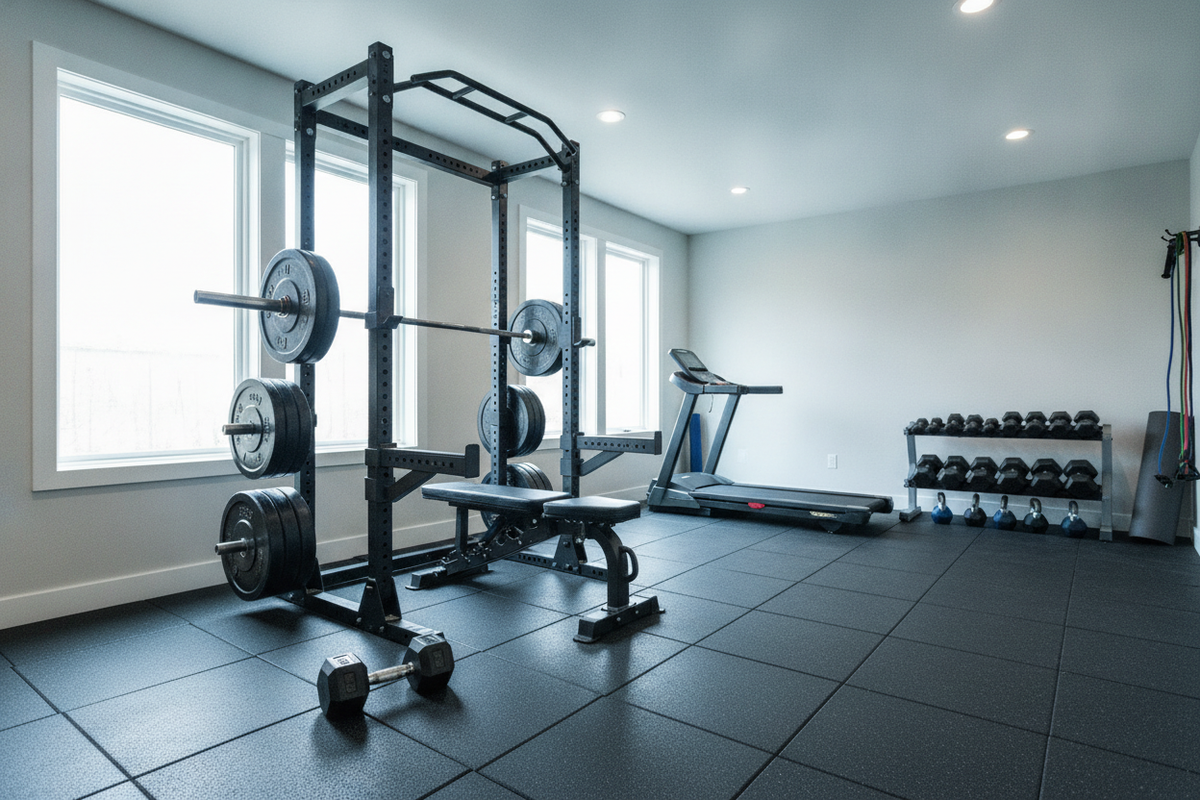
The physical floor under your feet serves as the foundation for every standing movement. Without proper floor staging, force transfer is compromised and equipment can become unstable. Dense rubber gym mats create an essential lifting platform that protects the subfloor, minimizes equipment slippage, and dampens vibration during heavy sessions.
Firm Base vs. Soft Matting for Heavy Lifts
A common mistake among home lifters is choosing overly soft foam mats. While soft matting may feel comfortable underfoot, it compresses unevenly under heavy loads, causing balance instability during heavy squats, overhead presses, and deadlifts. High-density vulcanized rubber or dense non-slip rubber rolls provide the firm, stable footing necessary for optimal ground-force transmission while resisting permanent indentation from benches and racks.
Equipment Flow and Clearance Zones
An efficient workout environment allows seamless movement between exercises without unnecessary clutter. Ensure adequate clearance around your barbell, power rack, and dumbbell racks so you can safely step back, set your stance, and re-rack weights without spatial hazards. Reviewing a streamlined home gym setup guide can help you design an organized, safe layout tailored to your training flow.
5. Prioritize Systematic Recovery and Fueling Frameworks
Workouts provide the stimulus for muscle adaptation, but actual muscle growth occurs during the recovery phase between sessions. Without adequate rest and nutritional support, the body cannot repair microtrauma sustained during resistance training.
- Sleep Consistency: Aim for restorative sleep schedules to support tissue repair and hormonal balance.
- Nutritional Support: Consume adequate protein distributed across balanced meals to support muscle protein synthesis, paired with sufficient carbohydrates to replenish muscle glycogen stores.
- Scheduled Deloads: Introduce periodic deload weeks with reduced volume or intensity every few weeks to dissipate systemic fatigue and keep connective tissues resilient.
6. Track Measurable Variables and Avoid Common Pitfalls
Consistency and data tracking are what separate long-term progress from stagnation. Keeping an accurate training log allows you to monitor load increases, rep improvements, and overall training density week over week. Without tracking, it is easy to succumb to program-hopping—switching routines every few weeks before meaningful adaptation can occur.
Stick with a structured training split for several consecutive weeks before making adjustments. When changes are warranted, adjust only one or two variables at a time, such as exercise selection or repetition ranges, so you can accurately identify what drives positive adaptations.
Conclusion: Building a Sustainable Physique from the Ground Up
Achieving meaningful bodybuilding results requires a grounded approach combining mechanical overload, precise movement execution, dedicated recovery, and an optimized training space. By treating every repetition with intent, maintaining a stable footing on high-density surfaces, and applying patience through systematic progression, you establish a solid framework for lifelong strength and physique development.