Your Resistance Exercise Machine Feels Like a Toy (Here's Why)
I’ve spent way too much time scrolling through equipment sites at 1 AM, comparing specs and trying to justify a new purchase. You buy a resistance exercise machine because you want the convenience of a commercial club without the $80 monthly membership or the guy hogging the cable tower for 45 minutes. But then it arrives, you pull the handle for the first time, and it feels... off. It’s jerky, it’s light, and it doesn't feel like you're actually fighting gravity.
There is a massive gap between what looks good in a glossy social media ad and what actually builds muscle in a garage. If your machine feels like it’s fighting you with friction rather than smooth weight, you’re not crazy. You’re just dealing with the physics of cheap engineering. Before you drop another dime, you need to know how to spot the difference between a real tool and a glorified toy.
- Consistency: Weight stacks provide steady tension; cheap bands get harder as they stretch.
- Friction: Plastic pulleys eat your gains by creating 'ghost resistance' that ruins your eccentric.
- Stability: If the machine weighs 50 lbs and you're pulling 60 lbs, someone's going for a ride.
- Progression: Tracking 'Level 3' on a dial is a nightmare compared to adding a 2.5-lb plate.
The Dirty Secret About Ultra-Compact Home Gyms
Most resistance gym machines marketed for small apartments are designed by furniture engineers, not strength coaches. To make a machine small enough to slide under a bed, they use tiny pulleys and thin, braided cables. The problem? Every time that cable turns a corner over a cheap plastic wheel, it creates friction. This is why the pull feels 'crunchy' or inconsistent.
When you’re doing a slow eccentric on a lat pulldown, you want the weight to pull you back up smoothly so you can control the muscle stretch. On a cheap setup, the friction holds the cable in place, so you lose that constant tension. You end up with a machine that is 30% friction and 70% actual work. That is a recipe for stalled progress and a lot of frustration in your home gym.
Weight Stacks vs. Tension Bands: A Brutal Breakdown
The mechanics of resistance training machines usually fall into two camps: gravity or elastic tension. Resistance machines that rely on bands or 'power rods' have a variable resistance curve. This means the start of the movement is easy, and the end is brutally hard. It sounds okay in theory, but it ruins your ability to fail at the right point in the lift because the tension is never constant.
If you compare these to heavy-duty weight lifting machines, the difference is night and day. A weight stack doesn't care how far you pull it; 100 lbs is 100 lbs from the bottom to the top. This constant load is what triggers hypertrophy. Most tension gym equipment feels like playing with a giant rubber band because, well, that is exactly what it is. You lose the most important part of the lift—the deep stretch—because the tension is almost zero at the beginning of the rep.
Why Plate-Loaded Gear Is Usually the Sweet Spot
If you want the feel of resistance machines in the gym without spending $3,000 on a selectorized stack, plate-loaded is the way to go. These weight resistance machines use your existing Olympic plates. Because they use actual iron and gravity, the resistance curve is predictable. You get that 'pro' feel for a fraction of the price, and you can micro-load with small change plates.
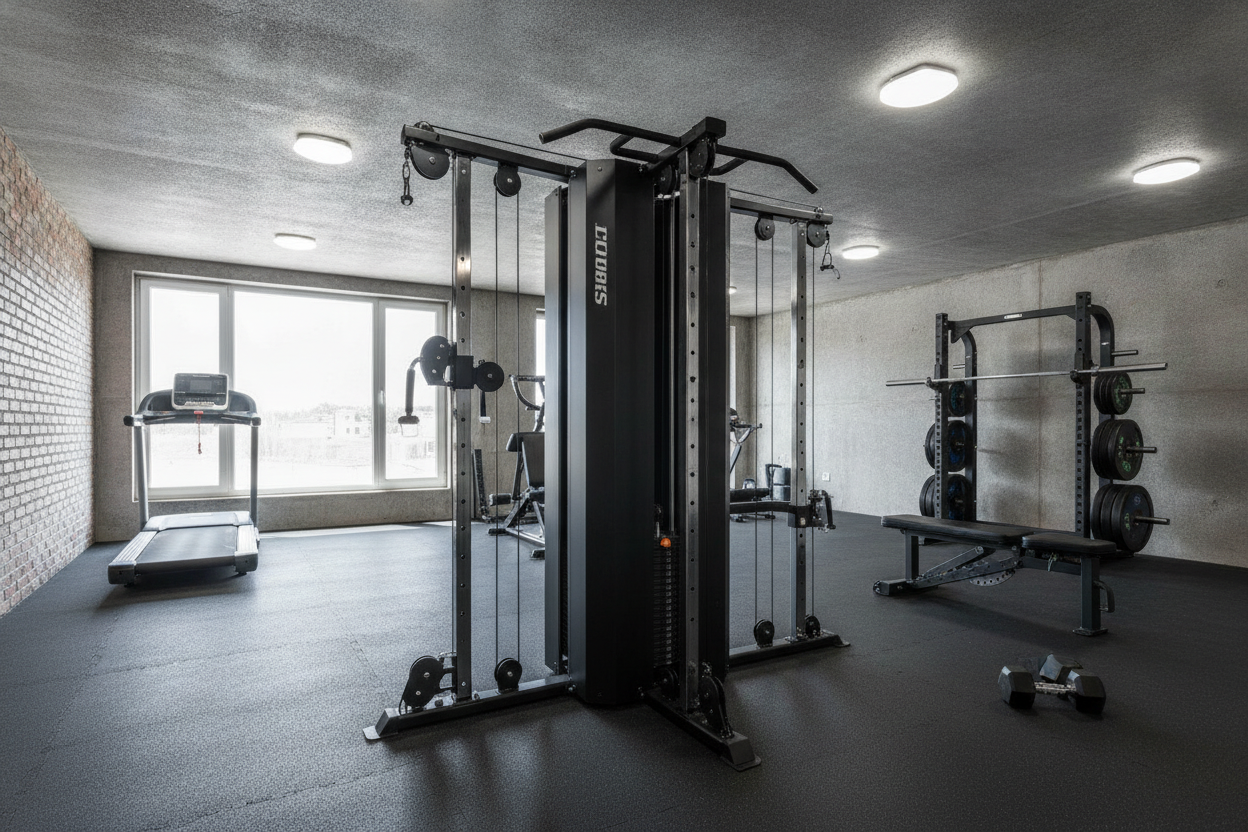
I always tell people that building the best home resistance gym doesn't mean buying the most expensive gear. It means buying gear that mimics the physics of a commercial club. A plate-loaded cable tower with 2-inch pegs and ball-bearing pulleys will outperform a high-tech 'smart' machine nine times out of ten. Plus, it won't have a software glitch in three years that turns it into a coat rack.
Stop Your Setup From Sliding Across the Room
Here is something the manual won't tell you: if your machine weighs 80 lbs and you try to row 100 lbs, you’re going to move, not the weight. Many gym resistance machines are too light for serious lifting. I’ve seen guys literally drag their cable towers across a garage floor during a heavy set of face pulls because the machine wasn't anchored.
If you can't bolt your rack to the studs, you need friction. Putting your gear on thick gym flooring for home workouts is the bare minimum. A high-density rubber mat creates enough grip to keep the base from walking away from you. For extra credit, I usually throw a couple of 45-lb sandbags or plates over the rear stabilizer bar to act as an anchor during heavy back days.
The Final Verdict: Do You Actually Need Cables?
Cables are great for isolation, but they aren't the foundation. Before you drop five bills on a dedicated cable setup, ask yourself if you’ve maxed out what a barbell can do. There are plenty of reasons why free weight resistance training often outperforms specialized machines, especially when it comes to stabilizer muscle recruitment and raw strength floor-to-ceiling.
If you’re tight on space, skip the all-in-one resistance exercise machine and get a solid pair of adjustable dumbbells. But if you have the room and you crave that smooth cable pump, don't settle for the cheap stuff. Look for 11-gauge steel, aluminum pulleys, and a 2:1 ratio for the best experience. Your gains will thank you for not buying a toy.
My Honest Mistake
A few years ago, I bought a 'silent' magnetic resistance rower from a budget brand. It looked great in the photos. In reality, the 'resistance' felt like pulling a string through a bowl of oatmeal. There was no 'catch,' no power, and the seat felt like it was made of cardboard. I ended up selling it for half what I paid two months later. I learned my lesson: if the machine weighs less than the person using it, it’s probably not going to survive a real workout.
FAQ
Are cable machines better than dumbbells?
They aren't better, just different. Cables provide constant tension throughout the range of motion, whereas dumbbells lose tension at the top of certain movements like chest flies or lateral raises.
What is a 2:1 pulley ratio?
It means if you have 100 lbs on the stack, it feels like 50 lbs at the handle, but you get twice as much cable travel. This is ideal for functional movements because it’s smoother and faster.
How do I maintain my resistance machine?
Wipe down the guide rods with a silicone-based lubricant every few months. Never use WD-40; it attracts dust and will turn your smooth pull into a sticky mess that ruins the bushings.