
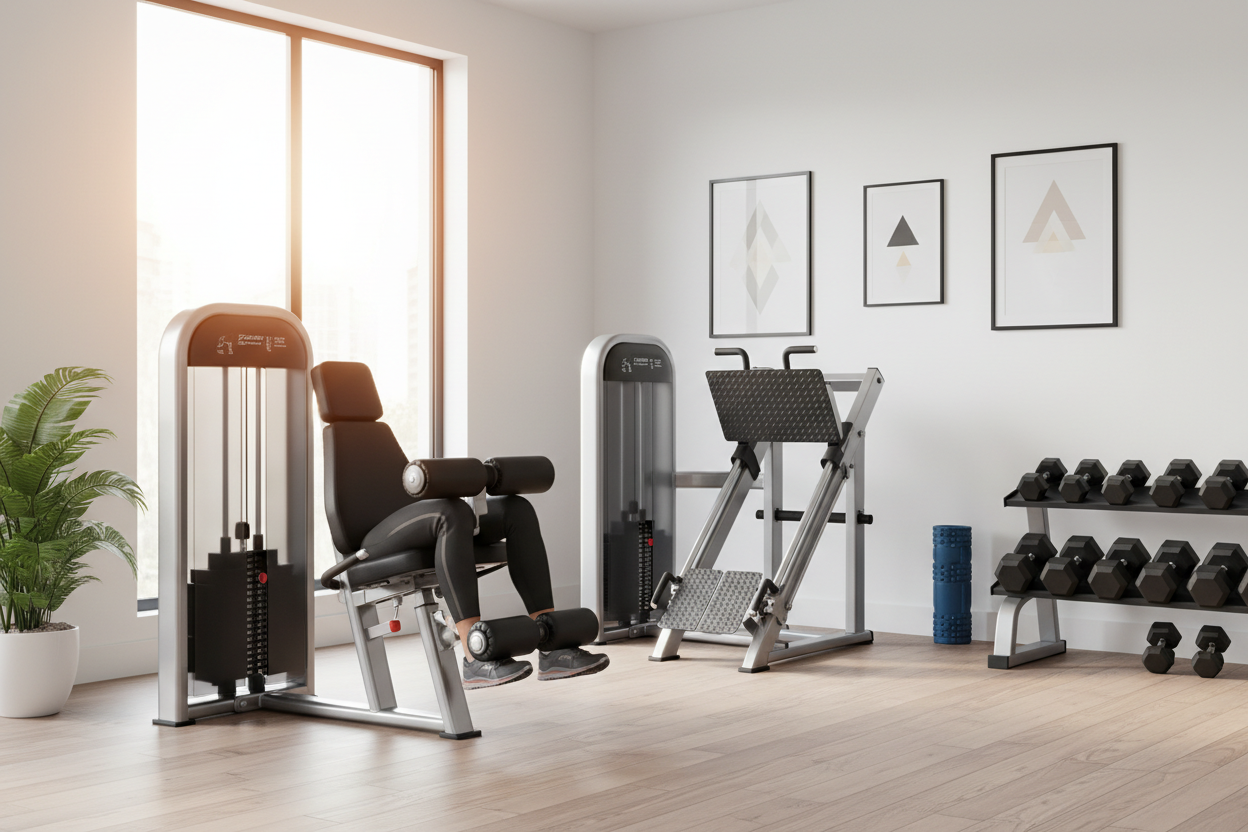
Why Your Home Gym Needs a Dedicated Leg Trainer (And How to Actually Use It)
A leg trainer is a specialized piece of fitness equipment designed to target the lower body muscles—specifically the quadriceps, hamstrings, glutes, and often the neglected adductors (inner thighs)—through guided, low-impact motion. Unlike free weights, these devices provide stability and consistent resistance, making them ideal for isolating specific muscle groups, rehabilitating injuries, or adding volume to a workout without stressing the lower back. While squats and lunges are foundational, a dedicated machine allows you to hit angles and stabilizers that standard compound movements often miss.
Building a complete lower body routine requires more than just moving heavy weight from point A to point B. It involves targeting the supportive muscles that protect your knees and hips. Many people ignore these smaller muscle groups until an injury forces them to pay attention. Incorporating specific apparatuses into your regimen fills these gaps, ensuring your legs are functional, not just strong in a single plane of motion.
My Wake-Up Call With Lateral Movement
I used to be a purist. If it wasn't a barbell squat or a deadlift, I didn't think it counted. That mindset worked fine until I tweaked my hip flexor during a heavy lift. My physical therapist pointed out that while my prime movers (quads and glutes) were strong, my stabilizers—specifically my inner and outer thighs—were practically asleep. I had zero lateral stability.
I picked up a compact lateral leg trainer, the kind where you stand on footplates and glide outward and inward. I honestly thought it would be too easy. I was wrong. After three minutes of continuous tension, my legs were shaking in a way they never did after a set of squats. The machine forced me to control the movement without momentum, isolating the adductors and abductors. That experience shifted my perspective: heavy lifting builds mass, but these targeted trainers build the bulletproof durability required to handle that mass.
Understanding the Mechanics of Leg Trainers
The term "leg trainer" covers a few different types of equipment, but they generally share a common goal: low-impact isolation. The most popular variation for home use is the lateral glide machine. These devices operate on a rail system. You place your feet on the pedals and use your own body weight as resistance to slide your legs apart and squeeze them back together.
This movement pattern is distinct because it works in the frontal plane (side-to-side). Most of our daily life and standard gym exercises occur in the sagittal plane (forward and backward). By neglecting the frontal plane, we invite imbalances. A lateral trainer targets the gluteus medius and the adductor complex. Strengthening these areas keeps your knees from caving inward during squats and running, a common mechanical fault that leads to chronic pain.
Other variations include compact steppers and seated resistance devices. While steppers focus more on the posterior chain and cardio endurance, seated devices are excellent for those with limited mobility or balance issues, allowing for muscle activation without the risk of falling.
Integration Into a Broader Routine
You shouldn't view this equipment as a replacement for your entire leg day, but rather as a high-value accessory or a finisher. If you rely solely on a glide machine, you might miss out on the bone-density benefits of axial loading (weight on the spine/hips). The magic happens when you combine methods.
The Pre-Exhaust Method
Try using the leg trainer at the very start of your workout. Doing 5 to 10 minutes of moderate-intensity gliding warms up the hip synovial fluid and activates the glutes. When you move on to your heavier compound lifts, your mind-muscle connection is already primed, leading to better form and safer lifting.
The Burnout Finisher
Alternatively, save it for the end. After you have exhausted your legs with lunges or goblet squats, jump on the trainer. Because these machines usually rely on body weight or elastic resistance, the risk of injury is low even when you are fatigued. Aim for high repetitions or timed intervals—like 45 seconds of work followed by 15 seconds of rest—to flush the muscles with blood and trigger metabolic stress, which is a key driver for muscle growth.
Common Mistakes That Kill Progress
People often turn these machines into coat racks because they don't see results, usually due to user error. The most frequent issue is relying on momentum. On a lateral trainer, it is easy to swing your body to generate force. This removes the tension from the muscles you are trying to work. Keep your upper body still. Engage your core. The only thing moving should be your legs.
Another error is poor posture. Leaning too far forward puts unnecessary strain on the lower back. Stand tall, keep your chest up, and maintain a soft bend in the knees. Locking your knees out at any point during the movement transfers the load from the muscle to the joint, which is exactly what we want to avoid.
Space and Practicality in Home Gyms
One of the biggest selling points of a dedicated leg trainer is the footprint. Power racks and leg press machines consume massive amounts of floor space. Most rail-style trainers or steppers fold up and slide under a bed or into a closet. For apartment dwellers or those with multi-use spaces, this accessibility removes the friction of starting a workout. If the equipment is easy to set up, you are infinitely more likely to use it.
Durability is a factor to consider. Look for steel frame construction rather than plastic. Since you are putting your full body weight on the device, stability is non-negotiable. A wobbly machine triggers a fear response in the brain, which subconsciously limits how hard you push your muscles.
Maximizing the Adductor Connection
The inner thigh is notoriously difficult to target. Wide-stance squats help, but they still heavily recruit the quads and glutes. A rail-based leg trainer is one of the few tools that allows for direct adductor isolation. Why does this matter? Strong adductors act as a second anchor for your pelvis. They assist in hip flexion and extension.
If you are a runner, strong adductors help stabilize your stride. If you play sports involving lateral cuts, like tennis or basketball, they prevent groin strains. Using a trainer to focus specifically on the inward squeeze (adduction) can correct pelvic tilt issues and alleviate certain types of lower back pain caused by muscular imbalances.
Programming Your Sessions
To get the most out of your leg trainer, stop treating it like a cardio machine and start treating it like a strength tool. Slow down the tempo. Take three seconds to slide out, pause for one second at the widest point, and take three seconds to bring your legs back together. This time-under-tension approach recruits more muscle fibers than frantically sliding back and forth.
Consider a circuit format. Perform one minute on the leg trainer, immediately followed by 20 bodyweight squats, then a 30-second plank. Repeat this cycle four or five times. This keeps your heart rate elevated while torching the lower body from multiple angles. It turns a simple piece of equipment into the centerpiece of a high-intensity interval training session.
FAQ
Can I build significant muscle mass using only a home leg trainer?
You can build muscle tone and endurance, but significant mass (hypertrophy) generally requires progressive overload with heavy weights. A home leg trainer is excellent for definition, stability, and conditioning, but for substantial size, you should combine it with weighted exercises like squats or lunges.
Is a lateral leg trainer safe for bad knees?
Generally, yes, because these machines are low-impact and do not involve the pounding force of running or the shearing force of heavy extensions. However, because they involve lateral movement, start with a small range of motion to ensure your collateral ligaments are comfortable before going full width.
How often should I use my leg trainer?
Since these devices usually rely on body weight and lower resistance, you can use them more frequently than heavy weights. 3 to 4 times a week is a good baseline. If you are using it for light active recovery or mobility, you can even use it daily for shorter durations.

...)