Why I Only Stretch to Improve Flexibility on My Rest Days
I spent years treating my post-workout cool-down like a competitive event. After grinding through heavy triples on the deadlift platform, I’d spend twenty minutes aggressively yanking on my hamstrings, convinced that more intensity equaled more range of motion. Instead of getting loose, I woke up every morning feeling like a rusted hinge. I finally realized that my body wasn't tight because I wasn't trying hard enough; it was tight because I was trying too hard to stretch to improve flexibility when my nervous system was already fried.
- Treat stretching like recovery, not a workout.
- Avoid the 'stretch reflex' by backing off the intensity to about 40%.
- Use rest days to tap into your parasympathetic nervous system.
- Invest in a thick mat so you don't rush the hold because your knees hurt.
The 'More Pain, More Gain' Myth in Mobility
When you grit your teeth and force a deep stretch, your muscle spindles—tiny sensory receptors—detect the rapid tension and send a signal to the brain to contract the muscle. It’s a survival mechanism designed to prevent tears. If you’re shaking and sweating while trying to improve flexibility stretches, you’ve already lost. Your brain is literally fighting the stretch to protect you.
Effective stretching techniques for flexibility require a physiological 'buy-in' from your nervous system. You need to breathe through your nose and convince your body that it’s safe to let go. I used to think a stretch didn't count unless it was a 9 out of 10 on the pain scale. Now, I aim for a 4. It feels almost too easy, but the results in my hip hinge range have been night and day compared to the old 'yank and pray' method.
Why I Moved My Mobility Work to Rest Days
Trying to hammer out a session of stretching for increased flexibility right after a heavy squat day is a recipe for frustration. Your tissues are already inflamed, full of micro-tears, and your central nervous system is on high alert. I found that yanking on my upper body after heavy presses just aggravated my joints. Sometimes you need to relieve tense shoulders for good by simply letting them rest rather than forcing them into extreme end-ranges while they're still recovering.
By moving my mobility work to my Sunday rest day, I’m in a completely different headspace. I’m not rushed to get out of the gym. I’m usually on the floor in my living room, the house is quiet, and my heart rate is low. This 'chill' environment is the secret sauce. You can’t force a muscle to relax when your adrenaline is still spiking from a 400-pound pull. Separating the two allows my training to be high-intensity and my recovery to be high-quality.
My 3-Move Rest Day Protocol
I don't do a 45-minute yoga flow. I do three specific moves that target my biggest sticking points—hips, ankles, and thoracic spine—usually while I'm catching up on a podcast. The goal is long, passive holds where gravity does 90% of the work.
The Couch Stretch (But Actually Comfortable)
The standard couch stretch—shin flat against the wall, knee in the corner—is a brutal quad killer. Most people do it with a rounded back and a grimace. To make it effective, I pull my knee six inches away from the wall and use a thick foam pad. This allows me to tuck my pelvis and actually feel the hip flexor release without my kneecap screaming. It’s a world of difference from the active drills you’d use to prime your legs for peak performance before a squat session.
The Supported Deep Squat
Instead of free-standing, I grab the upright of my power rack or even a heavy table leg. I sit into the deepest squat I can manage and just hang out there. By holding onto something, I can keep my torso upright and shift my weight into my hips without my lower back rounding or my shins fatiguing. I’ll stay here for two minutes, gently rocking side to side to hunt for tight corners in my ankles.
The Lazy Brettzel
The Brettzel is the king of full-body rotational stretches, but I do the 'lazy' version. I lie on my side, pin my top knee to the floor with my bottom hand, and reach back with my top hand. I don't force my shoulder to the floor. Instead, I focus on how to improve stretching by using my breath. Every time I exhale, I let my ribcage heavy-up and sink an eighth of an inch closer to the ground. It’s about patience, not torque.
Setting Up Your Living Room for Success
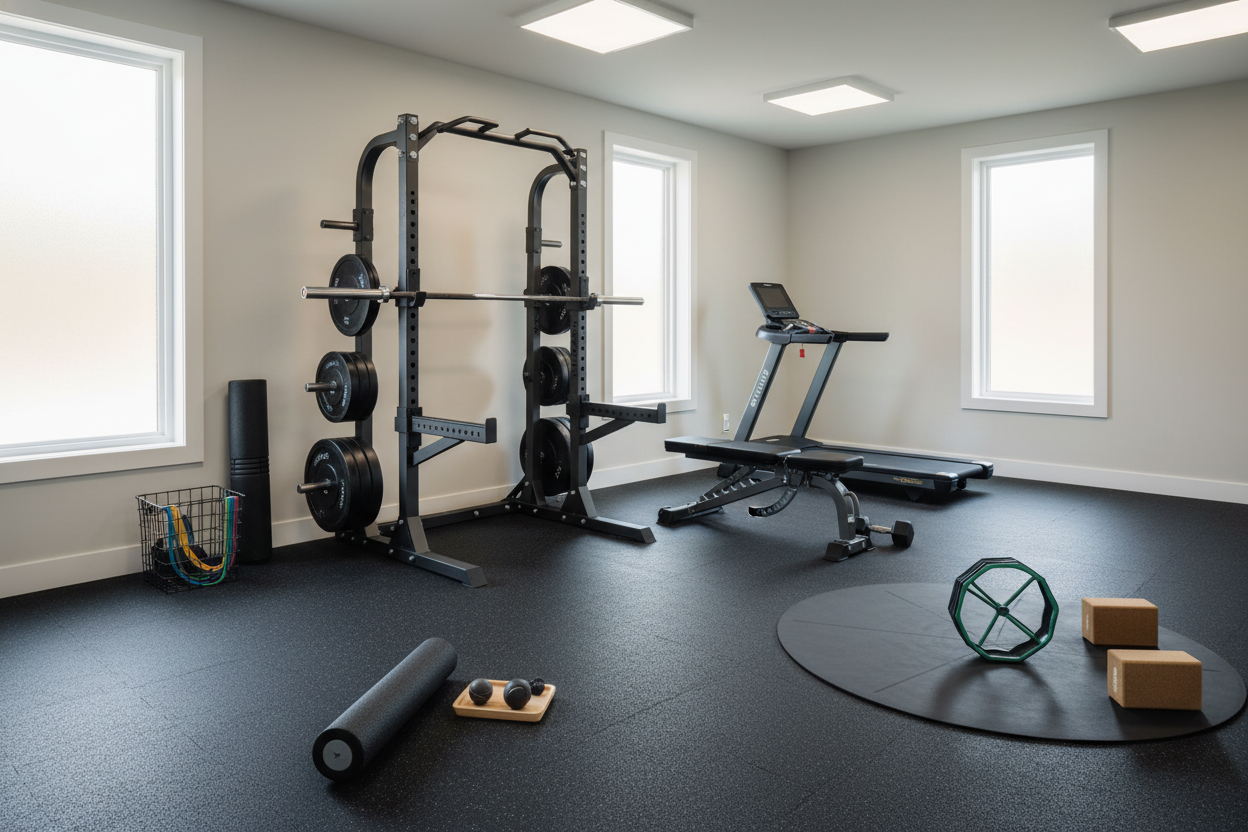
If you’re trying to do this on a thin, 5mm yoga mat on top of a hardwood floor, you’re going to quit after thirty seconds. Your joints need padding to relax. I eventually got tired of my knees bruising and laid down a dedicated gym flooring for home workout in my living room corner. Having that 7mm or 10mm of high-density foam makes a massive difference when you’re trying to sink into a deep pigeon stretch for three minutes.
The real secret to consistently using stretching to improve flexibility isn't some fancy strap or a vibrating foam roller. It’s making the process something you don’t hate. When you stop viewing mobility as a chore and start viewing it as a low-stakes recovery session on your day off, you’ll actually stick to it. And consistency is the only thing that actually moves the needle on range of motion.
FAQ
How long should I hold a rest-day stretch?
Aim for at least 90 seconds to two minutes. It takes about a minute for your nervous system to realize you aren't in danger and finally allow the muscle to relax into the new range.
Should I stretch if I'm extremely sore?
If you have DOMS, keep it very light. Aggressive stretching on highly damaged muscle fibers can actually slow down recovery. Think of it as 'active blood flow' rather than trying to set a flexibility PR.
Do I need to warm up before rest-day stretching?
Not necessarily, but it helps. I usually do my mobility after a hot shower or five minutes of easy movement. Cold muscles are less pliable, but as long as you aren't being ballistic, you'll be fine.