What Nobody Tells You When You Learn How to Lift Weights Alone
You are standing in your garage, staring at a cold piece of knurled steel, and wondering if your lower back is about to become a liability. We have all been there. Whether you are tired of the local commercial gym’s rising fees or just sick of waiting for a rack, the decision to learn how to lift weights in your own space is the best move you will ever make. But it is also the most intimidating.
The internet is flooded with 'perfect' form videos that make you feel like you need a PhD in biomechanics just to pick up a kettlebell. I have spent a decade loading bars, dropping plates, and occasionally failing a rep in total silence. Here is the reality of how to learn to lift weights when there is no one there to spot you but your own reflection.
Quick Takeaways
- Textbook form is a myth; focus on 'safe enough' and repeatable movement.
- Dumbbells are better than barbells for the first 30 days of solo training.
- Bumper plates are essential for beginners because they keep the bar at the correct height.
- Safety is about knowing when to stop a rep, not just having a cage.
The 'Textbook Form' Trap That Keeps You Weak
Stop trying to look like a fitness influencer with a 3D overlay on their spine. When you learn to lift, obsessing over every millimeter of hip hinge will lead to 'paralysis by analysis.' You will spend twenty minutes filming your set and zero minutes actually getting stronger.
Real lifting is messy. Your knees might wobble slightly. Your back might not be a perfectly straight line. The goal when you learn to lift weights alone is to find a movement pattern that feels stable and doesn't cause sharp pain. If it feels 'tight' and controlled, you are doing it right. The 'perfect' form will come after you have done 1,000 reps, not before the first 10.
Forget the Barbell at First (Seriously, Grab a Dumbbell)
Everyone wants to jump straight to the 45-pound Olympic bar. Don't. A barbell locks your hands and shoulders into a fixed plane. If you have mobility issues you don't know about yet, the bar will find them—and it will hurt. Starting with dumbbells allows your joints to find their own natural path.
I always tell people to start with seated or supported movements. Grab a solid adjustable weight bench and master the seated overhead press and the chest-supported row. This removes the 'balance' variable so you can actually focus on the muscle working. Once you can handle 30-pound dumbbells with total control, then you earn the right to touch the big bar.
The Iron Math: Starting Light Without the Ego
The hardest part of training alone is the 'ego check.' In a public gym, you might overreach to look cool. In a home gym, you might overreach because you don't realize how heavy 135 pounds actually feels when you're tired. To learn to lift weights safely, you have to embrace the empty bar.
The problem is that standard iron plates are small. If you put 10-pound iron plates on a bar, the bar sits three inches off the floor, ruining your deadlift setup. This is why I swear by bumper plate sets. Even at 10 or 15 pounds, these plates have the full 450mm diameter. This keeps the bar at the standard height, allowing you to practice proper mechanics without hunching over like a gargoyle.
Why Free Weights Teach You More Than the Pegs
Commercial weight lifting machines are great for bodybuilders, but they are terrible teachers. A machine balances the weight for you. If you only use machines, you never develop the tiny stabilizer muscles in your core and shoulders that prevent injury in the real world.
When you are training in a garage, the 'wobble' is your best friend. That slight shake you feel during a goblet squat is your nervous system learning how to stabilize your frame. You cannot buy that kind of feedback from a machine. Free weights force you to be the architect of the movement, not just the engine.
The 'Ugly Rep' Threshold: Knowing When to Stop
When you are alone, you are the coach and the athlete. You have to develop a 'technical max'—the heaviest weight you can move before your form goes from 'challenging' to 'dangerous.' If you have to hitch, grind, or round your shoulders to finish a rep, the set is over. No exceptions.
Learning how to lift a heavy weight isn't about moving the most iron possible; it's about moving the most iron with integrity. If the bar speed slows down significantly or you start 'yanking' to get momentum, you've hit your threshold. Put it down. Live to lift tomorrow.
Keep the Mess Organized Before You Trip
Spatial awareness is a safety skill. I’ve seen more people get hurt tripping over a stray 5-pound plate than failing a heavy squat. When you're gassed after a hard set, your coordination drops. If your floor is a minefield of iron, you're asking for a rolled ankle.
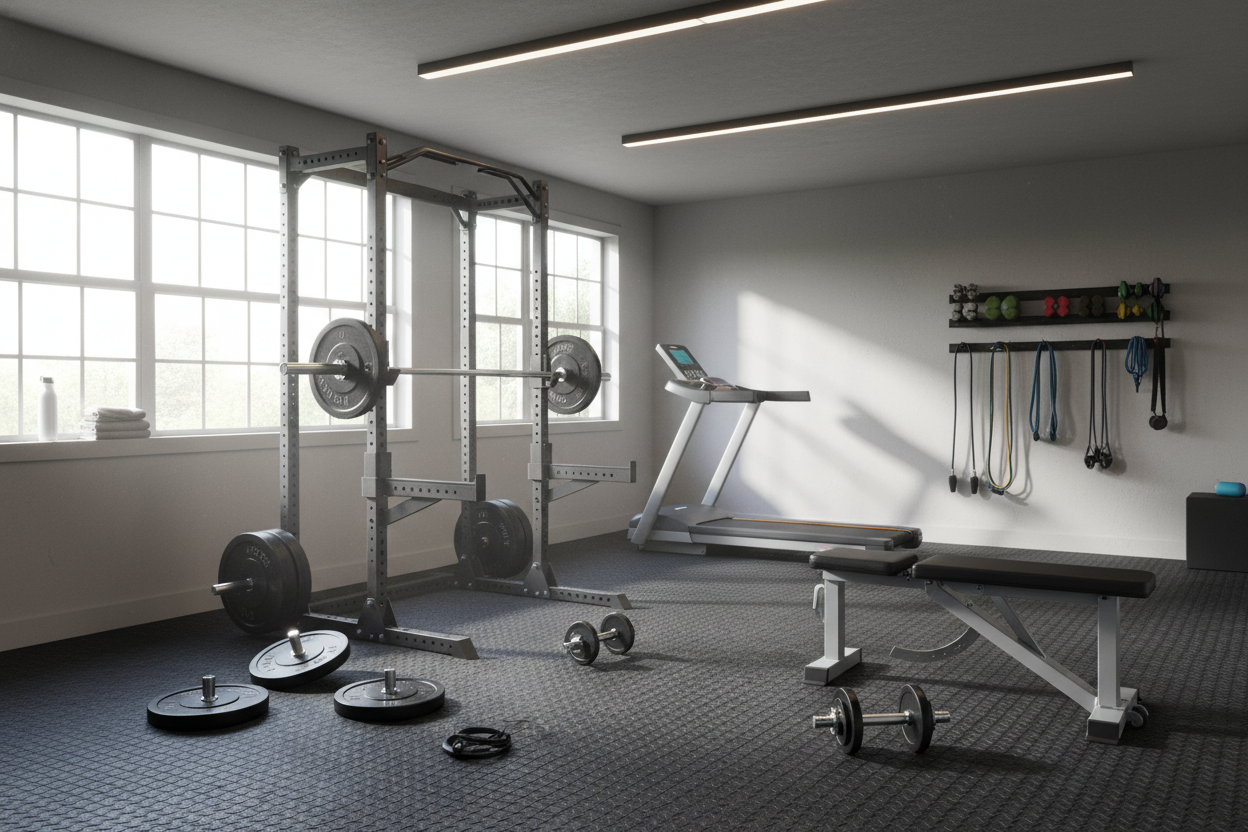
Invest in the right storage for your weights early on. Whether it's a vertical plate tree or a wall-mounted rack, keep the floor clear. A clean lifting deck is a safe lifting deck.
Personal Experience: The Roll of Shame
Years ago, I was benching alone in my basement. I thought I had one more rep in me. I didn't. The bar pinned me to the bench. I had to perform the 'roll of shame,' rolling 185 pounds of cold steel down my ribcage and stomach until I could sit up. It was painful, embarrassing, and entirely avoidable. I didn't have my safety bars set at the right height because I was 'sure' I wouldn't fail. Now? I test my safeties before every single heavy session. Don't let your ego write checks your safety gear can't cash.
FAQ
Do I need a squat rack to start?
Not on day one. You can do goblet squats, lunges, and dumbbell presses with just a bench and some weights. But once you want to move over 100 pounds, a rack with safety arms becomes mandatory for solo lifters.
How many days a week should I lift?
Start with three days. Your central nervous system needs time to adapt to the new stress. Lifting every day as a beginner is a fast track to burnout and tendonitis.
Is it safe to deadlift alone?
Yes, because the floor is your spotter. If the weight is too heavy, you just let go. Unlike the bench press or squat, you aren't under the bar, making it one of the safest movements to learn solo.