Strength Training and Muscle Building: Hypertrophy Dynamics, Loading Strategies, and Home Floor Staging
Strength Training and Muscle Building: Unpacking the Shared Foundation
Pursuing athletic development often leads lifters to question the relationship between strength training and muscle building. While often discussed as distinct goals, these two training adaptations share a common biological catalyst: mechanical tension. When a muscle contracts against resistance, the resulting tension signals internal pathways to fortify tissues and recruit motor units. The primary distinction lies in how the body adapts to differing forms of physical stress. Pure force production relies heavily on the nervous system learning to coordinate motor units rapidly, whereas structural growth involves enlarging muscle fibers to increase overall cross-sectional area.
Understanding building muscle mass vs strength requires moving past the idea that they are mutually exclusive. A larger muscle possesses greater mechanical potential to generate force, and a stronger muscular foundation allows an athlete to handle heavier loads during higher-volume sessions. Deciding whether to build muscle or strength first depends on movement quality, lifting background, and short-term athletic objectives. By addressing both neural adaptation and tissue development, home gym lifters can establish balanced, sustainable routines.
Building Muscle vs Strength: Divergent Mechanics and Training Stimuli
When comparing building muscle vs strength, programming shifts reflect the specific adaptations being targeted. Maximal strength training focuses on neurological efficiency. Lifting near-limit resistance teaches the brain to recruit high-threshold motor units simultaneously, demanding significant systemic recovery and extended rest between sets. In contrast, muscle gain vs strength adaptations focus on accumulating work and maintaining continuous tension across working muscle groups. Hypertrophy protocols often incorporate shorter recovery windows, localized muscular fatigue, and diverse movement variations that stress muscle fibers through varying ranges of motion.
These programmatic variations influence movement selection. Multi-joint compound barbell lifts—such as squats, deadlifts, overhead presses, and bench presses—remain standard choices for displaying force. For pure hypertrophy, those same compound movements can be paired with controlled tempo work or targeted accessory exercises to isolate specific muscle groups. Lifters exploring targeted volume strategies can reference this build size mass guide to examine how focused movement selection creates concentrated tissue stress. Prioritizing gaining muscle vs strength ultimately involves balancing total volume density with neural freshness, ensuring joints and connective tissues tolerate the chosen training loads.
Reps for Size vs Strength: Frameworks for Home Programming
The question of reps for size vs strength has historically produced rigid training rules, yet modern program architecture treats these ranges as fluid spectrums. Lower repetition efforts with higher resistance predominantly challenge neural output and technical bracing under load. Moderate to higher repetition sets emphasize metabolic accumulation, sustained tension, and full motor pool exhaustion. Because both approaches stimulate adaptations, lifters often achieve consistent results by blending rep ranges across distinct training blocks or within individual sessions.
A practical method for navigating build strength vs muscle is the concurrent model. Lifters begin a workout with a primary compound lift performed for low repetitions with extended rest intervals to develop coordination and force production. The secondary portion of the session transitions toward higher repetition ranges, controlled eccentric phases, and accessory movements to accumulate productive training volume. Incorporating versatile implements from a dedicated strength training collection allows home lifters to vary resistance profiles, shift grip angles, and target secondary muscle groups without requiring massive equipment footprints. Modulating cadence, accentuating the lowering phase, and avoiding technical breakdown remain central to balancing muscles vs strength.
Floor Staging and Subfloor Protection for Heavy Force vs High-Volume Lifts
Translating programming concepts into a home environment requires close attention to the training foundation. Ground-reaction forces differ markedly between high-load strength attempts and dynamic, high-volume hypertrophy circuits. Heavy compound lifts transmit significant downward force directly through the feet into the floor. In my editorial evaluations of home training layouts, structural stability always begins with what sits beneath the lifter's footwear. Soft, compressible surfaces introduce instability during axial loading, which can lead to balance shifts during deep squats or heavy pulls.
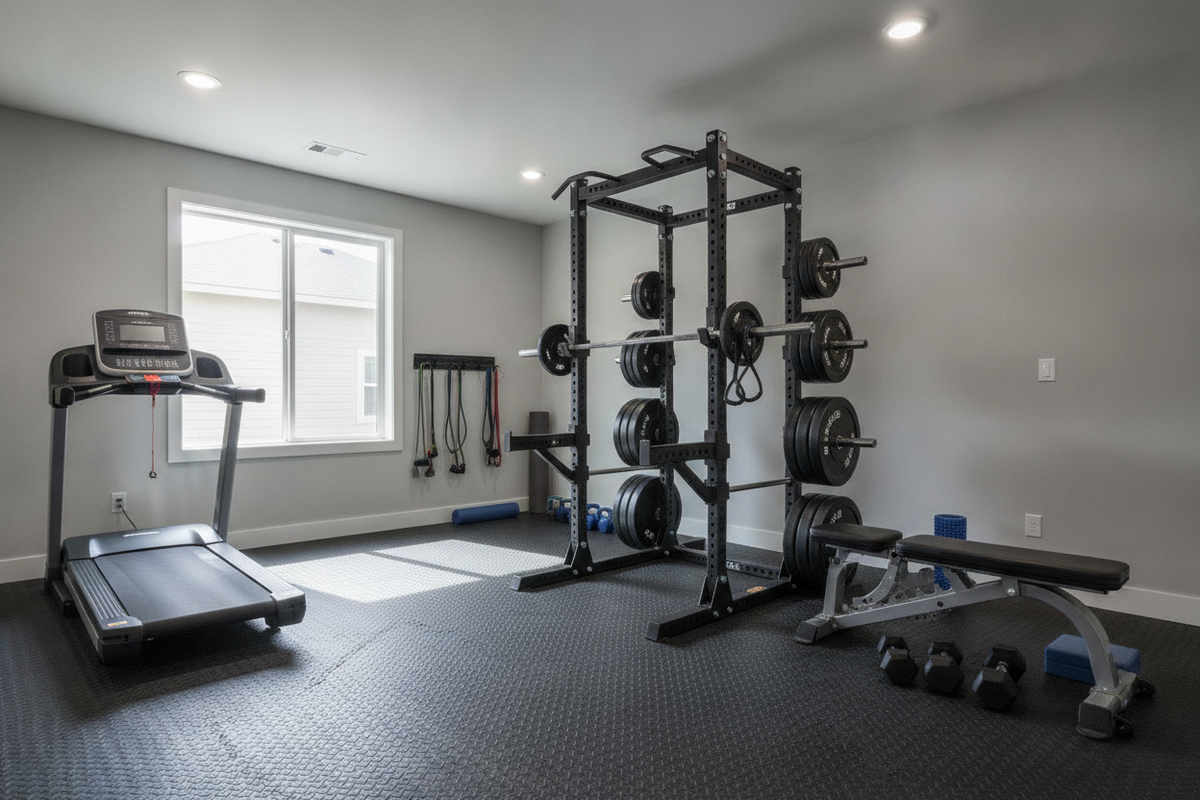
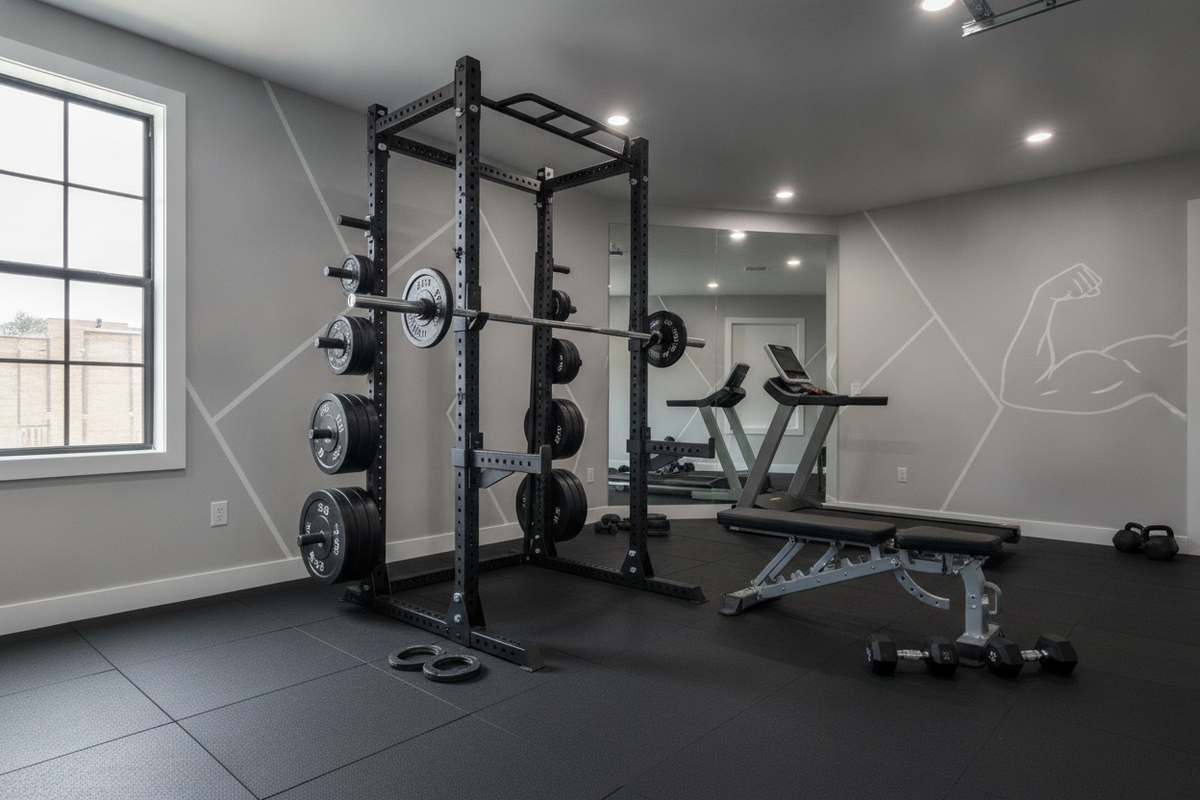
High-density rubber matting creates a non-compressible, firm platform that eliminates surface squish while safeguarding underlying concrete or wood subfloors. Dropping or lowering heavy iron generates localized impact energy that can crack bare residential slabs or compress subfloor framing over time. Staging thick, dense protective flooring creates a resilient buffer against plate contact, dumbbell drops, and the static pressure exerted by heavy rack uprights. Lifters building out their training space can consult this build strength training guide to understand how foundational flooring fits into functional room planning.
Equipment Layout and Movement Zoning: Balancing Compound Stations and Isolation Spaces
An efficient home training space balances dedicated stations for heavy lifting with open floor areas for accessory and conditioning work. When staging equipment for muscle gain vs strength gain, separating the training area into clear zones optimizes both safety and workflow:
- Primary Lifting Platform: Center the power rack or squat stand on a broad section of flat, dense rubber flooring. This zone must provide ample clearance for barbell path trajectories and walkout steps during squats, bench presses, and overhead lifts.
- Free-Weight Accessory Zone: Reserve an adjacent perimeter area for dumbbell work, kettlebells, and adjustable benches. Ensure this space provides unobstructed footpaths to weight storage trees to keep the floor clear of loose plates.
- High-Volume and Mobility Space: Maintain an open floor section lined with non-slip mats for warm-ups, bodyweight movements, core work, and tempo-focused accessory exercises.
Organizing equipment according to movement patterns prevents spatial bottlenecks and helps lifters maintain set pacing. Lifters outfitting their training zones can explore this building muscle training guide for recommendations on selecting versatile, space-conscious equipment suited for home environments.
Mat Selection, Maintenance, and Surface Grip Across Diverse Modalities
Surface traction plays a central role when executing heavy compound lifts and high-rep sets. Wide-stance squats and sumo pulls generate lateral shear forces, requiring a textured, slip-resistant mat surface that grips both athletic shoe outsoles and the subfloor underneath. For horizontal bench pressing, lifters rely on firm footing to maintain leg drive and spinal stability without their feet sliding across smooth finishes.
Selecting flooring that accommodates heavy free weights as well as specialized apparatus—such as items from a lower-body strength collection—demands materials that withstand static indentation without warping or tearing. Routine maintenance keeps these surfaces functional and clean. Over time, sweat, lifting chalk, and airborne dust can settle into mat textures, reducing surface grip. Regular vacuuming and light mopping with mild, non-corrosive cleansers protect the rubber from degradation while preserving the tactile traction needed for safe, stable foot placement.
Creating an Integrated Strategy: Should You Build Muscle or Strength First?
Deciding between strength or muscle as a primary training objective rarely requires choosing one exclusively. Beginners and intermediate lifters typically experience simultaneous progress in both areas, as technical proficiency and initial muscular adaptations develop together. Advanced lifters often find success by alternating emphasis: dedicating focused multi-week cycles to hypertrophy to build physical work capacity and muscle volume, followed by strength-focused blocks that condition the central nervous system to handle heavier loads.
Regardless of which adaptation takes priority in a given training cycle, physical staging remains essential. A well-organized layout featuring high-density rubber matting, clear movement lanes, and durable equipment creates a controlled space for both high-effort singles and high-volume burnouts. By aligning thoughtful program design with a resilient lifting foundation, home gym athletes can pursue strength and hypertrophy side by side for years to come.