How to Build on Strength: Movement Progression, Weak-Point Reinforcement, and Home Floor Staging
Introduction: Understanding How to Build on Strength
To build on strength is to treat physical development as an iterative architectural project. Rather than overhauling your lifting routine with every new trend, sustainable development relies on identifying your most consistent movement patterns and using them as anchors for progressive overload. Strength does not exist in isolation; it depends on technical proficiency, supportive accessory volume, and the physical environment in which you train.
For home gym athletes, the room itself serves as the foundation for this progress. A dependable training space requires stable footing, thoughtful layout design, and surface protection capable of handling repeated loading. When you pair disciplined movement selection with a well-staged training environment, you create conditions that allow your capabilities to compound over time.
Core Movement Architecture: Capitalizing on Primary Lifting Patterns
Every effective lifting program is anchored by multi-joint compound movements: the squat, hinge, horizontal press, overhead press, row, and pull-up. These foundational patterns recruit multiple muscle groups simultaneously, providing the greatest mechanical leverage for general physical development. To effectively build on strength, an athlete must master the mechanics of these foundational patterns before chasing load increases.
Capitalizing on your strengths begins with technical consistency. When bar path, foot placement, and torso rigidity remain uniform from warm-up sets through working weights, your body adapts efficiently to physical demands. Rushing to add weight to a technically inconsistent movement increases joint stress while diluting muscular engagement. By reinforcing repeatable mechanics across primary compound patterns, you create a baseline that supports continuous training volume.
Balancing Strengths and Weak-Point Mitigation
While leaning into your most natural lifts drives early progress, relying solely on your mechanical proficiencies can eventually lead to plateaus or movement compensations. A lifter with a dominant posterior chain may over-rely on hip extension during squats, leaving quad development underdeveloped. Similarly, excessive pressing without balanced pulling volume can create postural imbalances across the upper back and shoulders.
To build on strength comprehensively, incorporate targeted accessory work that addresses functional blind spots. Unilateral exercises, such as split squats and single-arm rows, help identify and resolve side-to-side discrepancies. Integrating specialized equipment, such as lower body strength machines, allows you to isolate targeted muscle groups without accumulating excessive spinal fatigue. This balance between compound mastery and targeted reinforcement helps preserve long-term training momentum.
Flooring and Subfloor Protection: Grounding Heavy Lifts
The interface between your feet and the ground dictates force transfer during heavy lifting. Spongy, unstable surfaces absorb energy that should be directed into the bar, compromising balance and lifting posture. High-density rubber mats provide a firm, unyielding surface that ensures stable footing during squats, presses, and deadlifts.
Beyond balance, proper flooring protects the underlying structure of your home. Dropped plates, heavy dumbbells, and rack feet exert localized pressure that can crack concrete or warp wooden joists. Establishing a dedicated surface, such as a large-format exercise mat setup, buffers force across a broader surface area. This layer protects both your subfloor and your equipment, creating a grounded platform suited for rigorous resistance training.
Equipment Staging and Spatial Flow for Progressive Training
A disorganized workout area introduces unnecessary friction into a training session. When lifters must navigate cluttered floors or squeeze past uprights to unrack a bar, focus drifts away from execution. Arranging your training space with dedicated functional zones supports smoother session transitions and disciplined habits.
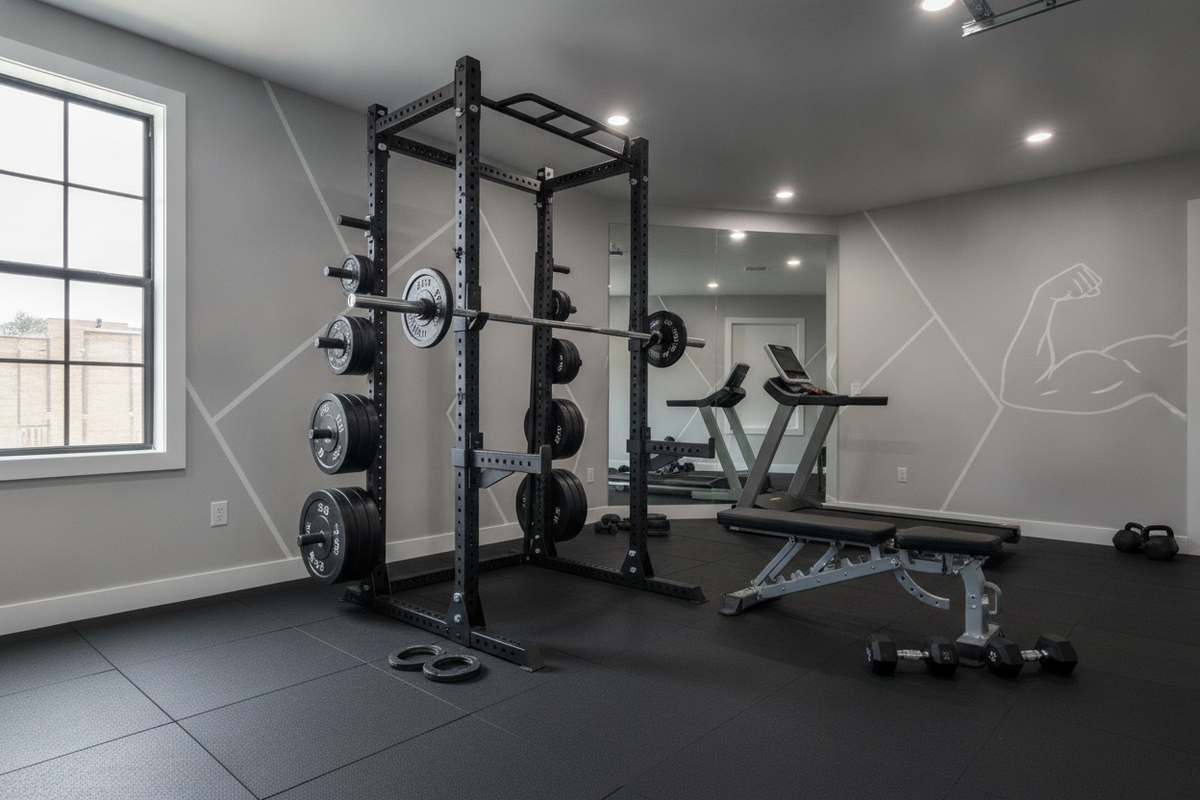
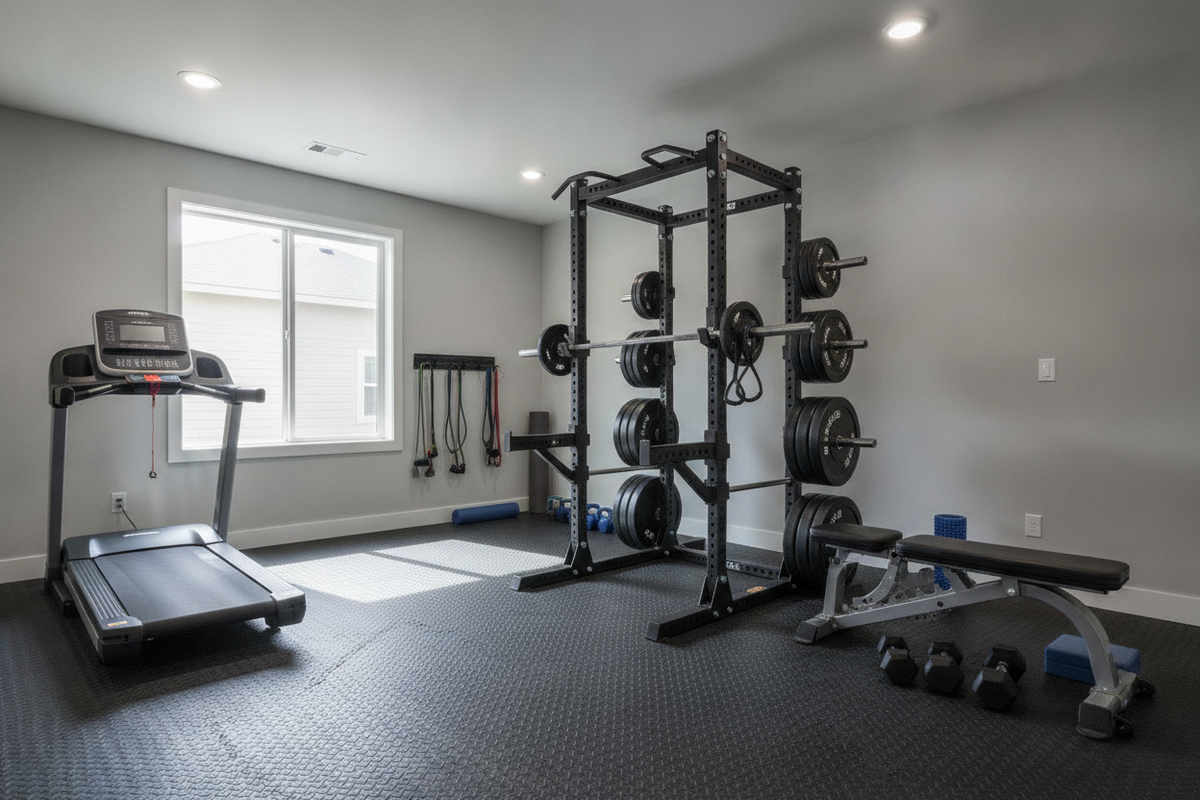
When laying out a room, prioritize ample clearance around primary stations. Position your power rack and barbell stations with generous perimeter spacing to allow unrestricted bar travel and plate loading. If you are developing a budget-friendly strength training space, prioritize versatile, modular equipment that serves multiple movement patterns without overcrowding the floor. Placing heavy-duty strength equipment along perimeter walls keeps central floor space open for free-weight movements, floor work, and mobility drills.
Mat Maintenance and Long-Term Durability Under Heavy Loads
Dense rubber gym flooring is engineered for durability, but sustained high-volume training requires routine upkeep to preserve surface grip and prevent uneven wear. Dust, chalk residue, and sweat accumulate over time, reducing surface friction and creating slippery contact points underfoot.
- Routine dry clearing: Sweep or vacuum mats regularly to remove abrasive chalk, dust, and grit that can erode surface texture.
- Gentle damp cleaning: Clean surfaces periodically using a mild, neutral soap solution. Avoid petroleum-based cleaners or harsh chemical solvents, which can degrade rubber compounds and compromise mat integrity.
- Surface rotation: In areas subject to continuous point loads—such as directly beneath weight racks or bench feet—periodically shift or rotate mat tiles to prevent localized compression fatigue.
- Moisture monitoring: Ensure the subfloor beneath your mats remains dry. Trapped moisture between non-porous rubber and concrete can degrade flooring finishes over extended periods.
Conclusion: Sustaining Strength Through Structured Progression and Solid Grounding
Learning how to build on strength requires a methodical approach to both athletic habits and room design. True athletic development is not about random effort; it is built on refined mechanics, intentional accessory reinforcement, and an environment designed to support demanding training sessions. By anchoring your routine in multi-joint fundamentals and preparing a stable, protective foundation underfoot, you establish a reliable home gym ecosystem designed for lasting physical progress.