Stop Treating the Assisted Weight Machine Like a Crutch
I remember the day I hit my first unassisted pull-up. I was so proud I practically sprinted away from the assisted weight machine, swearing I’d never look back. I thought I’d graduated. For the next two years, I struggled through 'survival' reps—ugly, swinging chin-ups where my neck did more work than my lats. My back growth stalled, and my shoulders felt like they were being held together by duct tape and prayers.
Quick Takeaways
- Consistent tension beats the variable resistance of bands every time.
- The machine allows for high-volume isolation that bodyweight reps can't match.
- It is the ultimate tool for mechanical drop sets and slow eccentrics.
- Commercial-grade units are huge; measure your ceiling height before buying for a home gym.
The Ego Trap of the Pull-Up Bar
Most people treat the assisted station like training wheels. They use it until they can wobble through three or four bodyweight reps, then they abandon it forever to protect their ego. But here is the truth: if you can only do four bodyweight pull-ups, you aren't actually training your lats for hypertrophy. You are training for survival. You're using momentum, shrugging your shoulders, and kicking your legs just to get your chin over that bar.
By ditching the machine too early, you sacrifice the volume necessary to actually build a big back. I’ve seen guys with 405-lb deadlifts swallow their pride and hop on the knee pad because they want to feel their lats stretch and contract without their grip or secondary stabilizers giving out first. It isn't about being weak; it’s about being smart enough to prioritize muscle tension over a 'cool' rep count in your logbook.
When you use the machine, you can focus on the mind-muscle connection. You can keep your chest up, your scapula depressed, and actually drive with your elbows. If you’re constantly fighting gravity with your entire body weight, that nuance is the first thing to go. Stop worrying about who is watching the pin on the weight stack and start worrying about the width of your V-taper.
Why an Assisted Weight Machine Actually Beats Bands
I get it, bands are cheap and they fit in a gym bag. But for serious assisted weight lifting machine work, bands are a distant second place. The resistance curve of a band is backwards. A band provides the most help at the very bottom where it’s stretched thin, but as you pull yourself up and the band shortens, that assistance disappears. You end up failing at the top of the movement not because your lats are tired, but because the physics of the rubber stopped helping you.
A dedicated machine provides a constant, measurable counterbalance throughout the entire range of motion. If you set it to 60 lbs of assistance, you get exactly 60 lbs of help from the bottom stretch to the peak contraction. This consistency allows you to track your progress with surgical precision. Adding 5 lbs of 'real' weight to your pull-up is easy to track on a stack; guessing which color band is slightly more stretched today is just gym-math guesswork.
Then there is the safety and comfort factor. We’ve all seen the videos of a band snapping or sliding off a shoe and hitting someone in a very sensitive place. A machine with a solid knee or foot platform is stable. You don't have to balance yourself while dangling from a rack. You can just focus on the work. For home gym owners, that stability is a massive plus, though the footprint is a different story.
Using It for Advanced Hypertrophy (Not Just Surviving)
If you think this machine is just for people who can't do a dip, you're missing out on some of the most brutal back and chest finishers in existence. Advanced lifters use the machine to blow past failure. My favorite method is the mechanical drop set. Start with your body weight on a standard bar. Do as many reps as possible. The moment your form breaks, immediately jump onto the assisted station and finish the set with 40-60 lbs of help. Your lats won't know what hit them.
The machine is also king for slow eccentrics. Try taking five full seconds to lower yourself on a dip. Doing this with your full body weight is a recipe for a shoulder impingement if you aren't a pro. But with the machine, you can safely overload the eccentric phase of the movement. This is a core tenet when considering building mass with machines versus free weights. The machine removes the stability requirement, allowing you to push the prime mover to absolute exhaustion without your form collapsing into a heap.
I also use it for deep-stretch holds. At the bottom of an assisted pull-up, the machine lets you hang with just enough tension to pull the lats apart without feeling like your shoulders are going to pop out of their sockets. You can sit in that 'stretch' for 10-15 seconds at the end of a set to trigger more sarcoplasmic hypertrophy. You can't do that safely when you're dangling 220 lbs of dead weight from a straight bar.
Buying One for the Home Gym? Read This First
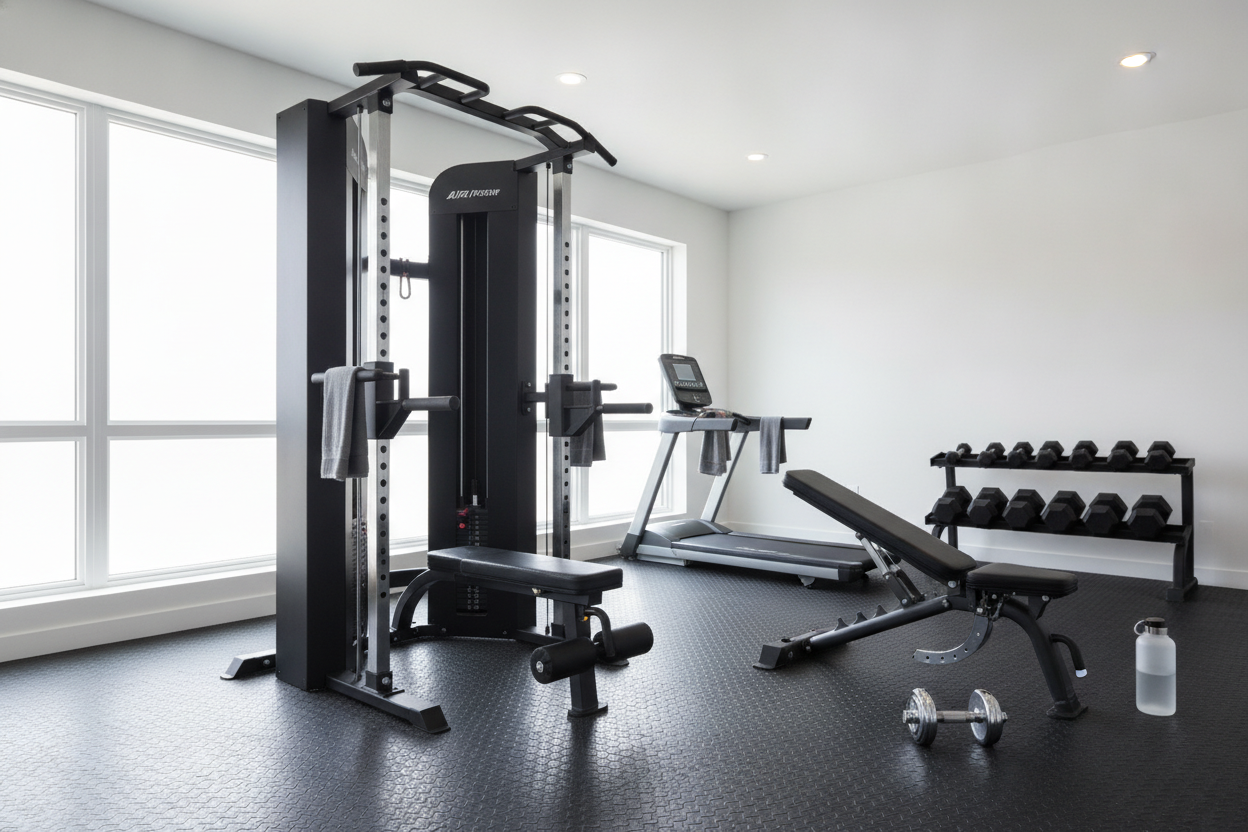
Adding a full-size assisted station to a garage gym is a commitment. Most of these units have a footprint of at least 4 feet by 5 feet and stand nearly 7 or 8 feet tall. If you have a standard 8-foot ceiling, you might find your head hitting the drywall on every rep. Before you pull the trigger, measure twice. I’ve seen plenty of guys buy a commercial unit at auction only to realize they have to cut a hole in their ceiling or sell it a week later.
You also have to choose between a weight stack and a plate-loaded version. Weight stacks are more convenient for drop sets, but they make the machine incredibly heavy—often over 600 lbs. If your gym is on a second floor or a weak subfloor, that’s a problem. Plate-loaded versions are lighter and cheaper, but loading and unloading 45-lb plates just to get some assistance is a chore that might make you skip the exercise entirely.
If you're hunting the used market, keep your eyes open for red flags on any weight lifting machine. Check the cables for fraying and look at the pulleys. If they are plastic and have flat spots, the movement will feel 'crunchy' rather than smooth. A high-quality machine should feel like it’s gliding on ice. If it jerks or catches, it’s going to ruin your mind-muscle connection and potentially strain a tendon.
The 3-Week Lat Isolation Protocol
Want to see what this machine can actually do? Swap your primary pull-up or lat pulldown for this protocol for the next 21 days. Focus entirely on the squeeze and the stretch.
- Week 1: 4 sets of 12-15 reps. Use enough assistance so that you can pause for 1 second at the top of every rep. No swinging.
- Week 2: 3 sets of 8-10 reps with a 4-second eccentric (lowering) phase. This will create massive amounts of muscle damage.
- Week 3: 3 sets to failure. Once you hit failure, drop the pin to add 20 lbs more assistance and go to failure again. Do this twice per set.
By the end of week three, you’ll likely notice that your 'real' pull-up strength has actually increased because you finally built the musculature required to do the movement correctly. I once spent a month doing nothing but high-volume assisted work after a minor bicep strain, and when I went back to bodyweight, I added five reps to my max set. The machine works if you use it right.
FAQ
Is the assisted machine better than lat pulldowns?
They are different tools. The assisted machine requires more core stabilization than a pulldown where your thighs are locked under a pad. I find the machine translates better to actual pull-up strength, while the pulldown is better for pure isolation.
Can I use it for other exercises?
Absolutely. One-legged step-ups on the knee platform are a fantastic way to target the glutes. The machine provides a steady upward push that helps you focus on the leg doing the work rather than just trying to balance.
How much assistance is 'too much'?
If you feel like the machine is launching you toward the ceiling, you've got too much weight on the stack. You want just enough help so that you can complete a full range of motion with a 2-second squeeze at the top.