Somatic Exercises for Beginners: What They Are and a 15-Minute Routine
Quick answer: Somatic exercises are slow, gentle movements done with close attention to how your body feels from the inside. Typical moves include pelvic tilts, gentle twists, side bends and "pandiculation" (a slow, deliberate contract-and-release, like a yawn-stretch). A beginner session takes 10–15 minutes on a soft mat. They can be a relaxing way to improve body awareness and mobility, though some popular claims, such as "releasing trauma", aren't well supported by research yet.
Key takeaways
- Slow and mindful: the goal is to feel the movement, not to push range or intensity.
- Low impact: done lying or seated on the floor, so they suit beginners, older adults and recovery days.
- Use a cushioned mat: most moves are done lying on your back or side.
- Keep expectations realistic: the evidence for relaxation and mobility is more promising than for bigger claims.
What are somatic exercises?
"Somatics" comes from the Greek soma, meaning the living body as experienced from within. Philosopher and movement educator Thomas Hanna popularized the term in the 1970s, and "Hanna Somatics" became one of the best-known methods. Related practices include the Feldenkrais Method and some forms of yoga and Pilates.
Somatic workouts exploded on TikTok and Instagram in 2024–2025, often marketed as an alternative to intense exercise. They remain one of the most-searched gentle workout styles.
How are somatic exercises different from stretching?
| Somatic exercises | Static stretching | Yoga | |
|---|---|---|---|
| Focus | Internal sensation, control, release | Lengthening a muscle | Postures, breath, flow |
| Speed | Very slow | Held positions | Varies |
| Key technique | Pandiculation (contract, then slowly release) | Hold 20–60 sec | Sequences of poses |
| Intensity | Very low | Low-moderate | Low-high |
What does the research say?
Research on somatic methods specifically is limited and mostly small. Mind-body movement in general (slow, attentive exercise with breathing) has been linked to reduced stress and improved mobility and balance in some studies. Claims that somatic exercises "release trauma stored in the body" or cause rapid weight loss go beyond what current evidence shows. Think of somatics as a gentle complement to strength and cardio, not a replacement.
15-minute beginner somatic routine
Lie on a soft mat. Move slowly, breathe naturally and pause between reps to notice how you feel.
- Body scan (1 minute): lie on your back, knees bent. Notice where your body contacts the mat.
- Arch and flatten (8 reps): slowly tilt your pelvis to arch your lower back, then slowly flatten it into the mat. Take 5 seconds each way.
- Pandiculation for the back (5 reps): gently press your lower back into the mat and contract your abs for 3 seconds, then release very slowly over 5–10 seconds.
- Knee drops (6 per side): knees bent and together, let them slowly fall to one side, then return.
- Side bend (5 per side): lying on your back, slide one hip toward your shoulder (shortening that side), then slowly release.
- "Washrag" twist (5 per side): turn your head one way while letting your knees drop the other way, then reverse slowly.
- Cat-cow on hands and knees (8 reps): slow, wave-like movement through the spine. Use a kneeling pad if your knees are sensitive.
- Child's pose (1 minute): breathe into your back.
- Rest (1 minute): lie still and notice any changes.
The best mat for somatic exercises
Because you spend most of the session lying on your back, side and hands-and-knees, comfort matters more than grip:
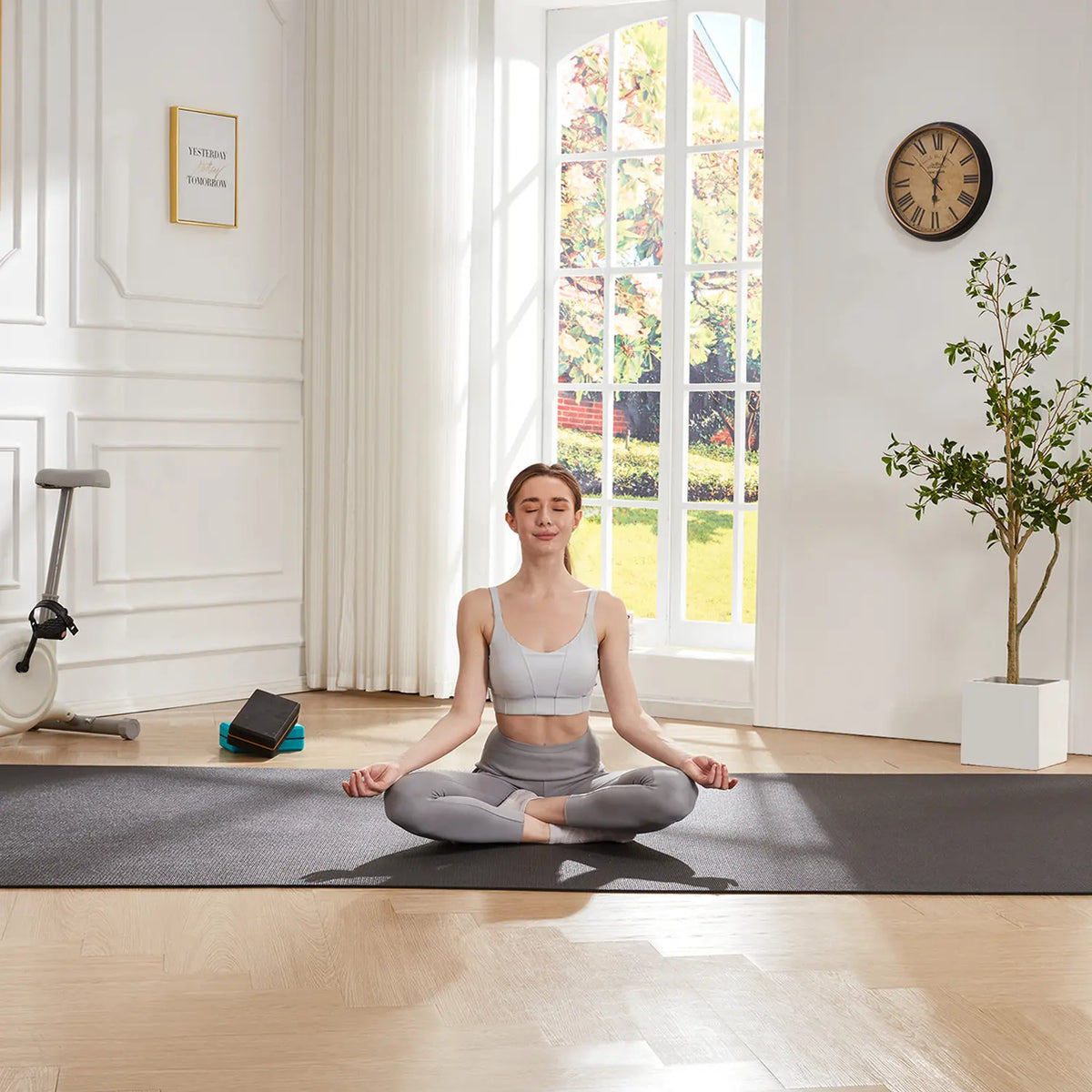
- Extra cushioning: the GXMMAT Extra Thick Large Yoga Mat (7' × 5' × 9 mm) protects your spine, hips and knees on hard floors.
- Room to move: large yoga mats (6' × 4' up to 6' × 12') let you roll and stretch without sliding onto the floor.
- Soft, barefoot-friendly surface with a double-sided non-slip design.
Who are somatic exercises good for?
- Beginners who find intense workouts intimidating.
- Desk workers with tight hips and backs.
- Lifters and runners on recovery days.
- Older adults looking for gentle mobility work. ACSM lists fitness programs for older adults and balance and mobility training among the top trends for 2026.
Want more structure? Combine somatic sessions with mat Pilates for core strength and with strength training 2 days a week.
FAQ
What are somatic exercises?
Slow, gentle movements done with close attention to internal sensation, such as pelvic tilts, twists and pandiculation (contracting a muscle and then slowly releasing it). Thomas Hanna popularized the approach in the 1970s.
Do somatic exercises really work?
They can improve body awareness and relaxation and offer gentle mobility work. Research specific to somatic methods is limited, and claims like rapid weight loss or trauma release aren't well supported.
How long should a somatic workout be?
10–20 minutes is enough for most people. Many do a short session daily or several times a week.
Can somatic exercises help with weight loss?
They're very low intensity, so they burn few calories. They're best used for mobility, relaxation and recovery alongside strength and cardio training.
What do I need for somatic exercises?
Just a soft, cushioned mat with room to lie down and move. A thicker mat (7–9 mm) is more comfortable on hard floors.
Written by Yuvien Royer for GXMMAT. This article is general fitness information, not medical or mental health advice.