Mat Pilates at Home: A 20-Minute Beginner Routine (and the Right Mat)
Quick answer: Mat Pilates is the original form of Pilates, and you can do it at home with just a cushioned mat. Start with 20 minutes, 2–3 times a week, using core classics like the Hundred, roll-ups, single-leg stretch, swimming and the shoulder bridge. Use a mat that's thicker than a standard yoga mat, around 7–9 mm, because Pilates involves rolling on your spine and lying on your back.
Key takeaways
- Mat Pilates builds core strength, posture and control without machines.
- A thicker, larger mat protects your spine during rolling exercises and gives you room to move.
- Quality over quantity: slow, controlled reps with steady breathing.
- Reformer Pilates is trending, but it's expensive. Mat Pilates is the affordable at-home alternative.
What is mat Pilates?
Pilates was developed by Joseph Pilates in the early 20th century, who called it "Contrology". The mat work is the foundation of the method: a sequence of controlled exercises that strengthen the deep core muscles, improve posture and build flexibility. Pilates is built on six principles: concentration, control, centering, precision, breath and flow.
Mat Pilates vs reformer Pilates vs wall Pilates
| Mat Pilates | Reformer Pilates | Wall Pilates | |
|---|---|---|---|
| Equipment | A cushioned mat | Spring-loaded reformer machine | Mat + a wall |
| Cost | Low | High (studio classes or a machine) | Low |
| Resistance | Your body weight | Adjustable springs | Body weight with wall support |
| Best for | Core strength, home practice | Guided resistance, rehab | Beginners who want support |
Search trends show reformer Pilates still growing while wall Pilates interest has dropped sharply. For home practice, mat Pilates is the most versatile option.
20-minute beginner mat Pilates routine
Move slowly, exhale on the effort, and keep your lower back controlled. Rest as needed.
| # | Exercise | Reps / time | Focus |
|---|---|---|---|
| 1 | Pelvic curl (bridge articulation) | 8 | Spine mobility, glutes |
| 2 | The Hundred (knees bent to start) | 100 arm pumps (10 breaths) | Core endurance, breathing |
| 3 | Roll-up (or half roll-back) | 6 | Abdominals, spinal flexion |
| 4 | Single-leg circles | 5 each direction, each leg | Hip control, pelvic stability |
| 5 | Rolling like a ball | 8 | Balance, spinal massage |
| 6 | Single-leg stretch | 10 each side | Lower abs, coordination |
| 7 | Spine stretch forward | 5 | Hamstrings, posture |
| 8 | Swimming | 30 seconds | Back extensors, glutes |
| 9 | Side-lying leg lifts | 10 each side | Outer hips, stability |
| 10 | Shoulder bridge with leg lift | 5 each leg | Glutes, hamstrings |
Finish with 1–2 minutes of child's pose and a spinal twist.
What kind of mat do you need for Pilates?
Pilates needs a different mat than yoga:
- Thicker cushioning (7–9 mm): rolling exercises, like rolling like a ball and roll-ups, put your spine directly on the floor. A standard 4–6 mm yoga mat can feel hard.
- Larger surface: leg circles and side-lying work need room so you don't slide off the edge.
- Non-slip on both sides: so the mat stays flat on hardwood or carpet.
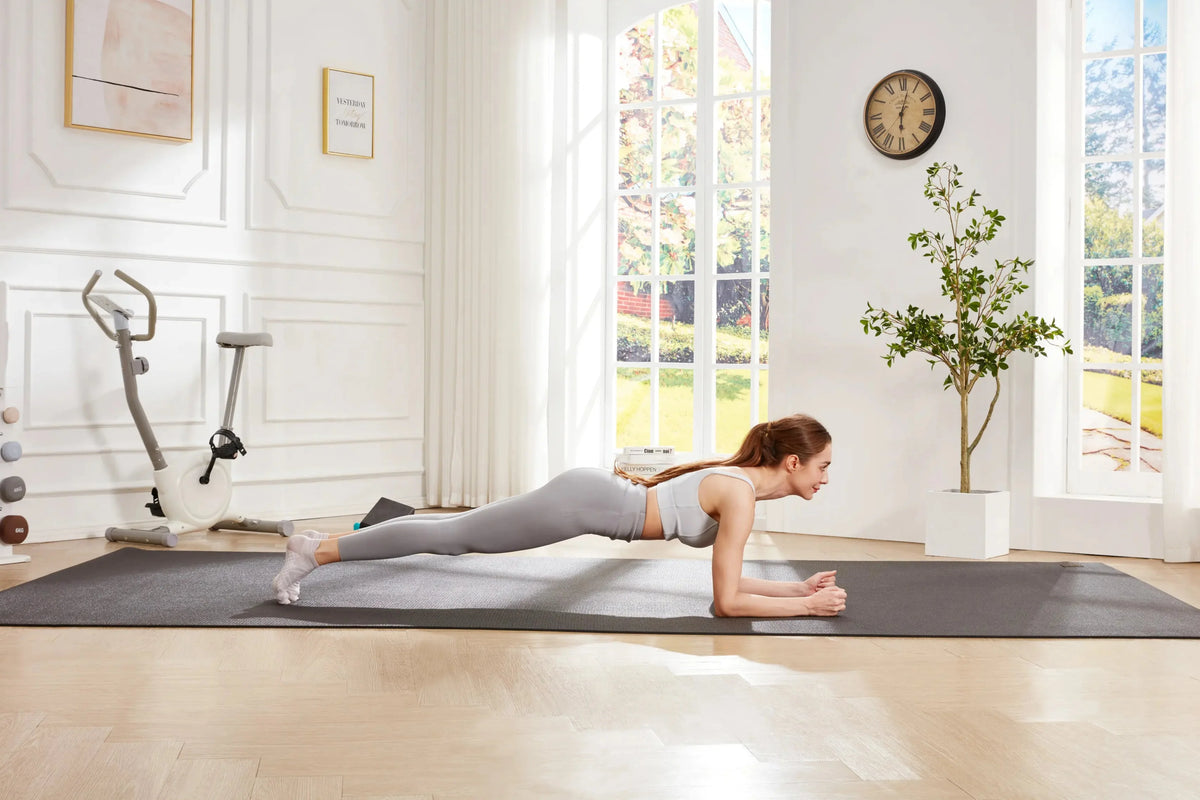
The GXMMAT Extra Thick Large Yoga Mat (7' × 5' × 9 mm) is made for exactly this, with extra cushioning for your spine, knees and elbows. The 7 mm large yoga mats (6' × 4' up to 6' × 12') have a soft, barefoot-friendly surface with a double-sided non-slip design. Learn more in how to choose mat thickness.
Helpful Pilates accessories
- Kneeling pad (24" × 10" NBR foam): extra cushioning under knees and wrists for kneeling and quadruped exercises.
- Foam roller: used in many Pilates classes for balance and core challenges. A long 24" roller works for lying lengthwise along your spine.
How often should you do Pilates?
2–3 sessions a week is a good start for beginners. As your control improves, you can practice more often. Pilates is low-impact, so it pairs well with strength training and walking, such as Japanese walking.
FAQ
Can I do Pilates at home without a reformer?
Yes. Mat Pilates is the original form of the method and needs only a cushioned mat. It builds core strength, posture and flexibility using your body weight.
What thickness mat is best for Pilates?
Around 7–9 mm. Pilates involves rolling on your spine and lying on your back, so it needs more cushioning than a typical 4–6 mm yoga mat.
Is a yoga mat OK for Pilates?
A thick yoga mat works. Thin yoga mats can feel uncomfortable on your spine during rolling exercises, so many people prefer a thicker, larger mat for Pilates.
How long until you see results from Pilates?
Many people notice better core control and posture within a few weeks of practicing 2–3 times a week. Visible changes depend on consistency, overall activity and nutrition.
Is mat Pilates good for beginners?
Yes. Start with modified versions, such as knees bent in the Hundred or a half roll-back instead of a full roll-up, and build up gradually.
Written by Yuvien Royer for GXMMAT. This article is general fitness information, not medical advice.