Posterior Chain Mechanics: The Best Exercises for Glutes and Hamstrings, Workout Splits, and Floor Staging
Developing a strong, resilient lower body requires a structured focus on the posterior chain. Among the various muscle groups that power movement, the gluteus maximus and the hamstring complex serve as primary engines for athletic performance, postural integrity, and overall functional strength. When planning a home or commercial gym routine, identifying the best exercises for glutes and hamstrings allows trainees to maximize muscle recruitment while maintaining joint comfort and structural balance.
A well-rounded lower-body training program does not rely on random exercise selection. Instead, it pairs hip-dominant hinges, horizontal extension vectors, knee flexion drills, and unilateral stability work. Establishing a safe and reliable workout zone with appropriate floor protection also ensures that heavy weights, benches, and aggressive foot drive remain stable throughout every set.
Understanding the Posterior Chain: How Glutes and Hamstrings Work Together
The glutes and hamstrings operate in close coordination during fundamental human movements, yet each group serves distinct mechanical roles. The gluteus maximus is the primary extensor of the hip, driving the pelvis forward out of flexion and stabilizing the sacroiliac joint during both bilateral and single-leg movements. Meanwhile, the hamstring complex—comprising the biceps femoris, semitendinosus, and semimembranosus—functions as a biarticular muscle group that crosses both the hip and the knee joint.
Because the hamstrings participate in both hip extension and knee flexion, their recruitment depends on the angle of the joint and the nature of the load. During hip-dominant hinge patterns, the hamstrings collaborate with the glutes to extend the hips from a lengthened position. In contrast, during dedicated knee-flexion movements, the hamstrings work with minimal assistance from the gluteus maximus. Achieving comprehensive development across both muscle groups requires selecting movements that target each of these functional actions.
The Best Exercises for Glutes and Hamstrings: Movement Classifications
To build a balanced lower body, training should encompass multiple movement angles. Grouping movements by biomechanical function ensures that no aspect of hip extension or knee flexion is neglected.
Hinge Patterns: Romanian Deadlifts and Good Mornings
Hip hinge variations represent the foundation of posterior chain loading. The Romanian deadlift (RDL) is widely regarded as one of the best glute hamstring exercises because it maintains constant mechanical tension through a deep eccentric stretch. By maintaining a soft knee bend and pushing the hips straight back, the hamstrings and glutes lengthen under control before contracting forcefully to return the torso upright.
Good mornings provide a comparable hinge pattern using a barbell positioned across the upper back. This shifts the moment arm, challenging spinal erectors and the glute-hamstring tie-in under lighter overall loads compared to deadlifts.
Bridging and Thrust Vectors: Barbell Hip Thrusts and Glute Bridges
While hinges load the posterior chain in the lengthened position, horizontal thrust vectors target peak tension at full hip extension. The barbell hip thrust places the upper back against a bench, allowing a full range of hip flexion and extension with minimal axial spinal loading. At the top of the movement, the glutes experience peak contraction against the resistance of the barbell.
Floor-based glute bridges, performed with bodyweight, resistance bands, or dumbbells, provide an accessible variation that emphasizes glute contraction while keeping secondary hamstring engagement active.
Dedicated Knee Flexion: Nordic Curls and Slider Curls
Hip extension alone does not fully stimulate the distal fibers of the hamstring complex. Incorporating knee-flexion movements ensures balanced development. Nordic hamstring curls challenge the hamstrings eccentrically as the body lowers toward the floor against gravity, requiring exceptional muscular control.
For home environments with smooth or sliding surfaces, hamstring slider curls provide a versatile alternative. Trainees lie supine, bridge their hips into the air, and curl their heels toward their glutes, challenging both knee flexion and hip extension simultaneously.
Unilateral Loading: Bulgarian Split Squats and Single-Leg Deadlifts
Single-leg training addresses bilateral strength discrepancies and challenges the pelvic stabilizing muscles, including the gluteus medius. Bulgarian split squats place substantial tension on the lead leg's glute and upper hamstring while reducing total spinal load. Single-leg Romanian deadlifts further test balance, ankle stability, and deep hamstring stretch control.
Designing a Balanced Glute and Hamstring Workout Routine
Constructing a productive best glute hamstring workout requires balancing exercise order, volume, and recovery. Placing heavy compound hinges or thrusts early in a session allows trainees to handle heavier loads when central nervous system readiness is highest.
- Primary Compound Movement: Begin with Romanian deadlifts or barbell hip thrusts to establish high mechanical tension.
- Secondary Compound Movement: Follow with a unilateral exercise, such as Bulgarian split squats or walking lunges, to address side-to-side symmetry.
- Targeted Knee Flexion: Introduce Nordic curls, slider curls, or stability ball curls to focus purely on hamstring knee flexion.
- High-Repetition Finisher: Conclude with banded glute bridges, frog pumps, or kettlebell swings to accumulate metabolic fatigue safely.
Home Gym Floor Staging and Equipment Placement for Posterior Chain Training
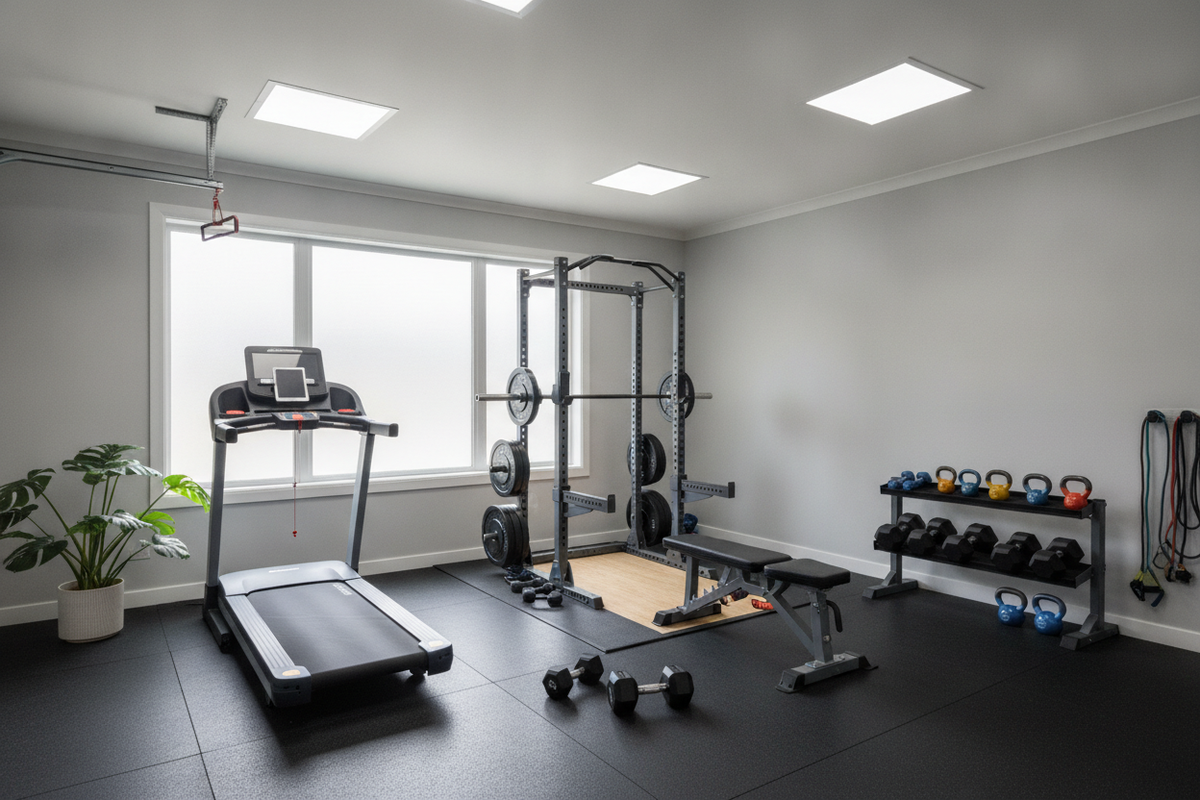
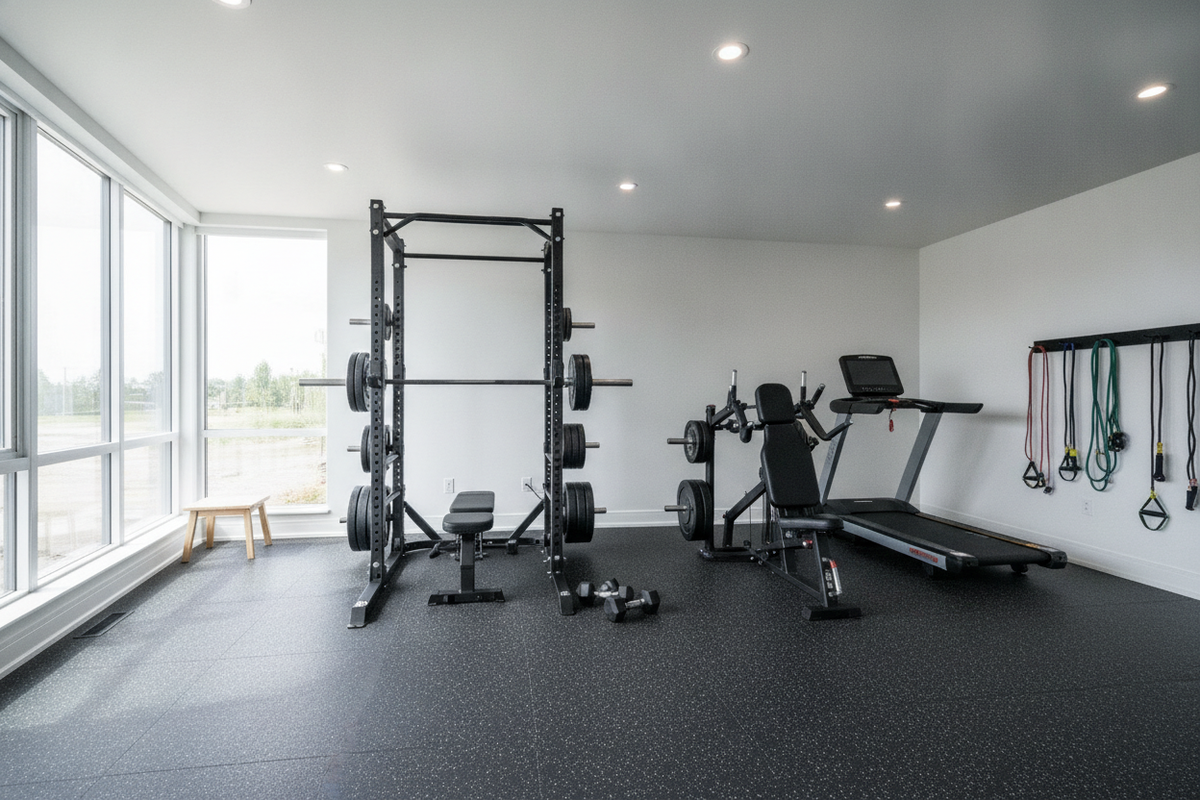
Heavy hinge and thrust training requires a stable, high-traction foundation. When setting up a home workout space, selecting a dedicated large home workout gym mat provides the non-slip grip necessary to drive through the heels during heavy Romanian deadlifts and hip thrusts without foot slippage.
Placing barbells, dumbbells, or weight benches directly on bare residential floors can lead to scuffing, pressure marks, or subfloor strain over time. Exploring a wide protective exercise mats collection allows home gym owners to find the appropriate dimensions and density needed to anchor weight benches securely and absorb the everyday demands of dropped plates and aggressive footing.
Mobility, Warm-Ups, and Finishers for Glute-Hamstring Health
Preparing the hips and posterior chain before lifting heavy loads promotes smooth joint movement and improves muscle activation. A dynamic warm-up should incorporate deep bodyweight squats, leg swings, and dedicated hip mobility and stretching exercises to open up the hip capsule and lengthen tight hip flexors.
At the conclusion of a training session, athletes can reinforce glute activation and muscular endurance by integrating a focused targeted glute finisher workout using light weights, resistance loops, or bodyweight pulses.
Maintaining Your Home Workout Flooring and Training Zone
Preserving your training zone ensures long-term comfort and safety. High-density exercise mats should be wiped down regularly using a damp cloth and mild soap solution to clear away dust, chalk, and sweat that can reduce surface traction. Avoid harsh chemical solvents that might degrade mat materials or soften textured grip surfaces.
Arranging equipment systematically—such as keeping weight plates racked when not in use and setting up dedicated lifting stations—protects both your flooring and surrounding walls, creating an organized, reliable environment for continuous lower-body progress.