Glute Hypertrophy Guide: Best Exercises for Glutes Growth, Programming Splits, and Home Floor Setup
Anatomy and Tension Curves in Glute Hypertrophy
Structuring an effective lower-body routine involves understanding the main functional actions of the gluteal complex. The gluteus maximus serves as the primary driver for hip extension and external rotation, while the gluteus medius and gluteus minimus control hip abduction, internal and external rotation, and lateral pelvic stabilization during single-leg tasks. To stimulate comprehensive muscular adaptation across all regions, a training program benefits from incorporating varied movement angles rather than relying on a single basic lift. Combining diverse movement patterns supports balanced muscular development throughout the posterior kinetic chain, similar to the multi-angle concepts discussed in our posterior anatomy and muscle growth guide.
Mechanical tension remains the foundational stimulus for muscle development, and how that tension is applied shifts across different phases of each exercise. Lengthened-state tension occurs when the gluteus maximus is loaded under a deep stretch, such as near the bottom of a controlled hinge, deep squat, or deficit lunge. Shortened-state tension peaks when the hips achieve full terminal extension against horizontal resistance, as seen during a barbell hip thrust or floor glute bridge. Incorporating movements that emphasize both lengthened and shortened ranges provides a comprehensive training stimulus across the gluteal muscle fibers while promoting balanced hip mechanics.
The Best Exercises for Glutes Growth by Force Vector
Categorizing exercises by their primary force vector helps lifters create a balanced training plan that addresses multiple planes of motion without accumulating unnecessary lower-back fatigue.
Horizontal Shortened-Zone Power: Barbell Hip Thrusts and Glute Bridges
The barbell hip thrust provides substantial shortened-state glute tension because the resistance curve remains perpendicular to the torso at terminal hip extension. In contrast to upright standing lifts where resistance on the hip extensors decreases near lockout, hip thrusts challenge the glutes heavily when fully contracted. To set up the movement comfortably, position the mid-to-upper back across a sturdy, stable bench, place both feet flat on the floor roughly hip- to shoulder-width apart, and push through the mid-foot and heel. At the top of the repetition, aim for vertical shins, a neutral spine with a slight posterior pelvic tilt, and a forward eye gaze to help avoid lower-back arching.
Vertical Lengthened-Zone Loading: Deep Romanian Deadlifts and Deficit Lunges
Romanian deadlifts and deficit lunges challenge the gluteus maximus in a stretched position under controlled eccentric lowering. During a Romanian deadlift, maintain a slight knee bend while hinging the hips backward horizontally, keeping the weights close to the legs throughout the descent. The downward phase finishes when the hips stop moving backward, maintaining a neutral lumbar spine. Deficit reverse lunges offer an extended range of hip flexion by elevating the front foot on a stable surface, increasing the stretch on the working glute before driving back to the start.
Unilateral Stability and Symmetry: Bulgarian Split Squats and Step-Ups
Single-leg exercises help balance strength across both sides while engaging the gluteus medius and minimus to maintain level hips. During a Bulgarian split squat, adopting a slight forward torso angle places steady emphasis on the front leg glute through a deep range of motion. Box step-ups, performed with minimal push from the rear foot, focus effort on single-leg hip extension while challenging dynamic balance. These unilateral drills help develop hip control in ways that complement the stabilization principles found in our runner-specific exercise guide.
Lateral Abduction and Upper Shelf: Cable and Banded Hip Abductions
Direct work for the lateral hip helps round out glute development and reinforces pelvic stability during heavier lifts. Standing cable abductions, seated resistance band abductions, and side-lying leg raises isolate the gluteus medius. Leaning slightly forward during standing cable abductions helps align the line of pull with the direction of the upper glute fibers, keeping tension focused on the target area rather than the front hip flexors.
Structuring the Best Workout for Glutes Growth
A structured routine combines compound movements with moderate-load isolation exercises, distributed across a realistic weekly frequency. Training the lower body two to three times per week provides ample opportunity for volume distribution while allowing adequate rest between demanding sessions. For additional programming ideas, training split structures, and routine templates, explore our training resource hub.
Sample Dedicated Glute Hypertrophy Session
- A1. Barbell Hip Thrust: 3 to 4 sets of 8 to 10 repetitions (pause for 1 to 2 seconds at full extension).
- B1. Dumbbell Romanian Deadlift: 3 sets of 8 to 12 repetitions (controlled lowering tempo).
- C1. Bulgarian Split Squat: 3 sets per leg of 10 to 12 repetitions (slight forward hinge).
- D1. Standing Cable Hip Abduction: 3 sets per leg of 15 to 20 repetitions (controlled pace without torso swing).
When applying progressive overload, prioritize smooth movement mechanics, full active range of motion, and steady tempo before increasing resistance. Increasing load too quickly can cause secondary muscle groups or the lower back to compensate, reducing direct glute engagement.
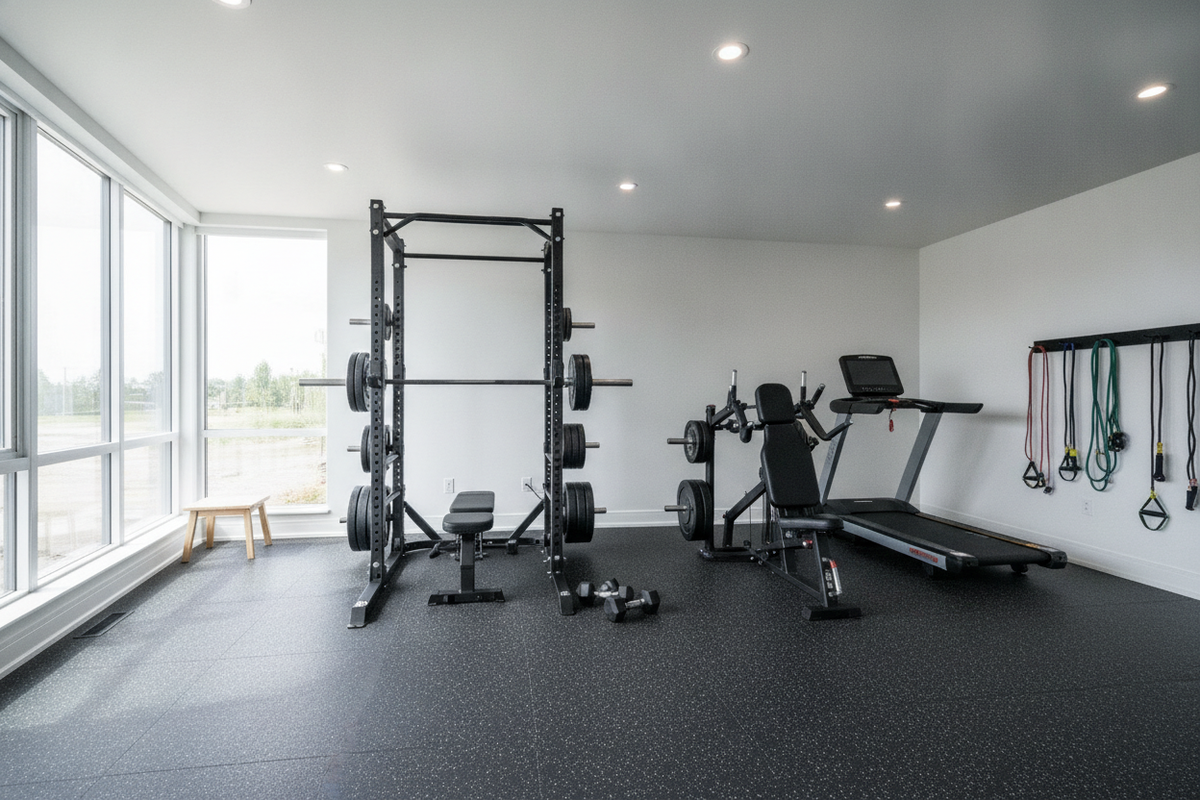
Home Gym Floor Staging and Equipment Anchoring for Glute Training
Lower-body strength workouts produce substantial downward and horizontal forces that call for a secure, non-slip floor foundation. Bare residential surfaces such as smooth tile, polished hardwood, or soft household carpet can shift underfoot or allow utility benches to slide during heavy hip thrusts.
Using a heavy-duty exercise mat for home workouts provides a reliable training platform that supports stable movement and protects the room:
- Bench Anchoring and Equipment Stability: Heavy hip thrusts exert horizontal backward pressure against benches. Dense rubberized matting creates traction that prevents bench feet from sliding across the floor.
- Foot Traction for Solid Force Transfer: Deep split squats, wide-stance deadlifts, and lateral band work require dependable grip underfoot. Textured mat surfaces help shoes stay firmly in place during wide-stance movements.
- Subfloor Protection and Equipment Cushioning: Resilient floor mats provide a protective buffer between heavy dumbbells or weight plates and the subfloor, reducing surface wear during regular lifting sessions.
- Moisture Management and Surface Cleanliness: Lower-body workouts can be sweat-intensive. Non-porous, water-resistant workout mats can be wiped clean after training to maintain surface grip and hygiene.
Pairing thoughtful exercise selection, deliberate progression, and a secure floor setup establishes a solid foundation for productive lower-body training at home.