I Added Bands to 4 great upper body exercises (Here's Why)
I spent three years thinking my chest was just genetically cursed. I would hit the flat bench, stack the 45s, and grind out reps until my eyeballs felt like they were going to pop. But the pump was always fleeting, and my lockout felt 'easy' compared to the struggle off the chest. It turns out, I was ignoring the physics of great upper body exercises and letting gravity do half the work for me.
- Bands provide 'accommodating resistance,' making the lift harder as you get stronger in the range of motion.
- Dumbbells and barbells lose tension at the top of a rep; bands keep the muscle under fire.
- This setup is perfect for home gyms with limited heavy weight options.
- You can turn a basic push-up into a heavy bench press alternative with one $20 band.
The Problem With Pure Iron (And Why Your Chest Won't Grow)
Gravity is a constant, but your strength isn't. When you perform a standard dumbbell press, the resistance stays the same—let's say 50 pounds—throughout the entire movement. However, your mechanical advantage changes. You are weakest at the bottom when your chest is stretched and strongest at the top when your arms are nearly locked out.
This creates a massive gap in your training. By the time you finish a rep, your muscles are barely working because your skeleton has taken over the load. You’re essentially resting at the top of every single rep. If you want real growth, you need tension that matches your strength curve. Pure iron simply can't do that. It’s why you see guys benching three plates with massive triceps but flat, underdeveloped pecs. They are missing the peak tension required to force the muscle to adapt.
Furthermore, the 'drop off' in tension at the top of top upper body exercises means you're missing out on the most stable part of the lift where you could actually handle more weight. You are limited by what you can move off your chest, not what your muscles can actually handle at the finish line. It’s an inefficient way to train if mass is the goal.
The 'Accommodating Resistance' Trick for Garage Gyms
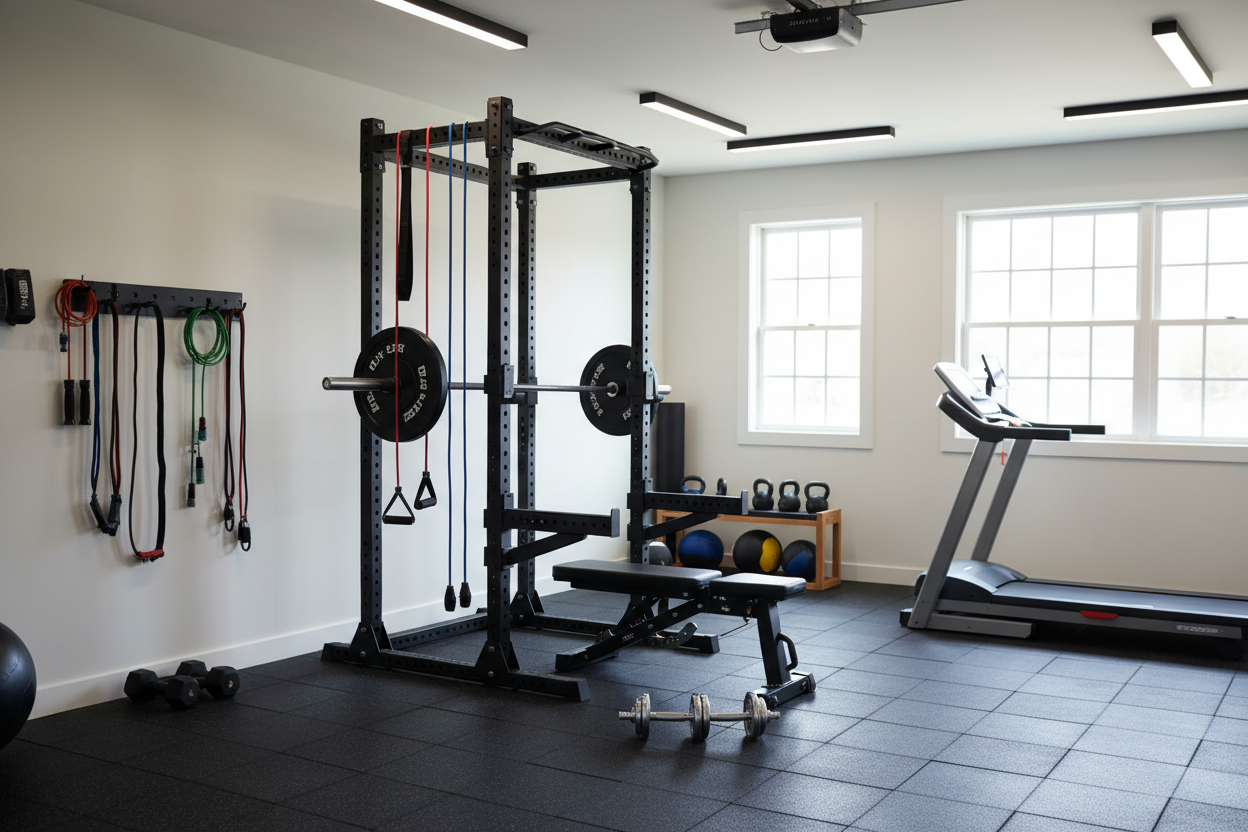
Accommodating resistance sounds like fancy lab talk, but it’s the secret sauce used by Westside Barbell and elite powerlifters for decades. In a garage gym setting, it’s a total lifesaver. By anchoring resistance bands to your body or your equipment, you create a dynamic load. As the band stretches, the resistance increases. This means as you move into your strongest physical position, the weight gets heavier to meet you there.
This forces your nervous system to 'accelerate' through the entire rep. You can't just coast through the lockout. If you do, the band will snap the weight back down toward your face. It demands total control and constant force production. This is how you turn standard movements into top upper body workouts that actually yield results without needing a 1,000-lb dumbbell rack.
I’ve found that adding even a light 'monster mini' band to my dumbbell work corrected my form almost instantly. You can’t use momentum to cheat a banded rep. If you swing the weight, the band loses tension or jerks you out of position. It’s a built-in coach that punishes bad habits and rewards explosive, controlled power.
4 Band-Resisted Setups for Serious Mass
Ready to stop wasting reps? These four setups take the equipment you already have and turn the intensity up to eleven. No fancy machines required—just some rubber and a little grit.
The Banded Floor Press
If you’re training in a cramped 6x8 ft corner without a bench, the floor press is your best friend. The only issue? The range of motion is short, and the triceps do most of the work. By looping a 41-inch band around your upper back and hooking the ends into your thumbs before grabbing your dumbbells, you change the game. The band creates a massive peak contraction at the top that a standard floor press lacks. This is how you sculpt and tighten your upper body while staying low to the ground. You’ll feel a 'squeeze' in your inner pecs that you simply cannot get with gravity alone.
The Heavy Band-Resisted Push-Up
Standard push-ups become high-repetition cardio once you can knock out 30 in a row. To keep growing, you need to load them. I prefer using a heavy 1.75-inch loop band over my shoulders. It mimics the heavy load of a barbell bench press but allows your scapula to move naturally, which is much kinder to your rotator cuffs. I’ve found these to be one of the most effective alternative chest exercises for lifters who get 'stinger' pains in their shoulders during heavy barbell work. It’s all the gains with half the joint wear.
Banded Dumbbell Rows
Most people 'cheat' their rows by using a hip hinge or momentum to yank the weight up. By anchoring a thin band to the bottom of your power rack and looping it over the head of your dumbbell, the weight gets significantly heavier as you pull it toward your hip. You can’t use momentum here; you have to squeeze the lat into submission. It fixes that 'rounding' of the shoulder that happens when people try to row weight that’s too heavy for them.
The Standing Band Pull-Apart
This isn't a mass builder in the traditional sense, but it’s mandatory for shoulder health. I do 100 of these every single day. It keeps the rear delts fired up and counteracts the 'hunched over a keyboard' posture that ruins most lifters’ bench press form. Use a light band and focus on pulling your shoulder blades together, not just moving your arms. It’s the ultimate 'prehab' move.
Programming These great upper body workouts Into Your Week
Don't go out and band every single set tomorrow. The eccentric (lowering) phase with bands is aggressive. Because the band is actively pulling the weight back down, your muscles have to work twice as hard to control the descent. This causes significantly more muscle fiber micro-trauma, which means you will be sorer than usual. Start by swapping out one 'straight weight' exercise for a banded version per session.
These are best used as 'finishers' or secondary movements. For example, do your heavy low-rep work with standard plates, then move to banded push-ups or floor presses for sets of 12-15 to maximize the pump. This approach builds top upper body workouts that don't fry your central nervous system in the first twenty minutes. While your upper body recovers from this new stimulus, you can focus on building leg drive on a dedicated lower body strength machine to ensure you aren't neglecting your posterior chain.
My Honest Mistake
I remember the first time I tried banded push-ups. I used a 'heavy' blue band I bought on a whim. Halfway through the third rep, the band slipped off my shoulder blades and whipped me across the back of the neck so hard I saw stars. I nearly bit my tongue off. Lesson learned: wear a hoodie or tuck the band under your armpits to keep it anchored. Don't let a $15 piece of rubber knock you out in your own garage.
FAQ
Do I need expensive name-brand bands?
Not really. Any 41-inch layered latex loop band will work. Avoid the cheap 'tube' bands with handles for these exercises; they don't provide the same tension and the plastic handles get in the way of your grip.
Will adding bands make me weaker on standard lifts?
Quite the opposite. Bands teach you to be explosive. When you go back to 'straight' weights, you'll find your lockout is significantly faster and more stable because your triceps and stabilizers are used to fighting the band's tension.
How often should I replace my bands?
Check them every month for 'nicking' or small tears. If you see white stress marks or any peeling, toss them. A snapping band is a great way to lose an eye or catch a nasty welt.