How to Program an All Machine Workout Without Losing Mass
I remember the day I realized I didn't need to fight for the only squat rack in my commercial gym. My lower back was cranky, the queue for the bar was five people deep, and I just wanted to get my work in and go home. I pivoted to an all machine workout and realized my pumps were better than they’d been in months of barbell grinding.
Quick Takeaways
- Machines provide stable resistance that allows for better mind-muscle connection.
- You can push to absolute failure without needing a spotter.
- Lower systemic fatigue means you can train with higher frequency.
- Modern plate-loaded gear often has better strength curves than free weights.
Why I Stopped Forcing Barbells on Every Routine
The 'hardcore' crowd loves to hate on anything with a cable or a pulley. There is this persistent myth that if you aren't clanging iron plates on a rusty bar, you aren't building real muscle. That’s total nonsense. A workout with machines only isn't a sign of weakness; it's a tool for surgical precision. I spent years grinding out barbell rows only to have my grip and lower back fail long before my lats were actually tired.
When you stop worrying about balancing the weight, you can finally focus on moving it. I’ve found that my recovery improved significantly once I stopped redlining my central nervous system on heavy triples. You get the stimulus without the 'beat-up' feeling that keeps you out of the gym the next day.
The Biomechanics of Bodybuilding with Machines
Modern selectorized and plate-loaded gear is designed with specific strength curves in mind. Bodybuilding with machines allows you to keep tension on the muscle where it is strongest. Think about a dumbbell fly—at the top, there's zero tension. On a high-quality pec deck, your chest is under fire through the entire range of motion. That constant tension is a primary driver for hypertrophy.
A machine only workout program isn't just 'easier' than free weights; it's often more metabolically demanding. Because you aren't limited by your stabilizers, you can take a set of leg presses far deeper into the 'pain cave' than you ever could with a barbell on your back. You aren't just moving weight; you're exhausting fibers.
Structuring Your All Machine Workout Plan
I usually recommend a Push/Pull/Legs split or an Upper/Lower split for a machine only workout plan. This ensures you aren't overlapping too much and gives your joints a break. Without the technical overhead of a snatch or a clean, you can pack a lot of volume into a 45-minute window.
Dialing in Chest and Back Mechanics
For the upper body, look for converging chest presses. Unlike a standard bench, these machines mimic the natural arc of the pec fibers as they contract toward the midline. For back, chest-supported rows are the gold standard. They take your ego and your swaying lower back out of the equation. If you're struggling to pick the right movements, I’ve mapped out a solid upper body machine workout plan that focuses on these exact mechanics.
Building Serious Legs Without a Squat Rack
Leg day on machines is a different beast entirely. A hack squat with a 45-degree angle hits the quads harder than any barbell squat I've ever done because it allows for incredible depth without your heels lifting. In a machine only workout, you can transition from a heavy leg press straight into a leg extension without resetting your heart rate. That kind of density is what builds massive quads.
How to Progress When You Max Out the Stack
What happens when you can do the whole 300-lb stack for 20 reps? Don't just find a new gym. This is where advanced intensity techniques shine. Use rest-pause sets: hit your set to failure, breathe for 15 seconds, and go again. You can also use magnetic micro-loading plates to add 1.25 or 2.5 lbs to the stack, keeping the progression moving when the standard 10-lb jumps feel too big.
Mechanical drop sets are another favorite. Start on a machine with a difficult profile (like a seated leg curl) and immediately move to a more advantageous position or a similar machine once you hit failure. You’re extending the set and forcing more blood into the area.
What to Do When Your Gym is Missing Equipment
Every gym has different brands—one might have Hammer Strength, another might have Life Fitness. If your specific row machine is taken, don't start ditching hypertrophy workout plans. A cable column with a D-handle can mimic almost any plate-loaded row. The muscle doesn't care about the brand name on the frame; it only cares about the mechanical tension applied to the fibers.
Personal Experience: The Pride Trap
A few years ago, I was nursing a shoulder impingement that made flat benching feel like a knife was in my joint. I was too proud to use machines, so I just stopped training chest for a month. I lost noticeable size. Once I finally swallowed my ego and hopped on a selectorized chest press, I realized I could train heavy and pain-free. I haven't looked back since. My joints feel better at 35 than they did at 25.
FAQ
Can you actually get as big using only machines?
Yes. Many pro bodybuilders from the 90s and today rely heavily on machines to build their base. Muscle grows from tension, mechanical stress, and metabolic waste—machines provide all three.
Are machines safer for beginners?
Generally, yes. The fixed path of motion prevents the 'wobble' that leads to injury when form breaks down. However, you still need to set the seat height correctly to align your joints with the machine's pivot point.
Can I do this in a home gym?
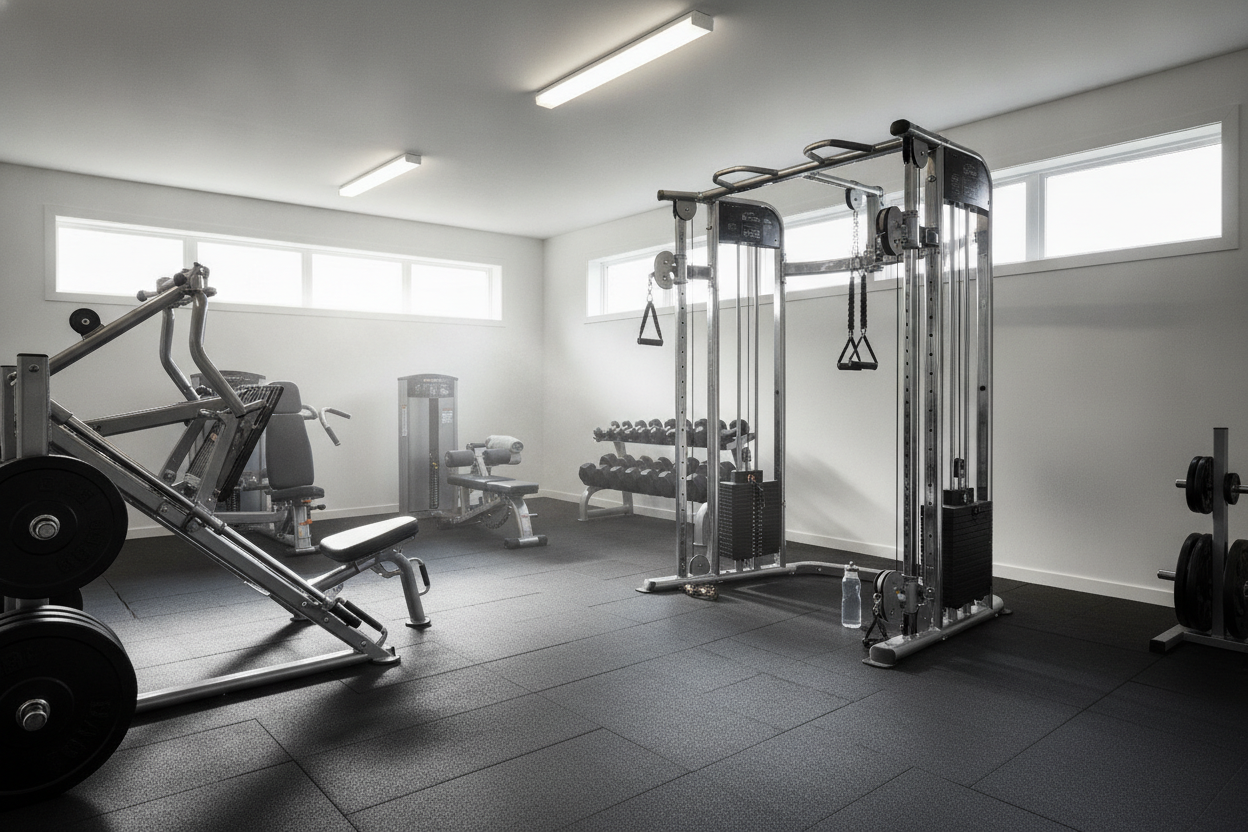
It's harder but doable. Plate-loaded leverage gyms or functional trainers with high-quality pulleys can replicate almost everything you find in a commercial setting.