How to Pick Up Weights Without Wrecking Your Back Before the Set
I once watched a guy at a local powerhouse gym pull 500 pounds for a clean triple, then absolutely wreck his back reaching down to grab his gym bag. It sounds like a joke, but the transition between sets is where the real danger lives. Knowing how to pick up weights isn't just about gym etiquette; it is the difference between a ten-year lifting career and a permanent relationship with a physical therapist.
Quick Takeaways
- Treat every plate like it is your 1-rep max.
- Hinge at the hips, never round the lumbar spine.
- Use the 'knee-kick' for heavy dumbbell transitions.
- Invest in storage to avoid lifting from the floor unnecessarily.
The Most Dangerous Part of Your Workout Isn't the Lift
The ego is a funny thing. We spend forty-five minutes focusing on 'perfect form' during our working sets, then we throw it all out the window the second the timer stops. Most home gym injuries happen during the 'casual' movements—re-racking a plate, sliding a dumbbell across the floor, or yanking a kettlebell out of a corner. You’re relaxed, your core is soft, and your spine is in a compromised, rounded position. That is when the disc decides to exit the chat.
I’ve been there. I’ve spent weeks sidelined because I thought I was too strong to 'need' form when moving a 45-pound plate. The reality is that your spine doesn't know the difference between a PR deadlift and a lazy reach for a 25-pound bumper. You have to stay switched on. If you're picking up weights, you're lifting. Period. There is no such thing as a 'casual' lift in my garage.
Stop treating the setup like a chore and start treating it like part of the set. Brace your abs, set your lats, and use your legs. If you can't be bothered to lift a plate correctly, you shouldn't be lifting it at all.
How to Pick Up Dumbbells From Floor (The Right Way)
When you're figuring out how to pick up dumbbells from floor, the most common mistake is the 'fishing pole' bend. You know the one—stiff legs, rounded back, reaching down with one arm. This puts an incredible amount of shear force on your lower vertebrae. Instead, you need to treat every pick-up like a strict suitcase deadlift. This means squaring your hips, keeping the weight close to your center of mass, and driving through your heels.
The shape of the weight matters more than people think. Whether you're dealing with flat-edged hex bells or rounded pro-style ones, choosing the right weights for your grip strength is vital. If the knurling is passive or the handle is too thick, you're more likely to use awkward body mechanics to overcompensate for a failing grip. I prefer a dumbbell with a consistent 32mm handle diameter—it gives you enough surface area to lock in before you even leave the ground.
Approach the dumbbells so they are positioned between your feet, not out in front of you. Squat down, grab the handles with a neutral grip, and keep your chest up. By the time the weights leave the floor, your hamstrings and glutes should be doing 90% of the work. If you feel it in your lower back, you've already lost the battle.
The Knee-Kick Method for Heavy Presses
If you're graduated to the 80s, 90s, or the big 100-pounders, simply how to lift heavy dumbbells into a pressing position becomes a workout in itself. I see guys trying to 'curl' the weights into position while lying down. That is a one-way ticket to a torn labrum. The 'knee-kick' is the gold standard used by every veteran lifter for a reason: it uses physics instead of raw muscle.
First, sit on the edge of your adjustable weight bench with the dumbbells standing upright on your thighs, close to your knees. Get your feet planted firmly—I’m talking about driving your toes into the mat. As you begin to lie back, kick one knee up toward your chest, using the momentum to propel the dumbbell to your shoulder. Immediately follow with the second leg. If you time it right, the weights 'float' into the starting position with zero strain on your rotator cuffs.
This technique requires a bench that doesn't wobble. If you're on a cheap, 14-gauge steel bench that shakes when you sit down, the knee-kick is going to feel sketchy. You want something with a wide tripod base or a heavy-duty frame that can handle the combined weight of you and a pair of 100s hitting the backrest at once.
Stop Yanking Barbell Plates Like a Caveman
Loading a barbell on the floor is a recipe for a 'tweak.' People tend to stand to the side of the bar and yank plates upward with a twisting motion. Combining spinal flexion with rotation is the fastest way to see a surgeon. When you're picking up weights to load a bar, you need to face the sleeve directly or use a deadlift jack.
Using bumper plate sets makes this whole process significantly easier. Since bumper plates have a uniform 450mm diameter regardless of weight, the bar stays at a consistent height off the floor. You aren't reaching down to floor level for a 10-pound plate and then reaching higher for a 45. It standardizes your movement, which means your brain can 'set' your hip hinge at the same depth every single time you change weights.
If you don't have a jack, slide the first plate on, then roll that side of the bar onto a small 2.5-pound plate (the 'poor man's jack'). This lifts the sleeve just enough so you can slide subsequent plates on without having to manually lift the entire weight of the bar with one hand while aiming with the other.
Why Your Storage System is Actually a Safety Feature
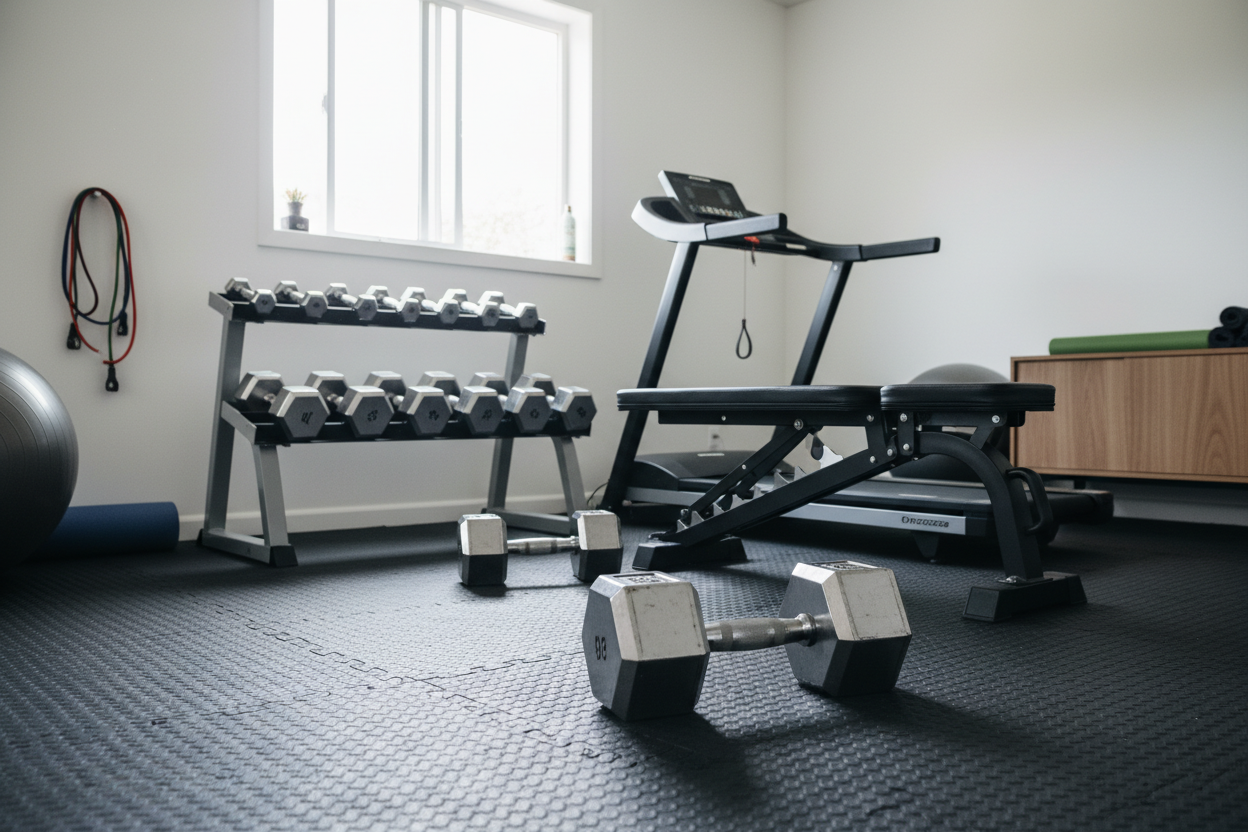
The best way to avoid injury while picking up weights is to stop picking them up from the floor entirely. Constantly pulling 50-pound dumbbells from ankle height is a tax on your joints that adds up over a 20-year training span. A rack isn't just about organization; it's about starting your lift from a 'power position'—usually around mid-thigh or waist height.
If you're working with a tight budget or a weirdly shaped room, you should build a rock-solid DIY dumbbell rack to get that iron off the floor. Even a simple two-tier shelf made from 2x4s and 11-gauge angle iron can save your back. The goal is to be able to walk up to the weight, hinge slightly, and pull it directly into your center of gravity without having to descend into a full squat every time you want to do a set of lateral raises.
Think about the workflow of your gym. If your heaviest weights are tucked in a corner behind a power rack, you’re going to be tempted to 'manhandle' them out of the tight space. Clear the clutter. Give yourself a 3-foot radius around your storage so you can use proper body mechanics every time you reach for a plate.
The 'Put It Down' Rule No One Talks About
The set isn't over when you hit the last rep; it's over when the weights are safely back on the floor or the rack. I see too many lifters reach failure on a bench press and then just 'drop' the dumbbells out to the sides. This is a massive risk for your biceps tendons and shoulders. As the weight falls, your arms are pulled into extreme external rotation under load.
The safest way to exit a heavy dumbbell set is to reverse the knee-kick. Bring your knees up, let the dumbbells touch your thighs, and use the weight of the bells to pull you back into a seated position. If you have to bail, drop them straight down—not out to the side—and only if you have proper rubber flooring. Respect the equipment, and it’ll respect your joints. The goal is to get stronger, not to see how much abuse your L5-S1 can take before it snaps.
Personal Experience: The 45-lb Plate Mistake
I learned this the hard way about five years ago. I was finishing a heavy back day and went to slide a 45-pound plate off the bar. I was tired, I was 'just' cleaning up, and I reached over with one arm while my feet were planted awkwardly. I felt a 'zip' in my lower back. I wasn't even lifting a heavy set; I was just being lazy with a single plate. I couldn't sit comfortably for three weeks. Now, I treat a 5-pound change plate with the same respect I give a 400-pound squat. My back has never felt better.
FAQ
Is it okay to drop dumbbells after a set?
Only if they are high-quality rubber-coated or urethane bells and you have at least 3/4-inch stall mats. Dropping iron bells on concrete will eventually crack the handles or the floor. More importantly, dropping them out to the sides can tear your rotator cuff.
How do I pick up weights if I already have a bad back?
Focus on the 'hip hinge.' Imagine there is a wall behind you and you are trying to touch it with your butt. This keeps the load on your hamstrings and glutes rather than your spine. Always keep the weight as close to your shins as possible.
Should I use a weight belt for moving plates?
You shouldn't need one for general loading, but if you're moving heavy stones or 100lb+ plates, it doesn't hurt. However, a belt is no excuse for bad form. Use your brain first, your legs second, and the belt third.