How to Build a Leg Day Workout at Home Without a Squat Rack
I remember the moment I realized my commercial gym membership was a sunk cost. I was standing in line for the only functional power rack, watching a guy do bicep curls in the squat zone. I went home, looked at my cramped living room, and wondered if I could actually get a decent leg day workout at home without a 300-pound barbell setup. The short answer? Yes. The long answer? You have to stop training like a powerlifter and start training like a physicist.
- Unilateral movements are the secret to doubling your effective load.
- Tempo and pauses compensate for a lack of heavy iron.
- Traction is non-negotiable—slipping kills your force production.
- Mechanical tension matters more than the number on the dumbbell.
Why You Can't Just Copy Your Gym Routine
Most guys try to take their 5x5 back squat routine and replicate it with a pair of 25-pound dumbbells. It doesn't work. When you're at the gym, you have the luxury of absolute load. At home, you’re usually working with limited resistance. If you try to do standard bilateral squats, you’ll end up doing 50 reps before you even feel a burn. That’s cardio, not hypertrophy. Most lifters are incredibly skeptical about whether they can build serious lower body size outside of a rack, but the issue isn't the environment—it's the programming.
A successful leg day exercise at home requires a shift from absolute weight to internal tension. You have to make light weights feel heavy. This means moving away from the stability of two feet and embracing the instability of one. By shifting your center of gravity and removing a point of contact, you effectively double the load on the working limb. If you weigh 200 pounds and do a lunge, that's significantly more tension on one quad than a 200-pound air squat distributed across both. Stop chasing the weight on the bar and start chasing the fatigue in the fiber.
The Blueprint for Your Leg Day Workout Home Session
To make a leg day workout home session effective, we focus on three drivers: mechanical tension, metabolic stress, and muscle damage. Since we can't always max out mechanical tension with a 500-pound bar, we lean heavily into the other two. We use high-rep ranges (15-20) and shortened rest periods to create that 'deep burn' that signals growth. We also use movements that put the muscle under a massive stretch, like deep deficit lunges, to trigger repair and growth.
Unilateral Movements Rule Everything
If you aren't doing Bulgarian split squats, you aren't training legs at home. Period. It is the single most effective leg day exercise at home because it forces the front leg to take 80-90% of the load. It also taxes your stabilizers in a way a Smith machine never will. I’ve seen guys with 405-pound back squats crumble under a pair of 50-pound dumbbells during a set of deficit reverse lunges. When you remove the ability to 'cheat' with your dominant side, you find out exactly where your weaknesses are.
Tempo and Pauses Are Your New Best Friends
Gravity is free, so use it. Instead of bouncing out of the hole, I want you to count to four on the way down. Hold the bottom position for two seconds. This eliminates momentum and forces the muscle to work through the entire range of motion. A 30-pound dumbbell feels like a 130-pound barbell when you refuse to use momentum. It’s about the quality of the contraction, not just moving the weight from point A to point B. If you can do 15 reps of a split squat with a 4-0-2-0 tempo and not feel like your quad is going to explode, you aren't going deep enough.
Stop Sliding Around: The Setup Actually Matters
The biggest mistake I see in leg days at home isn't the workout—it's the floor. Trying to do walking lunges on a hardwood floor or a dusty garage slab is a recipe for a groin tear. If your feet are sliding, your nervous system will 'brake' your power output to prevent injury. You cannot exert 100% force if your brain thinks you’re about to do the splits. I learned this the hard way when I tried to do heavy goblet squats on a cheap area rug and ended up face-first in my coffee table.
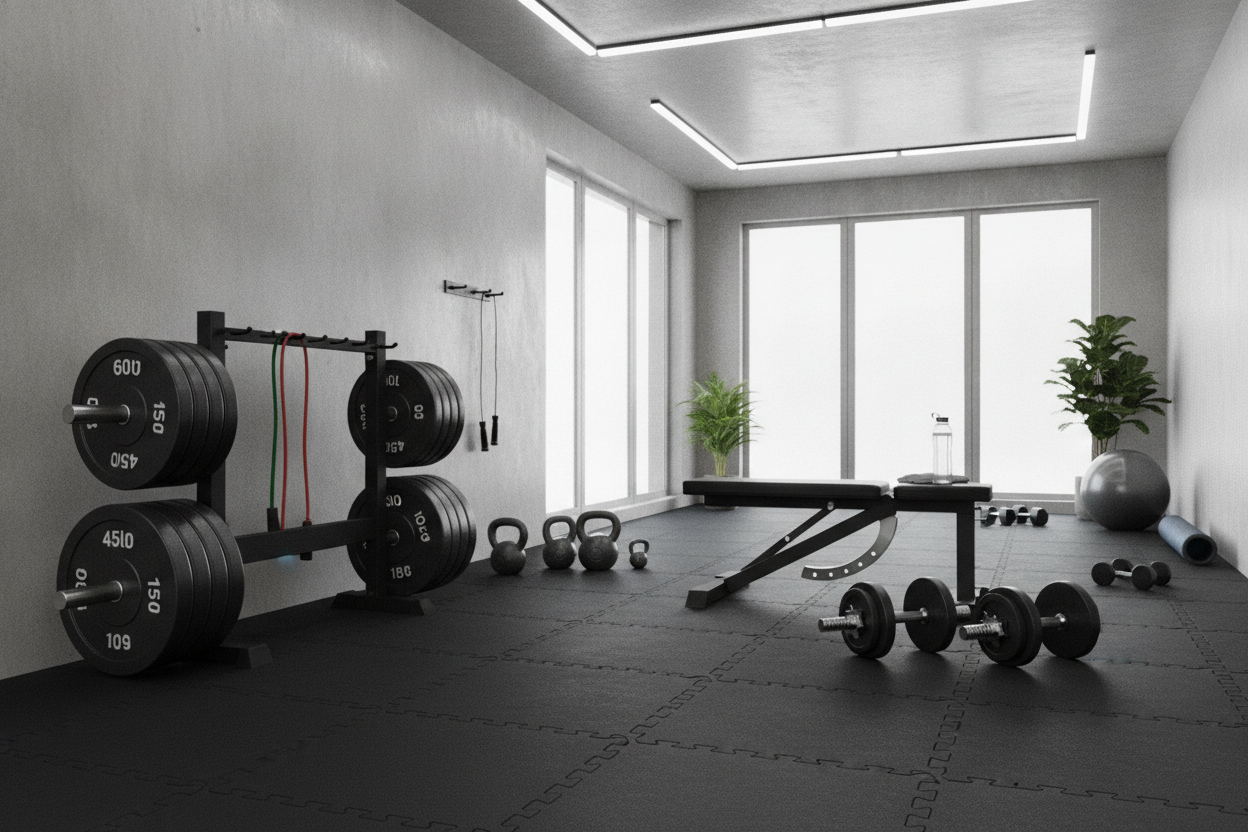
You need a high-friction surface. I always recommend a large exercise mat for home gym use because it creates a stable base for your feet to bite into. A yoga mat is too thin and will bunch up under your heels. You need something with density—at least 7mm—that won't move when you're driving through your midfoot. If you have the space, a dedicated 6x8ft exercise mat is the gold standard. It gives you enough room for lateral lunges and walking lunges without having to reset your position every two steps. It also protects your floor from the inevitable dropped dumbbell when your grip fails during that last set of RDLs.
A Brutal No-Rack Routine You Can Try Today
Here is a template I’ve used for months when I can’t get to the warehouse. It’s designed to be done with one or two dumbbells, or even a heavy backpack. Focus on the form, not the speed. If you finish this in 20 minutes, you didn't do it right.
- A1: Bulgarian Split Squats - 4 sets of 8-12 reps per leg. 4-second eccentric, 1-second pause at the bottom.
- B1: Goblet Squats - 3 sets of 15-20 reps. Constant tension (don't lock out at the top).
- C1: Single-Leg Romanian Deadlifts - 3 sets of 12 reps per leg. Focus on the hamstring stretch.
- D1: Deficit Reverse Lunges - 3 sets of 15 reps per leg. Stand on a thick book or a small plate for extra range.
If you still have gas in the tank after those four movements, you can finish with a quick bodyweight burnout circuit to completely flush the quads with blood. This is where you chase the metabolic stress. High reps, zero rest, total exhaustion.
My Personal Experience
I spent three years training in a 400-square-foot apartment. I thought my legs would shrink to nothing. I was wrong. I actually found that my knee pain vanished because I was doing so much unilateral work. The downside? My balance was so bad at first that I looked like a drunk sailor. I also once tried to use a heavy cooler as a weight—it leaked all over my carpet. Buy real weights, get a real mat, and don't overcomplicate it. The best workout is the one you actually do in your living room while your dinner is in the oven.
FAQ
Can I build big legs with just bodyweight?
To a point. Eventually, you need external resistance. If you don't have dumbbells, use a backpack filled with books or water jugs. You need enough tension to fail in the 10-20 rep range.
How often should I do a leg day workout at home?
Twice a week is the sweet spot for most people. It allows for enough recovery while keeping the frequency high enough to trigger muscle protein synthesis.
What if my balance is terrible?
Hold onto a wall or a sturdy chair with one hand during split squats. As you get stronger, try to rely on the support less. The goal is to train your legs, not join the circus.