I Ditched Heavy Plates for a Banded Pelvic Thrust Machine
I have spent way too many hours tripping over 45-pound plates in my 200-square-foot garage. For a long time, I was convinced that if I wanted real glute gains, I needed a massive, commercial-grade pelvic thrust machine. I even bookmarked a few that cost north of two grand and required a literal forklift to move.
Quick Takeaways
- Commercial units take up a massive 5x6 foot footprint you probably don't have.
- Bands provide peak tension at the top of the rep where glute contraction is highest.
- Setup time is slashed from minutes to seconds by ditching iron plates.
- A quality banded platform is a fraction of the cost of plate-loaded steel.
Why a Commercial Glute Drive Makes No Sense in Your Garage
Let’s be real: most of us are working with limited real estate. A standard plate-loaded pelvic thrust machine is a beast. It’s not just the machine itself; it’s the 'dead zone' you need around it to actually load the sleeves. If you're trying to hit a 400-pound thrust, you’re lugging eight plates across the gym just for one exercise.
Then there is the cost. You are looking at $1,200 to $2,500 for a single-station machine. In a home gym, every square inch needs to earn its keep. Spending that much money and floor space on a unit that only does one movement is a hard pill to swallow when you’re already tight on space for a power rack or a functional trainer.
Enter the Resistance Band Hip Thrust Machine
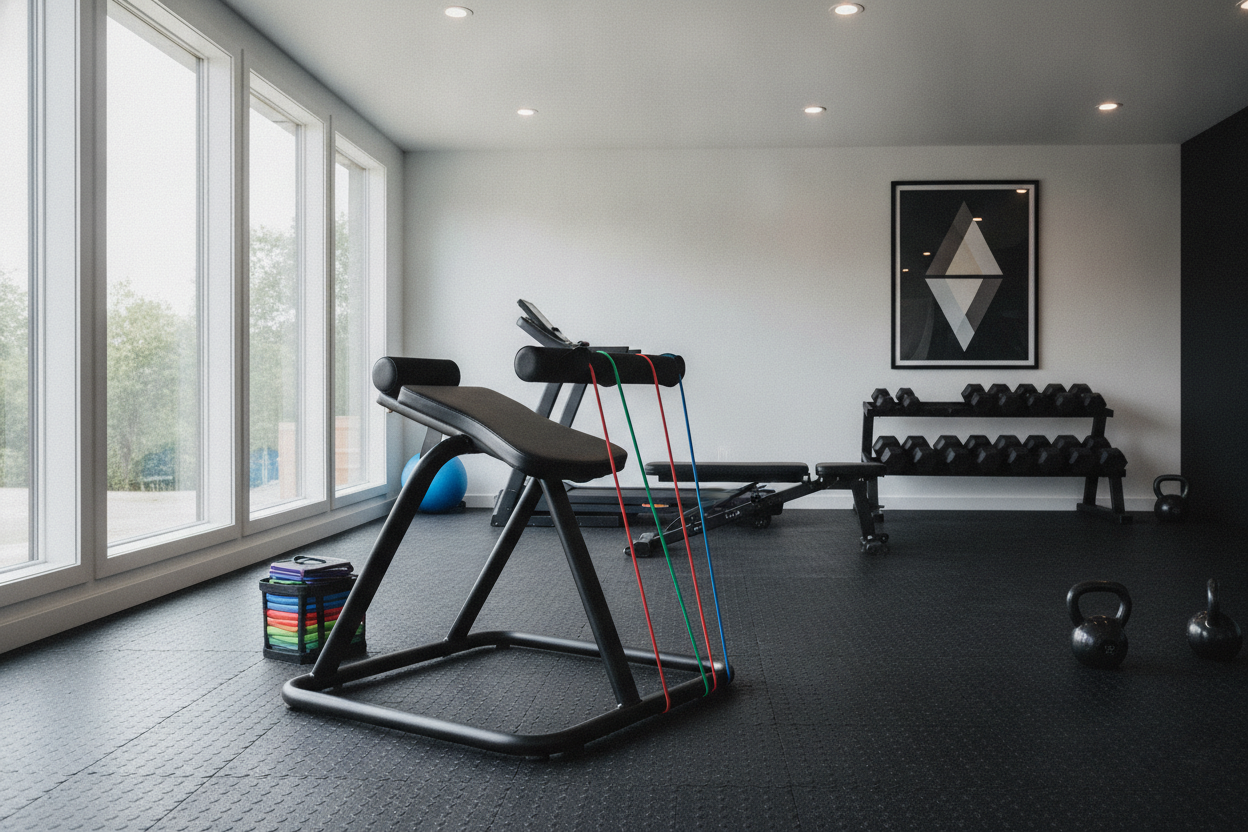
I eventually got fed up with the plate-loading circus and switched to a resistance band hip thrust machine. Instead of relying on gravity and iron, these setups use heavy-duty loop bands anchored to a steel base. It’s a completely different feel. When you use a barbell vs. hip thrust with band, you notice the weight doesn't drop off at the top.
With a band hip thrust machine, the resistance is 'accommodating.' This means the higher you thrust, the more the band stretches, and the harder the movement becomes. It matches your body’s natural strength curve perfectly. You are strongest at the top of a hip thrust, and that is exactly where the bands are trying their hardest to pull you back down.
The Science of the Squeeze: Why Bands Feel Harder Than Iron
I’ve seen guys who can move 400 pounds on a barbell absolutely crumble under 150 pounds of band tension. Why? Because you can’t cheat the lockout. With iron, momentum can carry you through the last few inches. With a banded pelvic thrust machine, the tension is exponential. If you don't fight for that final inch of hip extension, the band wins.
This constant tension means your glutes are under fire for the entire set. There is no 'resting' at the top of the rep like you might do with a barbell. My glute pumps since switching to bands have been significantly more intense, and my lower back feels way less beat up because I'm not compressing my spine with hundreds of pounds of static weight.
But Is a Banded Setup Actually Enough Weight?
The most common pushback I hear is that bands are 'too light.' That is usually coming from people who have only used the thin red bands for physical therapy. If you use a dedicated hip thrust bench with multiple peg levels, you can stack serious resistance. I regularly use a combination of 'Average' and 'Strong' bands that create over 300 pounds of peak tension.
The beauty is in the stacking. You can add a 50-pound band to a 100-pound band in three seconds. No clanging plates, no pinched fingers, and no floorboard-cracking drops. Unless you are an elite powerlifter who needs 600+ pounds of constant load, a high-quality banded setup will provide more than enough stimulus for hypertrophy.
How to Rig Your Setup Without Snapping a Band
If you’re worried about a band snapping and hitting you mid-set, join the club. The key is the anchor point. You need a platform that won't tip or slide. I’ve seen people try to DIY this with 2x4s, but a dedicated steel base is much safer. Much like how I eventually realized an exercise band machine could replace a bulky cable tower, a dedicated band platform is about stability.
Always check your bands for 'nicks' or 'cloudy' spots before you train. If you see a small tear, throw it away immediately. Also, make sure the bands are centered on your hips. If they are lopsided, the platform might shift, or you’ll end up with an uneven pump that’ll have you walking sideways for a week.
The Final Verdict: Keep Your Floor Space
I don't miss the commercial machine. My banded setup folds up and leans against the wall when I'm done. By ditching the massive footprint of a glute drive, I actually had room to add a more versatile leg machine like a compact leg press/hack squat combo. For 90% of home gym owners, the banded route is the superior choice for both your glutes and your floor plan.
FAQ
Do resistance bands build as much muscle as weights?
Yes, for hypertrophy, your muscles don't know the difference between the tension from a plate or a band. As long as you are nearing failure and progressively increasing the tension over time, you will grow.
Can I use any bench for banded thrusts?
You can, but it's risky. If the bench isn't heavy enough or bolted down, the tension of the bands can actually pull the bench toward your feet mid-rep. A dedicated platform with built-in anchors is much safer.
How long do the bands last?
If you buy high-quality layered latex bands and keep them out of direct sunlight, they’ll easily last 2-3 years of heavy use. Just do a quick 5-second inspection before your workout to check for wear.