How Much Anatomy of Working Out Do You Actually Need to Know?
I’ve been there—it’s 11:30 PM, you’re three deep into a YouTube rabbit hole, and some guy with a PhD is explaining why your pinky placement on a dumbbell row is the reason your lats aren't growing. You look at your 11-gauge steel power rack and suddenly feel like you need a medical degree just to do a set of curls. We’ve reached a point where people spend more time studying the anatomy of working out than they do actually moving heavy iron.
Quick Takeaways
- Movement patterns (push, pull, squat, hinge) matter more than memorizing muscle insertion points.
- Machines are great because they force your body into the right path without a kinesiology degree.
- Free weights build the 'hidden' stabilizer muscles that 3D charts often ignore.
- Small equipment adjustments, like bench angles, are the easiest way to shift muscle focus.
The Trap of the Social Media Biomechanics Expert
The 'optimal' police are everywhere. They’ll tell you that unless your arm is at a 30-degree scapular plane angle, your lateral raise is a waste of time. It’s enough to give any garage gym owner a massive case of analysis paralysis. While understanding workout muscle anatomy is a cool party trick, it’s often a distraction from the basics: intensity, consistency, and progressive overload.
I’ve seen guys with pristine home gyms—we’re talking custom cerakote bars and calibrated plates—who can’t squat 225 lbs because they’re too busy worrying about 'internal hip rotation' during their warm-up. Anatomy should be a map, not a cage. If you’re feeling the muscle work and your numbers are going up, you’re probably doing it right. Don't let a 3D muscle chart stop you from hitting a PR.
The Only Anatomy for Weight Training You Actually Need
You don't need to know the name of every minor stabilizer to build a respectable physique. Instead, simplify your anatomy for weight training into four big movement patterns: horizontal push/pull, vertical push/pull, squat, and hinge. If you cover these, you’re hitting every major muscle group your body owns.
When you learn How To Master Equipment Training Weight For Real Muscle Growth, you realize that your muscles don't know if you're using a $1,000 barbell or a sack of sand. They only know tension. Focus on the big movers—the pecs, lats, quads, and glutes—and the smaller 'vanity' muscles like the biceps and triceps will usually follow along for the ride. Programming becomes a lot easier when you stop thinking in 'muscles' and start thinking in 'movements.'
Why Machines Make Muscle Targeting Idiot-Proof
There’s a certain elitism in the home gym world that says you only need a rack and a bar. But honestly? Machines are the ultimate shortcut for mastering weight lifting anatomy. Because the path is fixed, the machine handles the stability, leaving you to just focus on the squeeze. It’s hard to mess up the 'line of pull' when the machine only moves one way.
I’m a big fan of adding Weight Lifting Machines to a home setup once you have the space. They allow you to train to absolute failure without worrying about a bar crushing your windpipe. Using Machine Weight Training The Blueprint For Safe Muscle Growth strategies means you can isolate a lagging muscle group without needing a spotter or a master's degree in biomechanics. It’s efficient, safe, and honestly, the pump is usually better.
But Don't Forget Your Stabilizers in the Rack
While machines are great for isolation, the real workout muscle anatomy magic happens when you have to stabilize a load yourself. This is where the deep core and spinal stabilizers come into play. If you only ever use machines, those 'hidden' muscles get lazy, which is a fast track to a lower back tweak when you try to move a couch in real life.
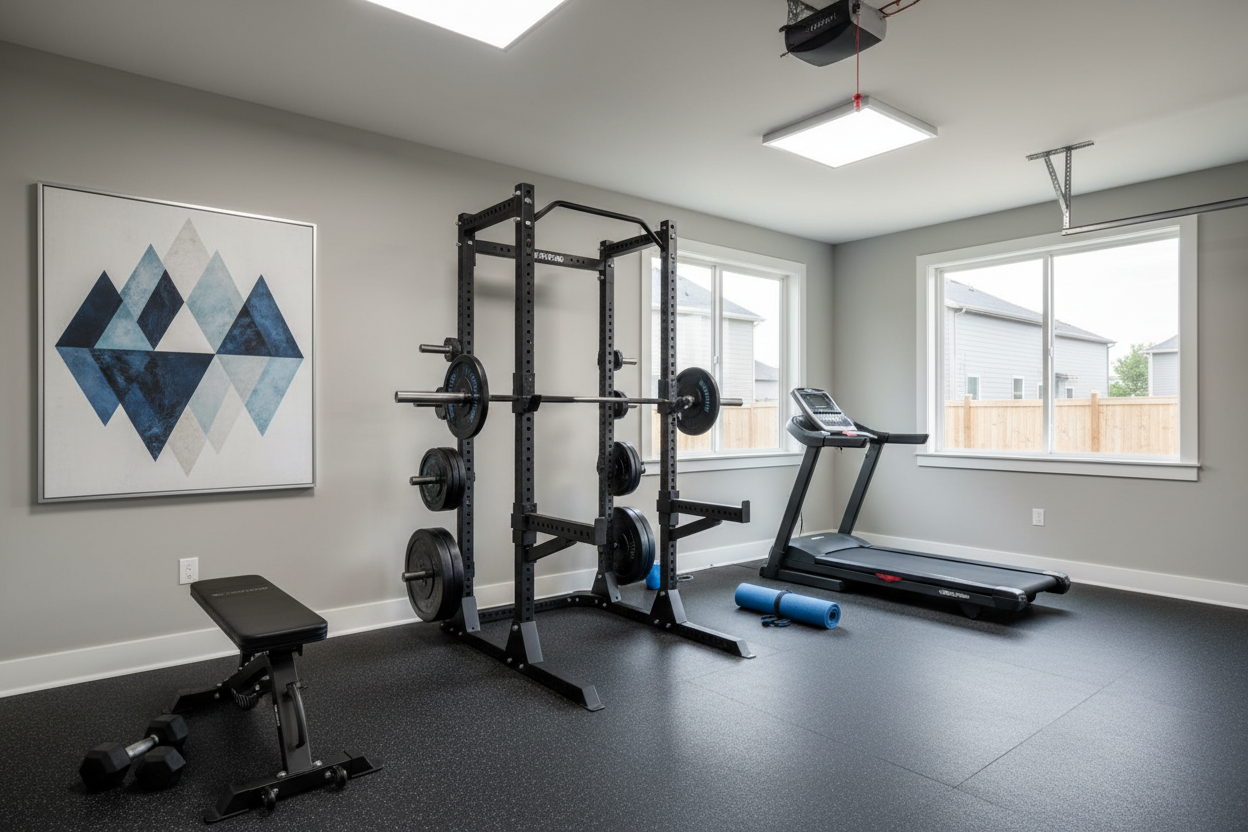
The Gxmmat X6 Power Rack Weight Bench Package is the perfect testing ground for this. When you're doing an overhead press or a heavy back squat inside a rack, your body has to work as a single unit. You aren't just hitting your shoulders or legs; you're forcing every muscle from your traps to your arches to fire. That’s the kind of functional strength that a leg extension machine just can’t replicate.
Practical Tweaks to Hit the Right Muscles at Home
You don't need to buy a new piece of equipment for every muscle. You just need to understand how to manipulate the gear you already have. Simple environmental changes can completely shift which part of your anatomy for weight training is taking the brunt of the load. Grip width on a pull-up bar or the position of your feet on a squat can change everything.
The best tool for this is a high-quality Gxmmat Adjustable Weight Bench. By moving from a flat position to a slight incline, you shift the tension from the mid-chest to the clavicular head (the 'upper chest'). You don't need a new exercise; you just need a 30-degree shift in your environment. Small tweaks are often more effective than completely overhauling your program every three weeks because you read a new anatomy blog.
My Personal Lesson in Overthinking
I once spent a solid month trying to optimize my 'lat engagement' on rows. I bought specialized grips, watched ten hours of anatomy videos, and spent every set over-analyzing my elbow path. My back actually got smaller. Why? Because I was so focused on the 'perfect' anatomical squeeze that I stopped using heavy weights. I went back to basic, heavy, slightly 'ugly' rows and my back started growing again. Moral of the story: don't let the science kill the effort.
FAQ
Do I need to memorize muscle names to get big?
Not at all. Knowing that your 'biceps brachii' has two heads won't make your curls more effective. Focus on the feeling of the muscle contracting and the weight on the bar.
What is the most important part of anatomy to understand?
Understand the difference between a hinge (hips back, like a deadlift) and a squat (knees forward). Mastering that distinction will save your lower back more than any Latin vocabulary list ever will.
Are free weights better than machines for learning anatomy?
Free weights teach you how your body moves as a unit, while machines teach you how to feel a specific muscle. You need both for a well-rounded physique.