
Hip Flexor Warm Up: 5 Dynamic Drills, Pelvic Alignment Mechanics, and Floor Mat Staging
Preparing the anterior hip complex prior to heavy lifting, running, or agility work requires more than passive stretching. An intentional hip flexor warm up primes the psoas, iliacus, rectus femoris, and surrounding stabilizers for loaded movement through active range-of-motion drills. By shifting away from prolonged, static holds before a workout and focusing on dynamic movement sequencing, lifters and athletes can optimize hip mechanics, coordinate pelvic alignment, and establish solid ground contact.
Why Dynamic Hip Flexor Preparation Matters Before Training
The hip flexor group bridges the lower spine, pelvis, and femur, playing a central role in both lower-body power generation and torso stabilization. Prolonged daily sitting often leaves these tissues in a shortened, resting position. Heading straight into deep squats, lunges, or sprints without a deliberate hip mobility warm up can lead to compensatory movement patterns, such as lumbar hyperextension or poor glute engagement.
Understanding how to warm up hips effectively involves active elongation and contraction cycles. Dynamic hip warm ups elevate local tissue temperature, circulate synovial fluid within the acetabulofemoral joint, and reinforce active neurological control at end ranges. Rather than temporarily relaxing muscle tone through static holds, dynamic movement prepares the hip capsule for multi-planar loading while preserving dynamic force production.
Biomechanical Fundamentals: Pelvic Control and Reciprocal Activation
A frequent error when executing a warm up exercise for hips is allowing the lumbar spine to arch excessively in an attempt to reach deeper extension. True hip extension occurs at the hip joint itself, not through lumbar lordosis. To warm up hip flexors with precision, athletes should establish a neutral to slight posterior pelvic tilt before initiating movement.
Reciprocal inhibition is a key biomechanical principle in this process: actively contracting the gluteus maximus on the trailing leg signals the opposing hip flexor complex to relax and lengthen cleanly. Integrating adductor and abductor stability alongside sagittal flexor work—as explored in our hips hip guide—creates a balanced, fully stabilized pelvis capable of handling compound loading.
5 Foundational Dynamic Hip Warm-Up Exercises
Implementing targeted hip warm-up exercises before training ensures comprehensive joint preparation. The following movement blueprints progress from ground-based kneeling drills to expansive multi-planar sequences.
1. Half-Kneeling Dynamic Psoas Glides with Posterior Tilt
The half-kneeling glide isolates the deep psoas and rectus femoris while reinforcing core bracing. Begin in a 90/90 half-kneeling stance on a supportive training surface. Tuck the pelvis slightly under to eliminate lumbar arching and squeeze the glute of the down knee. Maintaining this active contraction, glide forward a few inches until a controlled stretch is felt along the front of the hip. Hold for two seconds, return to the start, and repeat for 8 to 10 rhythmic repetitions per side.
2. 90/90 Dynamic Hip Rotations and Forward Hinges
Seated 90/90 transitions serve as an exceptional hip openers warm up by challenging both internal and external rotation simultaneously. Sit tall on the floor with both knees bent at 90-degree angles. Hinge forward over the lead hip with a flat spine, return to upright, and then pivot your knees smoothly to the opposite side without using your hands for support if balance allows. For broader floor routine ideas, review our hip mobility exercise guide to refine your seated floor work.
3. Quadruped Rockbacks with Lateral Leg Extension
This drill addresses the adductors, pectineus, and hip capsule. Start on all fours with hands beneath shoulders and knees beneath hips. Extend one leg straight out to the side with the entire foot flat on the floor. Keeping your spine neutral and hands firmly planted, slowly rock your hips back toward your supporting heel. Pause briefly at the point of gentle tension along the inner thigh and anterior hip, then glide back forward for 8 to 10 controlled reps before switching legs.
4. World's Greatest Stretch with Thoracic Reach
Often considered the gold standard for full-body readiness, this multi-planar sequence links deep hip extension, ankle dorsiflexion, and thoracic rotation. Step into a deep runner's lunge, placing both hands inside the front foot on a stable large exercise mat that provides ample traction. Drop the inside elbow toward the instep, then rotate the torso upward, reaching the same arm toward the ceiling while driving the rear heel back to lengthen the trailing hip flexor.
5. Standing Dynamic Hip Swings and Controlled Circles
To conclude your hip flexor warm ups, transition to standing drills that mimic the cadence of upright athletic movement. Lightly support yourself against a wall or power rack. Swing one leg forward and backward in a smooth pendulum motion, focusing on contracting the glute at the back of the swing without overarching the lower back. Follow with dynamic standing hip circles (opening and closing the gate) for 10 repetitions per leg to lubricate the joint across frontal and rotational planes.
Workout Floor Staging: Kneeling Cushioning and Grip Stability
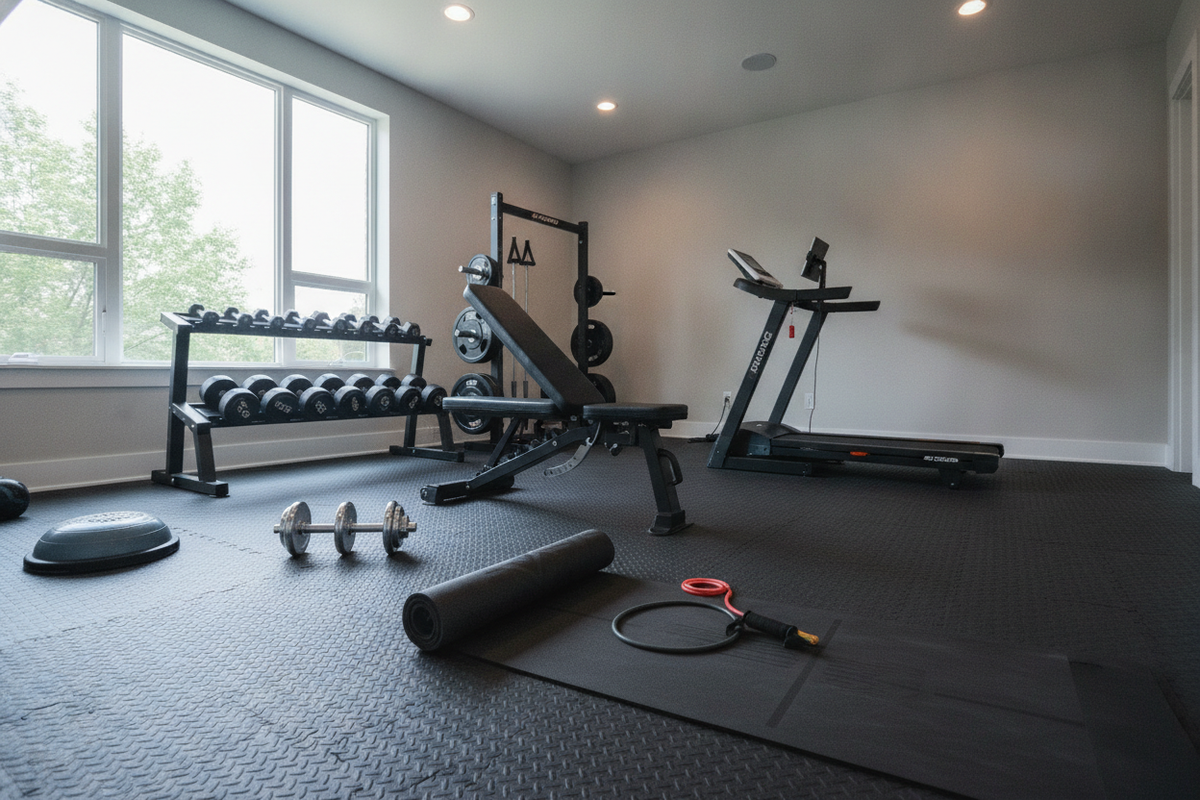
Dynamic hip drills place concentrated pressure on the patella and require reliable shoe or barefoot traction during dynamic lunges and reaches. Staging your mobility zone with a dedicated high-density exercise mat provides necessary joint protection during half-kneeling glides, preventing discomfort on hard concrete or hardwood home gym floors.
Furthermore, dynamic multi-directional stretches require an expansive, non-slip boundary. Setting up a dedicated 6x10ft exercise mat provides seamless floor coverage, allowing you to transition between quadruped rockbacks, deep lunges, and standing swings without constantly resetting your footing or stepping off the padded boundary.
Structuring Your Hip Mobility Warm Up: Session Sequencing and Mat Care
A well-designed warm-up sequence takes between five and eight minutes and fits seamlessly into your pre-lift routine. Follow this practical framework to structure your movement preparation:
- General Elevation (2 minutes): Light rowing, skipping, or brisk walking to elevate core temperature.
- Ground-Based Positional Control (3 minutes): Half-kneeling psoas glides and quadruped rockbacks (8–10 reps per side).
- Rotational & Multi-Planar Flow (2 minutes): 90/90 transitions and World's Greatest Stretch (5–6 reps per side).
- Dynamic Upright Activation (1 minute): Standing hip swings and controlled circles before loading the barbell.
Maintaining your workout surface is equally straightforward. After completing floor drills, wipe down your mat with a mild soap-and-water solution or neutral gym equipment wipe, and allow it to air dry fully before rolling or stacking to keep your training area clean and ready for the next session.


