5 Exercises to Trim Hips and Thighs: Biomechanical Blueprints, Tension Cues, and Floor Staging
Understanding Hip and Thigh Sculpting: Tension Mechanics and Structural Alignment
Developing a firmer lower body relies on progressive resistance, multi-planar movement patterns, and steady muscular tension. When programming exercises to trim hips and thighs, the objective is to challenge the gluteal complex, quadriceps, hamstrings, and hip adductors through full joint articulation rather than attempting localized spot reduction. Adopting balanced movement planes encourages comprehensive muscle engagement across the entire pelvic girdle.
The Mechanics of Lower-Body Definition: Beyond Spot Reduction
Muscular definition emerges as muscle fibers adapt to mechanical load and controlled eccentric phases. Learning how to tighten hips involves engaging both primary movers and stabilizing musculature, such as the gluteus medius, tensor fasciae latae, and deep hip rotators. When training on supportive surfaces, maintaining structural alignment from the feet through the pelvis ensures that the target muscles absorb the work rather than placing undue stress on connective tissues. For a deeper technical perspective on lower-body training parameters, consult this exercise thighs hips guide.
Realistic Progressions: Assessing Toned Hips Before and After Structured Training
Evaluating your physique when aiming for toned hips before and after consistent training requires patience and consistent tracking of movement quality. Visible changes in lower-body contours stem from gradual increases in training density, improved motor recruitment, and disciplined posture. Setting realistic expectations around progressive overload and movement symmetry creates a sustainable foundation for long-term lower-body strength and shape.
Compound Movement Blueprints: Multi-Planar Knee and Hip Dominance
Compound exercises recruit large muscle groupings simultaneously, elevating training efficiency and establishing stable movement patterns across both hips and knees.
1. Tempo Goblet Squat: Quad Depth and Adductor Engagement
The tempo goblet squat reinforces bilateral hip tracking while actively working the quadriceps, glutes, and adductor magnus. Holding a single load at chest height naturally shifts the center of gravity slightly forward, assisting with an upright torso position.
- Execution Blueprint: Stand with feet slightly wider than hip-width apart, toes turned outward comfortably. Lower down into the squat across a slow count, keeping your chest tall and knees tracking over your mid-to-outer toes. Pause briefly at the bottom position before pressing evenly through your whole foot to return to standing.
- Tension Cue: Actively spread the floor with your feet during both the descent and ascent to maintain constant activation along the lateral hip complex.
2. Dynamic Lateral Lunge: Frontal-Plane Loading and Inner Thigh Control
Frontal-plane movements build strength in angles often neglected during standard forward-and-backward walking or running patterns. The lateral lunge directly challenges the abductors of the working leg and the adductors of the trailing leg.
- Execution Blueprint: Begin standing tall with feet parallel. Step out wide to one side, hinging at the hip while sitting back over the trailing heel. Keep the non-working leg straight with the foot grounded, then press firmly off the bent leg to return to the starting position.
- Tension Cue: Keep your pelvis level throughout the lateral shift to avoid rotation at the lumbar spine.
Targeted Hip and Outer Thigh Isolation Blueprints
Complementing compound lifts with focused isolation movements allows you to concentrate tension directly into the outer hips, upper glutes, and posterior chain. For additional programming variations covering hip and glute development, review this exercise thighs guide.
3. Deficit Curtsy Lunge: Glute Medius and Lateral Hip Tension
The curtsy lunge introduces rotational torque across the hip joint, heavily engaging the gluteus medius and piriformis to stabilize the pelvis.
- Execution Blueprint: Step one leg diagonally behind the other, bending both knees as if performing a curtsy. Lower down until the front thigh is nearly parallel to the floor, ensuring the front knee stays aligned with the front foot. Drive through the front heel to return upright.
- Tension Cue: Resist excessive pelvic twisting by keeping both hip crests squared forward throughout the repetition.
4. Quadruped Fire Hydrant with Isometric Pause: Outer Hip Activation
Ground-based hip abductions isolate the lateral hip stabilizers without requiring heavy external loading, making them gentle on the lower spine while challenging muscular endurance.
- Execution Blueprint: Position yourself on hands and knees with your wrists beneath your shoulders and knees beneath your hips. Keeping the working knee bent at a right angle, lift the leg out to the side without shifting weight excessively to the opposite side. Hold for a brief pause at the peak of contraction, then lower with control.
- Tension Cue: Brace your core musculature to prevent arching or rotating through the lower back as the leg lifts.
5. Elevated Glute Bridge with Banded Abduction: Pelvic Stability and Posterior Chain Tightening
Combining hip extension with continuous lateral abduction recruits the gluteus maximus along with the hip abductor complex, reinforcing pelvic balance and firming the posterior thigh.
- Execution Blueprint: Lie supine with your upper back supported or feet set flat on a non-slip surface, placing a resistance loop just above your knees. Drive through your heels to extend your hips until your torso and thighs form a straight line. At the top, press your knees outward against the band, return to neutral, and lower slowly.
- Tension Cue: Squeeze the glutes firmly at full hip extension rather than overarching through the lower back.
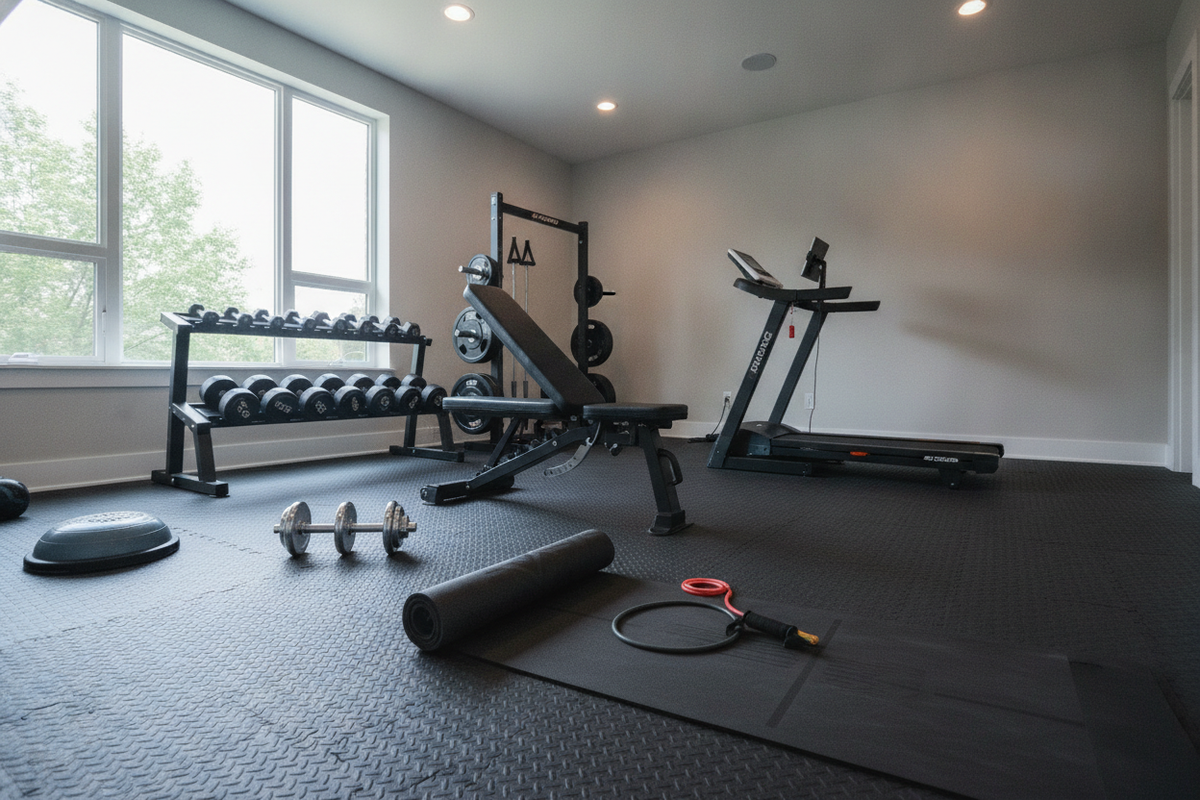
Home Gym Floor Staging and Joint Protection for Lower-Body Workouts
Executing dynamic lower-body routines requires intentional home gym staging. Unyielding hard floors or overly slippery surfaces compromise exercise form and can cause discomfort during floor-based movements.
Subfloor Protection and Traction During Dynamic Lateral Drills
Multi-directional movements, such as lateral lunges and curtsy lunges, exert distinct horizontal shear forces on your flooring. Setting up a dedicated high-density exercise mat ensures reliable shoe-to-ground grip, preventing sudden slips during explosive drive-offs. Furthermore, a firm training surface absorbs foot strikes, guarding underlying hardwood or tile against impact damage.
High-Density Mat Cushioning for Kneeling and Floor Work
Floor-based exercises like quadruped fire hydrants and glute bridges concentrate body weight directly over sensitive contact points, such as the patella, wrists, and shoulder blades. High-density foam or textured rubber mats provide resilient cushioning that distributes pressure evenly without compressing completely flat, protecting joints and allowing you to hold tension comfortably through long isometric pauses.
Mat Maintenance and Equipment Placement in Compact Spaces
To keep your workout area safe and organized, position your main workout mat with ample clearance on all four sides for unrestricted lateral steps. Clean your training mat regularly with mild soapy water or gym-safe surface wipes to remove sweat and maintain optimal surface tackiness, ensuring a stable, supportive foundation for every lower-body training session.