Group HIIT Workout Guide: Partner Circuit Blueprints, Class Formats, and Multi-User Flooring Setups
Dynamics of Group HIIT: Why Collective Interval Training Thrives
Executing a group hiit workout introduces an element of shared momentum that solitary workouts rarely duplicate. Whether you train with a single workout partner in a garage gym or manage a small cohort in a studio, hiit group fitness leverages shared effort, structured timing, and collective accountability. High-intensity group interval training blends brief surges of high-output exertion with controlled recovery periods, providing a flexible framework that scales across various training spaces.
Collective training structures also remove decision fatigue. When a session follows predetermined interval clocks or station rotations, participants can focus entirely on movement execution and pacing. Furthermore, training in pairs or small groups builds steady workout consistency, as scheduled partner sessions encourage regular attendance and mutual motivation.
Structural Formats for Group HIIT Classes and Partner Training
Designing a smooth group hiit class requires selecting an operational format that matches your available space, equipment roster, and participant count. For general session architecture, consulting a comprehensive home workout training guide can help establish basic periodization and warm-up routines before diving into intense interval work.
Synchronized Intervals vs. Station-Based Rotations
Two primary structures dominate hiit group training environments:
- Synchronized Work Intervals: All participants perform the same exercise or target interval simultaneously on a unified timer (for example, 40 seconds of work followed by 20 seconds of rest). This approach simplifies pacing, unifies rest periods, and keeps the group visually aligned.
- Station-Based Rotations: Participants rotate through dedicated movement zones (such as a lower-body station, an upper-body station, a core zone, and a cardio drill). Station structures distribute equipment usage efficiently, allowing two or three people to share limited weights or resistance tools without waiting.
- "You Go, I Go" (YGIG) Circuits: One partner performs a set rep target while the other rests or holds an isometric position, alternating immediately upon completion. This introduces natural autoregulation based on individual completion speed.
Managing Mixed Fitness Levels in a Single Group Session
In any collective session, participants naturally possess varying baseline stamina and technical familiarity. To ensure everyone experiences an appropriate stimulus without creating bottlenecks, establish baseline regression options for each planned movement:
- Impact Regressions: Pair high-impact movements with low-impact alternatives, such as substituting step-back lunges for jumping split squats, or bodyweight squats for tuck jumps.
- Tempo and Range Adjustments: Allow newer participants to focus on controlled eccentric tempo and partial ranges of motion while advanced trainees work through full explosive ranges.
- Load Selection: Keep bodyweight versions accessible for every loaded drill so trainees can drop external resistance at any point during an interval.
Sample Group HIIT Workout Ideas and Circuit Blueprints
These practical hiit group workout ideas can be deployed in living rooms, garages, or training studios using minimal equipment.
Blueprint 1: The Synchronized 4-Station Bodyweight Matrix
Perform four total rounds. Work for 45 seconds, rest for 15 seconds, and take a full 60-second transition rest between complete rounds.
- Station 1 (Lower Body Power): Alternating jump lunges or rhythmic reverse lunges.
- Station 2 (Upper Body Push): Tempo push-ups or hand-release push-ups.
- Station 3 (Cardio Core): Mountain climbers or slow cross-body knee drives.
- Station 4 (Full-Body Dynamic): Skater hops with lateral stick or lateral side steps.
Blueprint 2: The Partner YGIG Contrast Circuit
Partner A completes their work while Partner B holds an active support position, switching roles after each mini-set. Combining explosive movements with steady strength movements draws on proven contrast training methods to challenge multiple energy systems.
- Movement Pair 1: Partner A performs 10 kettlebell swings or dumbbell snatches using versatile strength accessories while Partner B holds a high plank. Complete 3 sets each.
- Movement Pair 2: Partner A executes 8 burpees over a mat line while Partner B maintains an isometric wall sit. Complete 3 sets each.
- Movement Pair 3: Partner A executes 12 alternating lateral bounds while Partner B holds a hollow-body hold. Complete 3 sets each.
Following Digital and Video Workouts with Multiple Participants
Streaming follow-along sessions or a group hiit youtube workout is a common way to conduct partner training at home. When multiple people follow a single screen, set up the space carefully to maintain clean sightlines.
Position your streaming display slightly above eye level so both participants can view interval countdowns without straining their necks during floor exercises. Orient training mats at parallel or staggered angles toward the screen, ensuring that neither partner's lateral leaps or floor movements obstruct the other's view of the timer cues.
Space Planning, Buffer Zones, and Equipment Staging
Dynamic, multi-person interval workouts involve rapid transitions, sprawling floor drills, and lateral jumps. Organizing your floor plan with clear perimeter safety zones prevents collisions and tripping hazards.
- Individual Movement Footprint: Allocate an active movement envelope around each participant that extends beyond the edge of their individual mat.
- Buffer Perimeter: Maintain an unobstructed buffer between training stations and surrounding walls, support posts, or storage shelving.
- Central Transition Pathway: If using a circuit setup with multiple stations, keep a clear central walking path so partners can rotate between zones without stepping across active exercise areas.
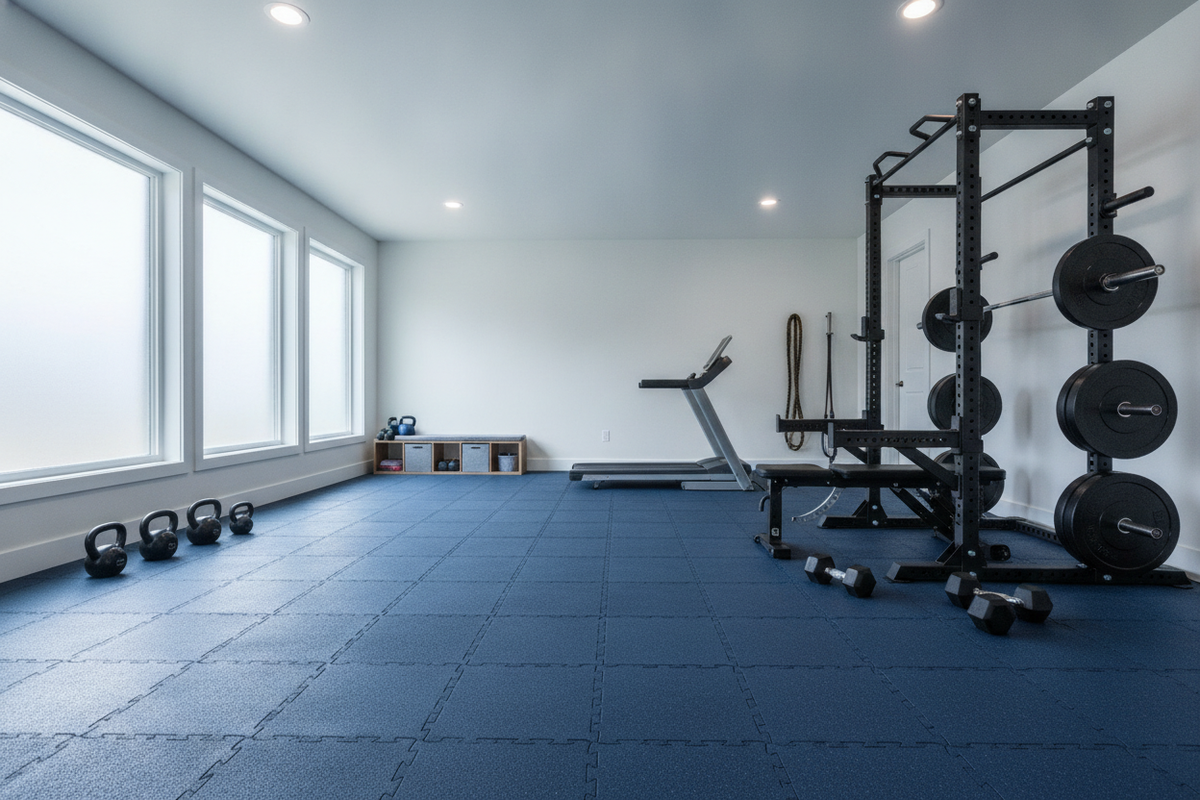
- Flooring Stability: Grounding the space with wide non-slip exercise flooring creates a cohesive boundary that prevents individual mats from sliding apart during lateral bounds.
Multi-User Flooring Solutions: Traction, Room Protection, and Mat Stability
Standard single-person yoga mats (typically 24 inches wide) are unsuited for simultaneous partner intervals. Multi-directional movements, sprawling burpees, and alternating footwork quickly push exercisers off the edges of narrow mats, leading to uneven footing and mat slippage.
Outfitting your space with a dedicated large multi-user workout mat provides several technical benefits for shared training environments:
- Continuous Surface Coverage: An expanded mat footprint allows two people to train side-by-side or face-to-face without shifting individual pads across the floor.
- Subfloor Impact Attenuation: Dynamic jumping, plyometric landing, and kettlebell placement require dependable floor shielding to protect concrete, tile, or hardwood subfloors.
- Dual-Sided Traction: Textured bottom surfacing grips the underlying floor to prevent migration, while a non-slip top layer maintains traction under intense footwear use and sweat.
- Simple Cleaning and Maintenance: Closed-cell surfaces resist moisture absorption, allowing fast wipedowns between group rounds to maintain hygienic conditions.
By pairing intentional station layouts, scalable interval blueprints, and a secure multi-user flooring foundation, you can transform any open room into a dynamic, safe, and motivating group interval training environment.