Lower Body No Weight Exercises: Tension Frameworks, Bodyweight Circuits, and Home Mat Stability
Biomechanical Principles of Weight-Free Lower-Body Training
Developing lower-body strength and muscular endurance without external barbells or dumbbells requires intentional biomechanical manipulation. When load is constant—limited to body mass—muscular tension must be generated through deliberate mechanical disadvantage, manipulated tempo, extended ranges of motion, and unilateral stabilization. Relying solely on momentum or high-speed repetitions often reduces muscle recruitment across target muscle groups like the quadriceps, hamstrings, and glutes.
By prioritizing continuous tension, practitioners can elevate the stimulus of standard lower body no weight exercises to match the demanding conditioning stimulus of loaded training sessions.
Manipulating Tempo and Isometric Pauses for Muscle Recruitment
Cadence control alters the difficulty of bodyweight training. Slowing the eccentric, or lowering, phase of a movement demands continuous motor unit recruitment while minimizing joint stress. For instance, executing a descent over three to four seconds prevents bouncing at the bottom position, ensuring that the target musculature manages the load throughout the entire movement arc.
Introducing isometric pauses at the point of maximum mechanical tension—such as the bottom of a deep squat or the mid-point of a split squat—eliminates the stretch reflex. This static hold forces stabilizers across the ankles, knees, and hips to maintain structural alignment. Eliminating the lockout at the top of repetitions keeps target tissues under continuous metabolic strain.
Unilateral Progression Mechanics
Transitioning from bilateral movement patterns to single-leg variations shifts load distribution significantly. Unilateral work naturally doubles the effective resistance placed on the working limb while introducing a rotational and lateral stability demand that bilateral squats cannot replicate.
Progressing from standard squats to staggered-stance split squats, elevated rear-foot positions, and single-leg hinge patterns requires active pelvic stabilization. This single-leg focus recruits the gluteus medius and deep hip rotators to prevent lateral hip drop and knee valgus, building balanced functional control across both limbs.
Foundational Lower Body No Weight Exercises by Movement Pattern
A comprehensive routine balances knee-dominant, hip-dominant, and multi-planar movements. Organizing training around fundamental movement patterns ensures balanced development between the anterior and posterior kinetic chains.
Squat and Lunge Variations for Anterior Chain Loading
Knee-dominant patterns primarily target the quadriceps while engaging the glutes and core musculature:
- Tempo Air Squats: Stand with feet shoulder-width apart, descending under strict control while maintaining an upright torso, mid-foot balance, and complete hip depth before driving upward without locking out the knees.
- Bulgarian Split Squats: Elevate the rear foot on a stable ledge or low bench. Lower the trailing knee vertically toward the floor, keeping the forward shin vertical to place isolated tension on the lead quadricep and glute.
- Alternating Reverse Lunges: Stepping backward reduces anterior shear stress on the front knee compared to forward lunges, allowing for controlled deceleration and deep hip flexion.
- Curtsy Lunges: Stepping diagonally behind the front leg challenges the hip abductors and vastus medialis through transverse-plane rotation.
Posterior Chain Mechanics: Hinges and Glute Bridges
Targeting the hamstrings, gluteus maximus, and spinal erectors without weights requires focused hip-hinge mechanics and ground-based activation drills:
- Single-Leg Romanian Deadlifts: Hinge at the hips with a soft knee bend on the standing leg, extending the opposite leg backward in line with the torso to load the working hamstring and glute.
- Elevated Single-Leg Glute Bridges: Lie supine with one heel placed on an elevated surface or flat on the floor, driving through the heel into full hip extension to maximize glute contraction.
- Quadruped Hip Extensions: Positioned on hands and knees, drive the heel toward the ceiling while maintaining a neutral lumbar spine to isolate hip extension without spinal compensation.
- Frog Pumps: Bring the soles of the feet together in a supine position and bridge upward to target the gluteal complex through combined hip abduction and external rotation.
Structuring an Effective Lower Body No Weight Workout
Assembling individual movements into a coherent session requires managing work-to-rest ratios, movement order, and pre-exhaustion techniques. A well-designed lower body no weight workout delivers high training density while preserving movement quality.
Dynamic Warm-Up and Joint Mobility Preparation
Before initiating high-cadence or deep-range lower body work, dynamic mobility preparation primes joint articulation. Focus on active ankle dorsiflexion rocks, deep bodyweight Cossack squats, and quadruped fire hydrants. This routine elevates tissue temperature, lubricates the hip and knee capsules, and activates the core stabilizers necessary for balance.
Sample Time-Dense Circuit Architecture
Structuring movements into alternating pairs or multi-exercise circuits maintains training intensity while allowing local muscular recovery. The following template demonstrates a balanced, non-weighted lower-body circuit:
- Bulgarian Split Squats: 10 to 12 repetitions per leg with a 3-second descent and a 1-second pause at the bottom.
- Single-Leg Romanian Deadlifts: 10 to 12 repetitions per leg focusing on slow eccentric hamstring loading.
- Alternating Lateral Lunges: 16 to 20 total repetitions moving side to side through the frontal plane.
- Supine Glute Bridges with Static Hold: 15 repetitions concluding with a 15-second isometric hold at the peak.
Rest for 60 to 90 seconds after completing all four movements, repeating the circuit for three to four total rounds.
Flooring, Surface Traction, and Joint Protection for Bodyweight Leg Workouts
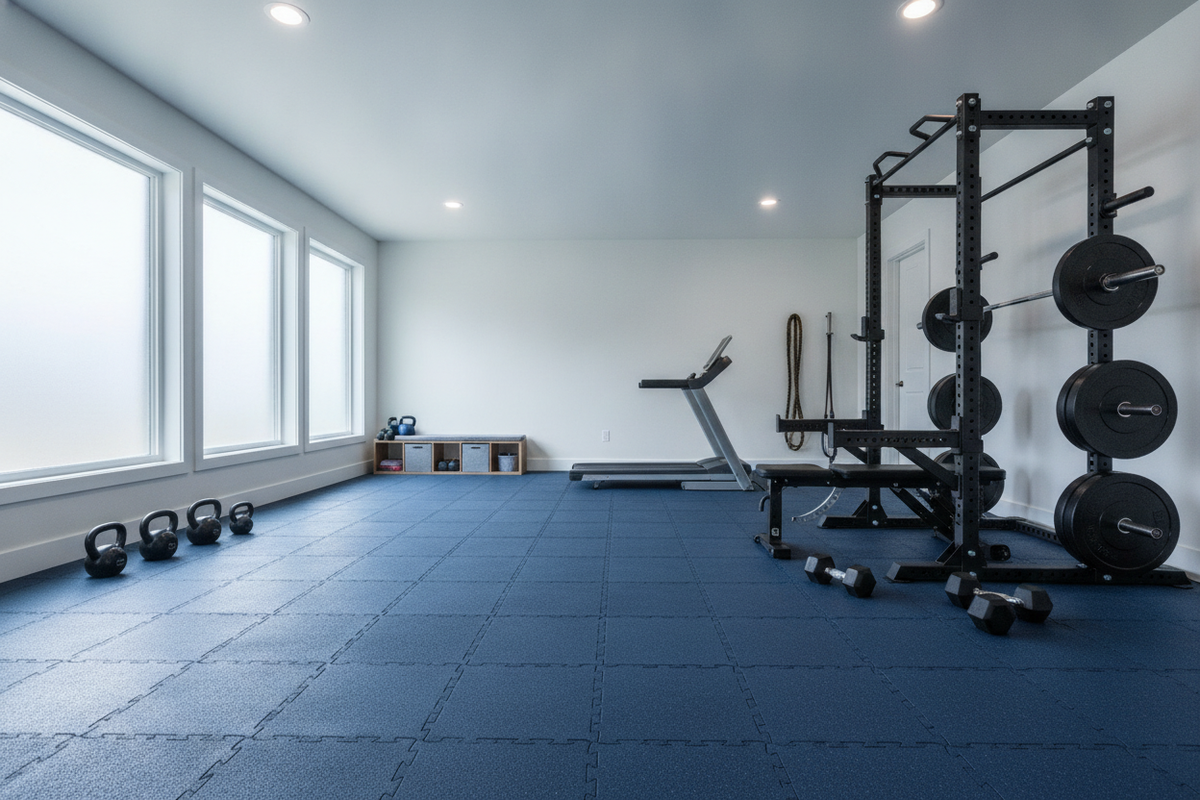
Home training surfaces directly dictate movement mechanics, balance, and joint comfort. High-density floor support is foundational when performing high-repetition bodyweight leg workouts on domestic subfloors.
Using a large-format workout product creates a dedicated training boundary that shields underlying hardwood, laminate, or tile from sweat, scuffing, and localized friction while providing a stable foundation.
Traction Under High-Friction Lateral and Dynamic Movements
Lateral lunges, skater bounds, and split-stance transitions generate multidirectional shear forces against the floor. Hardwood surfaces or shifting area rugs often present slip hazards that cause trainees to shorten their stride or limit joint depth out of caution.
A specialized exercise mat featuring a textured, non-skid backing provides consistent foot grip. This reliable traction allows you to push off forcefully during lateral transitions and maintain firm balance without foot slippage.
Cushioning Support for Ground-Contact and Kneeling Positions
Repetitive ground contact during reverse lunges, kneeling hip thrusts, and quadruped drills can cause uncomfortable pressure on knee joints when executed directly on unyielding floors. Incorporating a dedicated high-density workout product provides firm impact absorption that dampens pressure points without creating an unstable, overly soft platform that disrupts balance.
Progression Pathways: Transitioning Toward Loaded Movements
As bodyweight movements become familiar and volume thresholds are reached, trainees can gradually introduce progressive overload through external tools. Exploring a detailed lower body workout guide allows you to integrate incremental loads, such as weighted vests, which add resistance while preserving the functional freedom of bodyweight movements.
For those expanding their home gym capabilities, referencing a comprehensive exercise weight lower guide helps transition movement patterns into barbell and dumbbell training. Trainees aiming for maximum hypertrophy and dedicated loading can also browse a specialized lower body collection to incorporate targeted machines that isolate specific muscle groups under controlled paths of motion.