Best Home Fitness Workout: The Contrast Training Method
I remember staring at my 52.5-pound adjustable dumbbells in my cramped 400-square-foot apartment a few years ago. I had maxed out the weight on my goblet squats and felt my progress stalling. I didn't have the space or budget for a 300-pound barbell setup, but I desperately needed to keep building muscle and power. That is when I shifted my programming to what I now consider the best home fitness workout: contrast training.
Contrast training pairs a heavy, slow strength movement immediately with a fast, explosive plyometric movement using the same muscle group. It tricks your nervous system into recruiting massive amounts of fast-twitch muscle fibers. You get the stimulus of heavy lifting without actually needing heavy weights.
Quick Takeaways:
- Contrast training uses Post-Activation Potentiation (PAP) to increase power output.
- You only need moderate weights (dumbbells or kettlebells) and your body weight.
- Rest periods are critical; you must rest 2-3 minutes after a contrast pair to recover your central nervous system.
- Proper flooring is mandatory to protect your joints during the explosive jumping phases.
Why Contrast Training is the Missing Link at Home
Most home fitness plans fail because they rely entirely on high-rep endurance work. Doing 50 air squats will make your legs burn, but it won't build dense muscle or athletic power. To build real strength, you need high mechanical tension.
In a commercial gym, you achieve this by loading up a barbell. At home, your weight is limited. Contrast training bridges this gap through a physiological phenomenon called Post-Activation Potentiation (PAP). By performing a slow, heavy-ish movement first, you 'wake up' your high-threshold motor units. Your nervous system is primed, expecting a heavy load.
When you immediately drop the weight and perform an explosive jump or push, your body fires those primed muscle fibers at maximum capacity. The result is a massive increase in force production. For my clients who lack heavy equipment, this method consistently delivers the best home training results. You get stronger, faster, and more muscular without grinding your joints into dust under a heavy yoke.
The Science of Pairing Slow Strength with Speed
To make this work for a fitness program for home, you have to understand the contrast. The first exercise is your 'strength' move. It must be done slowly and deliberately. You want 3 to 5 reps of a challenging movement, controlling the eccentric (lowering) phase for about 3 seconds.
If you have ever structured a gym workout at home: the power of tempo becomes incredibly obvious when you try to jump immediately afterward. The slow tempo forces muscle recruitment. The second exercise is your 'speed' move. This is an unweighted, explosive movement done for 3 to 5 reps. The goal here is maximum height or distance, not fatigue.
Because the heavy lift has potentiated your muscles, your explosive movement will actually feel lighter and faster than if you did it fresh. This combination creates a highly effective stimulus, making it one of the most potent exercise programs to do at home. You are teaching your body to generate force rapidly, which translates directly to better muscle tone and functional athleticism.
Building Your Contrast Exercise Pairs
Safety and setup are your top priorities when designing a training programme at home based on contrast sets. You will be moving from a slow, grinding lift to a high-speed jump in less than 15 seconds. You cannot afford to trip over a stray dumbbell or slip on a hardwood floor.
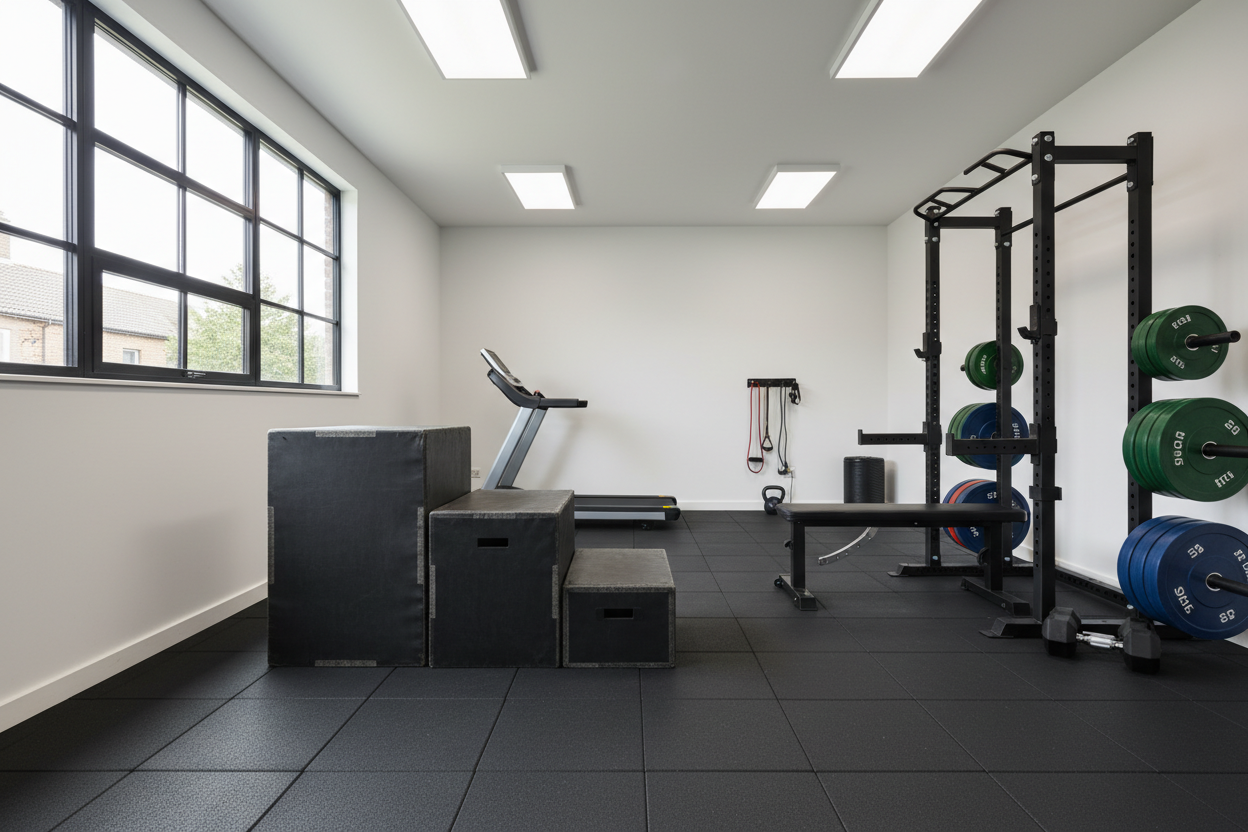
Before you start, clear a dedicated 6x6 foot space. I always tell my clients they need reliable gym flooring for home workout setups to keep from sliding during those fast transitions. A sweaty floor and a dynamic lateral bound is a fast track to a groin injury.
When selecting your pairs, match the biomechanical pattern. A squatting strength move pairs with a squatting jump. A horizontal pressing move pairs with a horizontal explosive push. This ensures the exact same muscle fibers activated by the heavy lift are utilized in the explosive movement. This precise matching is what makes a home fitness programme actually effective rather than just a random sweat session.
Lower Body Power Pairings
For leg development, you want to focus on squat and hinge patterns. A classic pairing I use in almost every full workout plan at home is the Goblet Squat paired with the Vertical Squat Jump. Grab your heaviest dumbbell, perform 5 slow, deep squats, drop the weight safely, and immediately execute 4 maximum-height squat jumps.
Another excellent option is the Bulgarian Split Squat paired with the Split Squat Jump. This unilateral focus will torch your quads and glutes. Since you are landing with significant force on a single leg, joint protection is non-negotiable. Landing a 24-inch vertical jump on bare concrete is a recipe for knee pain, which is why a large exercise mat for home gym use is mandatory to absorb the shock.
For the posterior chain, pair a heavy Dumbbell Romanian Deadlift (RDL) with Broad Jumps. Do 5 slow RDLs, then 3 long, explosive broad jumps forward. Your hamstrings will feel this for days.
Upper Body Explosive Pairings
Upper body contrast sets are notoriously difficult but highly rewarding for chest and back development. They fit perfectly into any gym routines at home. For the chest, pair a heavy Dumbbell Floor Press (or a weighted push-up if you have a vest) with Clapping Plyo Push-ups. Perform 5 heavy presses, stand up, drop to the floor, and hit 4 explosive clapping push-ups.
For the back, if you have a pull-up bar, pair strict, weighted Pull-ups with explosive Inverted Rows (pulling the chest violently to the bar). If you only have dumbbells, pair heavy, slow Bent-Over Rows with explosive Dumbbell Power Cleans. Keep the reps low; 3 to 5 is the sweet spot. Anything more turns into cardio, defeating the purpose of a gym program at home designed for power.
Structuring Your Weekly Contrast Routine
Contrast training is incredibly taxing on the central nervous system (CNS). You cannot do this every day. A proper home training program utilizing PAP should be limited to 2 or 3 days per week, with at least 48 hours of rest between sessions.
Volume management is key in a training at home program. I recommend picking just two contrast pairs per workout (one upper body, one lower body). Perform 4 to 5 sets of each pair. The most crucial element is the rest period. After you complete the heavy lift and the explosive jump, you must rest for 2 to 3 minutes. If you rush the rest, your CNS will not recover, and your power output will plummet on the next set.
My Experience: I tested this exact protocol for six weeks using nothing but a single 50-pound adjustable kettlebell and a thick mat in my living room. My vertical jump increased by two inches, and my legs retained the mass I thought I would lose without a barbell. The one honest downside? The CNS fatigue is real. I tried doing a third contrast pair one afternoon and ended up feeling sluggish for two days. Stick to the prescribed volume, and respect the rest periods.
FAQ
Do I need heavy weights for contrast training to work?
No. You need a weight that is challenging for 5 reps at a slow tempo. For many, a single 50-pound dumbbell or resistance bands used correctly provides enough tension to potentiate the muscles for the jump.
Can beginners do contrast training?
I recommend beginners start with basic strength training first. You need a solid foundation of joint stability and movement mechanics before adding high-impact plyometrics to your routine.
Will this build muscle or just make me jump higher?
Both. The slow, high-tension phase stimulates hypertrophy (muscle growth), while the explosive phase trains your fast-twitch fibers, creating a denser, more athletic physique than traditional high-rep home workouts.