
Full Body Routine Workout: Unilateral Architecture, Movement Blueprints, and Dedicated Floor Staging
Architecting a Balanced Full Body Routine Workout
A well-designed full body routine workout organizes the major movement patterns of the human body into cohesive, time-efficient training sessions. Rather than isolating individual muscle groups across separate days, full-body programming stimulates the entire kinetic chain several times per week. This structure balances mechanical tension across the lower body, upper body, and core while allowing ample recovery between training sessions.
Structuring an effective session requires more than randomly assembling free weight movements. To build balanced strength and joint resilience, an all-over body gym workout must integrate multi-joint compound lifts alongside targeted single-limb variations. For practical layout advice and structural fundamentals, explore our full body routine guide to understand how session frequency and movement selection interact across different training spaces.
The Strategic Role of Unilateral Loading in Full-Body Training
Bilateral exercises—such as traditional barbell back squats or conventional deadlifts—are foundational for developing absolute strength. However, relying exclusively on bilateral movements can mask lateral imbalances where a dominant limb compensates for a weaker side. Introducing unilateral loading directly addresses these discrepancies by requiring each side of the body to independently produce force and stabilize load.
Unilateral exercises demand significant anti-rotational core engagement. When holding a weight on one side of the torso or pressing through a single leg, the deep musculature of the trunk must brace dynamically to maintain spinal alignment. Integrating single-leg and single-arm movements into a complete body workout at gym or home environments improves multi-planar stability, enhances hip control, and promotes symmetrical movement mechanics.
Core Movement Pillars for an All-Over Body Workout
A comprehensive full body gym routine is constructed around fundamental human movement archetypes. By selecting one or two exercises from each core pillar, lifters can build an adaptable training template that delivers full-body stimulus without redundant volume.
- Knee-Dominant Lower Body: Movements that challenge the quadriceps, glutes, and adductors through deep knee flexion and hip extension, such as front squats, goblet squats, and split squats.
- Hip-Dominant Lower Body: Patterns emphasizing the posterior chain, hamstrings, and spinal erectors via hip hinging, including Romanian deadlifts and single-leg hinges.
- Upper Body Horizontal Press and Pull: Antagonistic pairings that develop the chest, anterior shoulders, lats, and mid-back through movements like dumbbell bench presses and single-arm rows.
- Upper Body Vertical Press and Pull: Exercises reinforcing overhead shoulder stability and vertical back strength, such as standing overhead dumbbell presses and lat pulldowns or pull-ups.
- Rotational and Anti-Rotational Core: Bracing exercises that resist unwanted spinal movement, including suitcase carries, Pallof presses, and plank variations.
Lower Body Unilateral Sequences: Split Squats and Single-Leg Hinges
Rear-foot elevated split squats and walking lunges represent potent unilateral lower-body exercises. When executing a split squat, establish a stable base with the lead foot planted firmly, distributing pressure across the heel and base of the toes. Descend with a controlled tempo, allowing the back knee to lower under control while keeping the torso upright or slightly pitched forward at a natural angle. This positioning distributes mechanical load evenly between the quadriceps and hip musculature.
Single-leg Romanian deadlifts place direct demand on hamstring tension and pelvic stability. Maintain a soft bend in the working knee while hinging at the hips, reaching the non-working leg behind the body to act as a counterbalance. Avoid opening or rotating the hips toward the ceiling; keeping the pelvis square to the floor ensures targeted engagement of the posterior chain while training balance across the ankle and foot.
Upper Body and Core Vectors: Offset Presses, Rows, and Carries
Upper-body unilateral training introduces offset rotational forces that challenge core stability while building pressing and pulling strength. Single-arm overhead dumbbell presses require active bracing through the abdominal wall and glutes to prevent the torso from leaning laterally during the ascent. Driving the weight smoothly overhead while keeping the ribs down reinforces overhead mechanics.
In pulling sequences, single-arm supported dumbbell rows allow lifters to focus on lat recruitment without excessive lower-back fatigue. Stabilizing one hand on an incline bench while rowing with the opposite arm encourages a full range of motion, stretching the latissimus dorsi at the bottom and achieving a complete contraction at the top. Offset loaded carries—such as suitcase carries—serve as an effective bridge between strength and functional core stability, training the obliques and transverse abdominis to resist lateral spinal flexion under dynamic movement.
Structured Full-Body Gym and Home Workout Blueprint
Executing an effective full body gym workout routine involves organizing exercises into strategic pairings, or supersets, to maintain training density and manage fatigue. Pairing non-competing movements—such as a lower-body push with an upper-body pull—allows one muscle group to recover while another works, reducing total workout duration.
Below is a sample modular blueprint suitable for both commercial facilities and residential training areas:
- Primary Superset A: Unilateral Lower Push paired with Upper Horizontal Pull (e.g., Dumbbell Split Squats alternated with Single-Arm Dumbbell Rows). Perform moderate repetition ranges with steady control.
- Primary Superset B: Lower Hip Hinge paired with Upper Overhead Press (e.g., Romanian Deadlifts alternated with Standing Single-Arm Dumbbell Presses). Focus on complete range of motion and core bracing.
- Integrated Finisher: Anti-Rotational Core Carry (e.g., Suitcase Carries alternated across left and right sides) to reinforce grip strength, upright posture, and trunk endurance.
For further inspiration on progression schemes and periodization structures, consult our full body workout guide to optimize set-and-rep combinations for your specific strength goals.
Floor Staging and Sub-Surface Room Protection
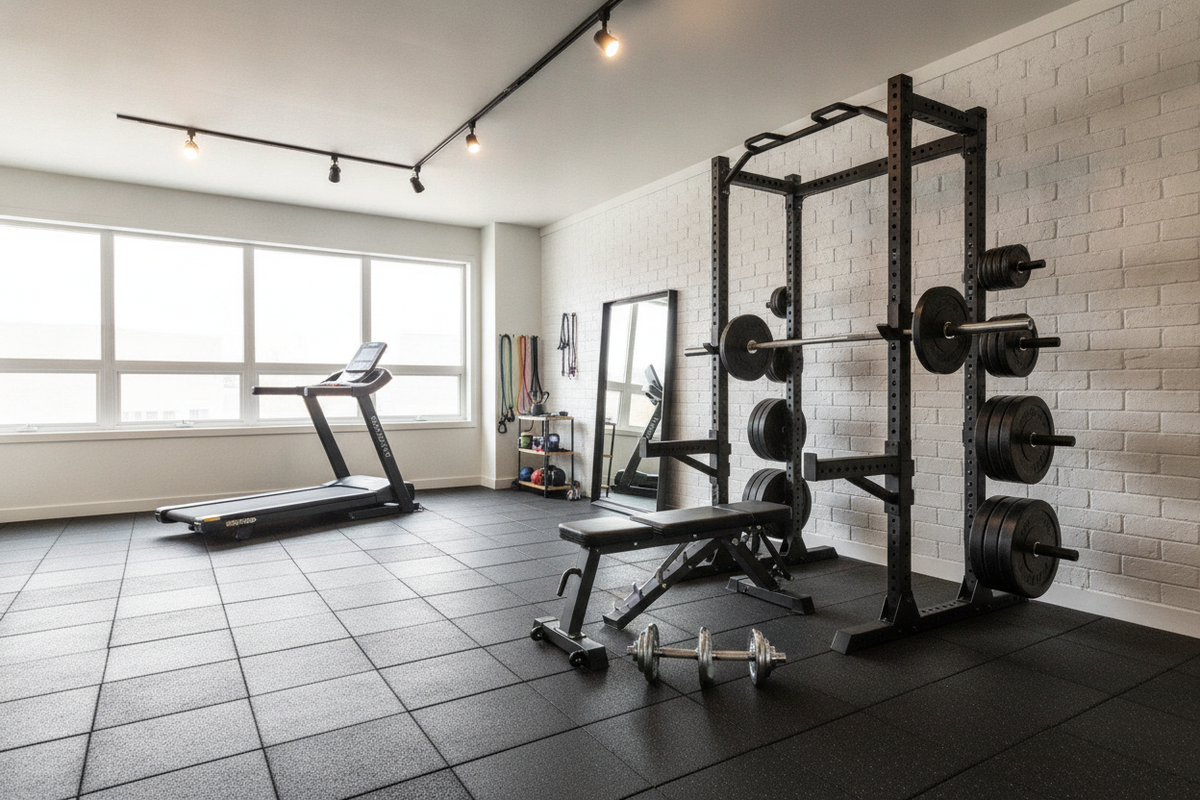
Establishing an appropriate foundation is essential when performing dynamic lunges, single-leg hinges, and heavy dumbbell sequences. Training on bare concrete, slick tile, or plush carpet introduces instability and risks damage to both equipment and flooring. A dedicated workout area requires dense, non-slip gym flooring that absorbs localized point loads and provides consistent shoe traction during multidirectional foot drives.
When selecting flooring for a home gym or designated studio zone, choosing options from a specialized exercise gym collection ensures sufficient surface area for wide split stances and equipment staging. A spacious mat, such as a durable exercise gym workout product, provides expansive coverage so lifters can move fluidly from unilateral lunges to floor-based core exercises without stepping off the protective boundary.
Maintaining Grip Traction, Mat Durability, and Training Space Cleanliness
Preserving the lifespan and traction of gym mats requires straightforward, consistent maintenance habits. Routine care prevents surface buildup, maintains floor grip, and protects the subfloor beneath:
- Dust and Grit Removal: Regularly sweep or vacuum the mat surface to remove dirt particles that can reduce grip friction and cause premature surface abrasion during pivoting movements.
- Surface Wiping: Clean the mat periodically with a mild, non-abrasive soap solution or gentle mat cleanser. Avoid harsh chemical solvents or bleach that could degrade high-density foam or rubberized materials over time.
- Equipment Placement: Avoid dragging heavy, sharp-edged steel plates or unpadded kettlebells across the mat surface. Stage weights deliberately on designated rubber floor tiles or weight trees to prevent localized tears.
- Moisture Control: Ensure the subfloor beneath portable exercise mats is dry prior to installation, preventing trapped moisture from compromising flooring adhesives or hardwood finishes.


