Full Body Workout for Muscle and Strength: Rethink Your Home Gym
If you are juggling a busy schedule and trying to squeeze workouts into a cramped garage gym, the traditional five-day body-part split is likely holding you back. You need efficiency without sacrificing results. That is exactly where a properly structured full body workout for muscle and strength changes the game.
By hitting major muscle groups multiple times a week with compound lifts, you maximize hypertrophy and power in less time. This guide will show you how to structure your training, what equipment actually matters, and how to execute a flawless routine right from your own home gym.
Key Takeaways
- Frequency over volume: Hitting muscles 3x a week yields better natural strength gains.
- Compound focus: Squats, deadlifts, presses, and rows should make up 80% of your routine.
- Minimal gear needed: A quality power rack, barbell, and bench are your foundation.
- Progressive overload: Consistent, incremental weight increases drive a full body workout muscle and strength adaptation.
Building Your Full Body Strength Training Program
Designing an effective full body strength training program requires balancing intensity with recovery. You cannot max out every lift every day. Instead, focus on heavy, multi-joint movements that offer the highest return on your investment of time and energy.
Compound Movements Are Non-Negotiable
Isolation exercises have their place, but they should not be the core of your routine. Your primary focus must be on squats, deadlifts, overhead presses, bench presses, and barbell rows. These lifts recruit the maximum number of muscle fibers and trigger the hormonal responses necessary for growth.
Essential Equipment for Your Space
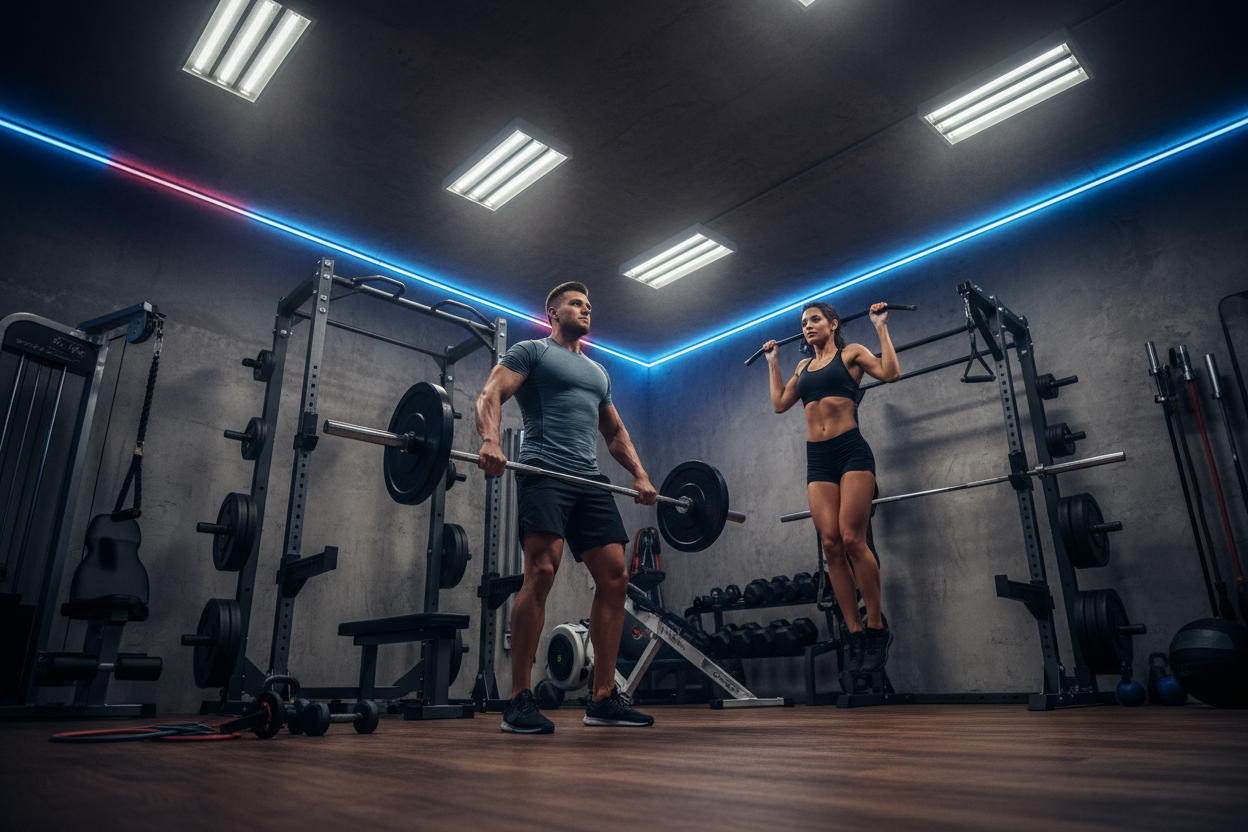
You do not need commercial gym machines to build a massive physique. For North American home gyms—whether in a basement, garage, or spare bedroom—a heavy-duty power rack is your centerpiece. Pair it with a 20kg Olympic barbell featuring moderate-to-aggressive knurling, a flat or adjustable bench, and enough bumper or iron plates to challenge your deadlift. A standard garage setup requires roughly an 8x8 foot footprint to safely accommodate a barbell and rack.
Balancing Volume, Intensity, and Recovery
The biggest mistake lifters make when transitioning to a full body routine is doing too much in a single session. If you try to perform five sets of five different compound lifts, you will burn out and stall your progress.
Finding the Sweet Spot
Aim for 3 to 4 training days per week. Stick to 3-5 sets of 4-6 reps for your primary strength movement of the day, followed by 3 sets of 8-12 reps for secondary hypertrophy movements. This ensures you are targeting both myofibrillar (strength) and sarcoplasmic (muscle size) hypertrophy.
From Our Gym: Honest Take
When I transitioned my training to a strict 3-day full body routine, I was skeptical. I was used to chasing the 'pump' on chest days. But testing our new commercial-grade power rack in my humid, uninsulated garage gym changed my perspective. I needed a routine that got me in and out in under an hour.
Using our flagship 20kg barbell, I noticed the aggressive knurling held my chalked grip solid through heavy, sweaty deadlift sets—something my cheap starter bar always failed at. One minor caveat: at 6'2', I realized my basement ceiling was just an inch too low for strict overhead presses inside the rack. I had to move the j-cups to the outside uprights. But the results? My squat jumped 40 pounds in four months, and my joints felt significantly better without the endless isolation volume.
Frequently Asked Questions
Can you really build muscle with just a full body routine?
Absolutely. Muscle growth is driven by mechanical tension and progressive overload. Hitting a muscle group 3 times a week with moderate volume often produces better hypertrophy results for natural lifters than destroying it once a week on a bro-split.
What equipment is strictly necessary for this workout?
At a minimum, you need an Olympic barbell, weight plates, a sturdy squat stand or power rack, and a bench. Adjustable dumbbells are a fantastic secondary addition for accessory work if you have the budget and floor space.
How long should a full body workout take?
If you are resting properly between heavy sets (2-3 minutes), a comprehensive session should take between 45 and 70 minutes. If it takes longer, you may be adding too much accessory 'junk volume'.