Explosive Leg Workout Blueprint: 6 Power Exercises, Triple Extension Cues, and Home Floor Staging
Biomechanical Foundations of Explosive Leg Training
Developing dynamic lower-body power requires training the nervous system and muscular structures to generate force rapidly. While standard strength training emphasizes moving heavy loads through a full range of motion, explosive leg training prioritizes the rate of force development. This quality allows lifters and athletes to accelerate their body weight or external resistance with immediate velocity.
Rate of Force Development vs. Absolute Strength
Absolute strength represents the maximum force a muscle group can produce regardless of time. In contrast, rate of force development focuses on how quickly muscular tension can peak during dynamic movement. High-velocity exercises tap into the stretch-shortening cycle, where tendons and muscle fibers rapidly absorb eccentric loading and immediately rebound into concentric propulsion. To explore how base strength translates into athletic movement, review our does strong legs guide for fundamental principles.
The Mechanics of Triple Extension in Dynamic Movement
At the center of virtually every jumping, sprinting, and lifting movement is triple extension: the synchronized, simultaneous opening of the hips, knees, and ankles. When these three joint complexes extend in unison, force transfers seamlessly from the floor through the kinetic chain. Mastering this timing ensures that vertical and horizontal propulsion comes from large posterior chain muscle groups rather than isolated strain on smaller stabilizing joints.
The 6 Essential Explosive Leg Exercises
Integrating targeted movements into an explosive training session helps develop multidirectional power, reactive ground contact, and stability. Incorporating foundational movements alongside your regular routine or complementing them with equipment from a dedicated lower body strength collection creates a well-rounded foundation.
1. Dynamic Jump Squats: Vertical Propulsion and Core Bracing
The jump squat is a fundamental bilateral plyometric exercise. Begin in an athletic stance with feet shoulder-width apart. Lower into a quarter or half squat, maintaining an upright torso and engaged core, then forcefully drive through the entire foot to achieve full vertical extension. Focus on exploding straight upward, keeping the ribcage locked down so energy does not dissipate through lumbar hyperextension.
2. Explosive Split Squat Jumps: Unilateral Power and Stance Alignment
Split squat jumps address unilateral force production and leg symmetry. Start in a staggered lunge position with the front knee stacked directly over the midfoot. Drive explosively upward, switching leg positions mid-air, and descend smoothly into the opposite lunge. Maintaining upright torso alignment and level hips prevents rotational torque across the pelvis during the airborne transition.
3. Broad Jumps: Horizontal Force Production and Hip Drive
Horizontal propulsion is essential for sprinting acceleration and dynamic field movement. For the standing broad jump, hinge deeply at the hips while swinging the arms back. Vigorously drive the hips forward and sweep the arms overhead to propel the body horizontally across the floor. For additional exercise progressions, consult our build explosive power guide.
4. Kettlebell or Dumbbell Ballistic Swings: Posterior Chain Snap
Ballistic swings develop rapid hip hinge power without the impact forces associated with repetitive jumping. Stand with feet slightly wider than shoulder-width, hinge at the hips with a neutral spine, and snap the hips forward into full extension to swing the weight upward. The power should originate entirely from the glutes and hamstrings rather than an active shoulder raise.
5. Skater Plyometric Bounds: Lateral Force and Ankle Deceleration
Athletic movement requires force production and absorption across multiple planes. Skater bounds train lateral power and dynamic single-leg stability. Push off laterally from one foot, bound across the training area, and land softly on the opposite leg while controlling knee alignment. Absorb the landing through a slight hip hinge and bent knee before springing back in the opposite direction.
6. Depth Jumps to Tuck: Reactive Ground Contact and Kinetic Rebound
Depth jumps train the stretch-shortening cycle by challenging the body to minimize ground contact time. Step off a low, stable platform, land balanced on both feet, and instantly rebound into a vertical tuck jump. The primary objective is an immediate, spring-like transition off the floor rather than a deep, prolonged squat upon landing.
Deceleration and Landing Mechanics: Protecting Joints and Maintaining Stability
Producing explosive force is only half of the movement equation; learning to absorb dynamic forces safely is equally critical for long-term joint health and movement longevity.
Soft Landing Biomechanics: Distributing Impact Forces
Every jump or bound must conclude with a controlled deceleration phase. When making contact with the floor, land softly from the ball of the foot through the heel, simultaneously bending the ankles, knees, and hips to disperse kinetic energy across large muscle bellies. Maintaining an active, braced midsection prevents excessive spinal flexion during high-impact moments. Utilizing supportive gear from our strength training collection can also assist in maintaining joint stability during heavy volume phases.
Common Landing Errors: Knee Valgus and Trunk Collapse
Two frequent technical breakdowns during explosive training are knee valgus—where the knees collapse inward upon landing—and excessive forward trunk collapse. Knee valgus places unwanted stress on passive connective tissue, while trunk collapse indicates insufficient core bracing. Focus on tracking knees directly over the second toe and keeping the chest proud throughout every landing phase.
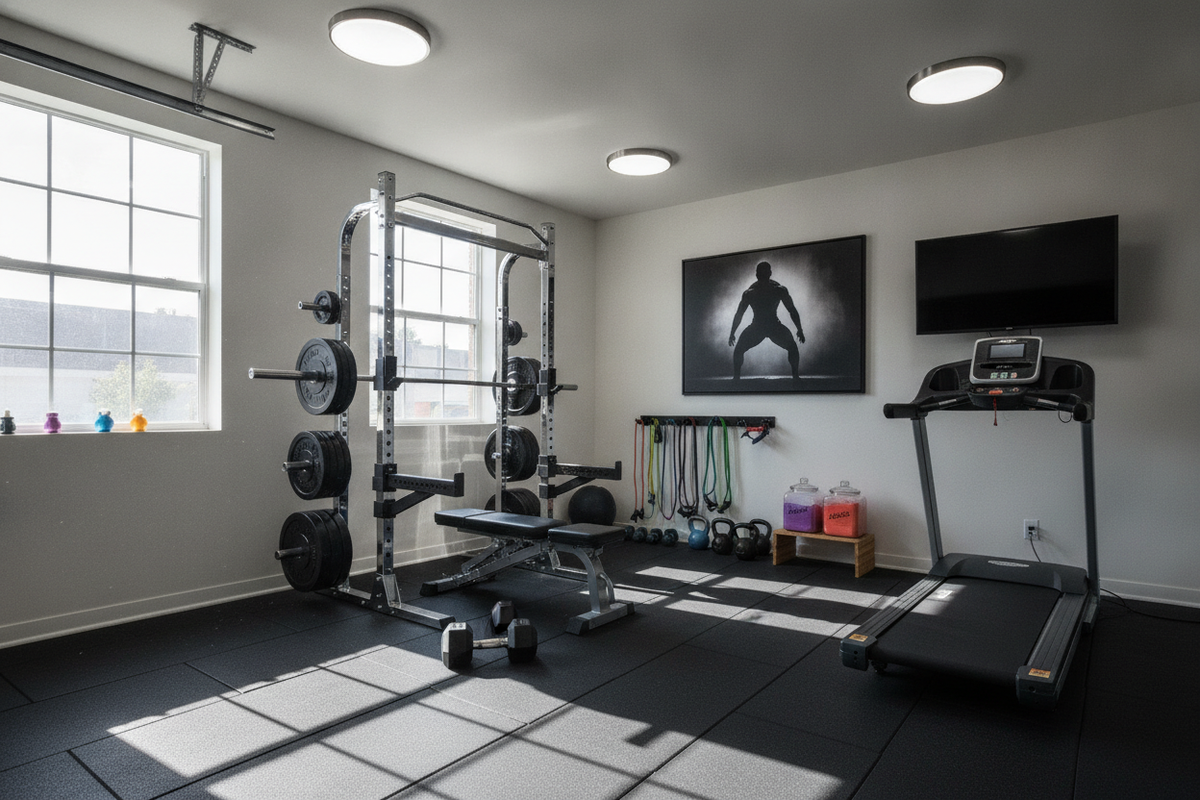
Home Gym Floor Staging for High-Impact Explosive Workouts
Conducting high-velocity plyometrics and ballistic lifts at home requires careful floor preparation to ensure dependable traction, impact dampening, and subfloor defense.
High-Density Matting for Impact Absorption and Grip
Standard household flooring like hardwood, tile, or bare concrete does not provide sufficient grip or cushioning for dynamic footwork. Installing dense rubber or high-density exercise flooring offers a stable base that prevents slipping during lateral bounds and cushion-assisted landings. A dedicated surface like the exercise workout product provides expansive floor coverage that remains flat and secure under dynamic foot strikes.
Subfloor Protection: Preventing Damage to Hardwood and Concrete
Repeated high-impact exercises and dropped ballistic weights can crack concrete or scuff delicate wood subfloors. High-density mats distribute downward shock loads across a broader surface area, reducing structural wear on underlying floors while simultaneously dampening ambient noise and floor vibrations throughout your living space.
Spatial Layout: Creating Safe Landing and Clearance Zones
Explosive movements demand generous clearance in all directions. Ensure adequate overhead ceiling space for vertical jumps and remove nearby benches, kettlebells, or accessories that could interfere with lateral bounds or broad jumps. Establishing a clear, dedicated zone keeps transitions seamless and training focused.
Workout Structuring, Volume Management, and Recovery Strategy
Because explosive training places high demands on the central nervous system, programming should prioritize movement quality over sheer fatigue.
Sample Power-Building Session Structure
- Dynamic Warm-Up: 5 to 10 minutes of hip mobility, ankle dorsiflexion drills, and bodyweight activation.
- Explosive Movement 1: Depth jumps to tuck – 3 to 4 sets of 3 to 5 repetitions.
- Explosive Movement 2: Broad jumps – 3 sets of 4 to 6 repetitions.
- Unilateral Power: Skater plyometric bounds – 3 sets of 6 bounds per side.
- Ballistic Finisher: Kettlebell swings – 3 sets of 8 to 10 crisp repetitions.
Rest Intervals and Quality-Over-Quantity Rep Schemes
Unlike metabolic conditioning circuits, explosive leg training relies on full neurological recovery between efforts. Allow 60 to 90 seconds of rest between explosive sets to ensure each repetition is performed with maximum intent and crisp biomechanics. Terminate sets before speed or movement form deteriorates.