
6 Exercises for Legs and Hips: Kinetic Movement Blueprints, Tension Cues, and Home Floor Staging
Kinetic Synergy: Why Integrated Hip and Leg Training Matters
The lower kinetic chain relies on seamless coordination between the pelvis, hips, knees, and ankles. When training the lower body, isolating individual muscles can create imbalances across movement planes. Combining multi-joint movement with deep hip recruitment helps establish structural balance across both athletic tasks and daily movement patterns. By training the hips alongside the quadriceps, hamstrings, and calves, you reinforce functional movement paths while building well-rounded lower-body control. For broader programming ideas on thigh and pelvic mechanics, exploring our legs exercise hips guide provides additional perspective on balanced training splits.
Multi-planar hip control also supports knee tracking during heavy loading. Because the gluteal group acts as the primary external rotator and abductor of the femur, stable hips prevent dynamic valgus—the inward collapsing of the knees during squatting and landing mechanics. Developing these movement pathways ensures smooth force transmission across the floor, hips, and trunk.
The 6 Best Exercises for Legs and Hips
To establish balanced lower-body development, your routine should incorporate sagittal, frontal, and transverse plane movements. Below are six core exercises targeting the primary prime movers and deep stabilizing musculature.
1. Bulgarian Split Squat with Pelvic Hinge
The Bulgarian split squat isolates each leg while placing high demand on the gluteus medius and maximus. Elevating the rear foot increases the working depth of the front hip while challenging balance.
- Setup: Place the laces of your rear foot on a stable bench or foam block. Step forward with your lead foot so your front shin remains nearly vertical at the bottom of the descent.
- Tension Cue: Hinge forward slightly at the waist rather than staying completely upright. This slight forward torso angle shifts load directly into the gluteus maximus and deep hip rotators while moderating shear force across the anterior knee.
- Execution: Descend under control until your rear knee hovers just above your padded training surface. Drive through your front midfoot and heel to return to standing.
2. Lateral Cossack Squat
The Cossack squat introduces deep frontal-plane hip abduction and adduction alongside unilateral knee flexion. It builds strength through wide ranges of motion while requiring active ankle dorsiflexion.
- Setup: Take a wide stance, roughly twice your shoulder width, with your toes pointing slightly outward.
- Tension Cue: Shift your pelvis laterally and back toward one heel while keeping the opposite leg straight with the toes rotated slightly upward or planted flat.
- Execution: Sink into the working hip while keeping your chest proud and spine neutral. Push firmly into the floor through the bent leg to return to the center starting position.
3. Single-Leg Romanian Deadlift
This posterior-chain exercise develops unilateral hamstring and glute strength while challenging anti-rotational core stability and hip leveling.
- Setup: Stand tall with soft knees, balancing on one foot. Hold a dumbbell or kettlebell on the opposite side of the working leg to balance lateral rotational forces.
- Tension Cue: Initiate the movement by pushing the hip straight back rather than bending forward at the spine. Keep your non-working hip pointed toward the floor to prevent pelvic rotation.
- Execution: Lower the weight until you feel a firm stretch across the working hamstring, maintain a neutral spine, and contract the glute to drive your hips back forward.
4. Curtsy Lunge with Glute Engagement
By crossing the trailing leg behind the lead leg, the curtsy lunge places intense eccentric demand on the lateral hip abductors and external rotators.
- Setup: Stand with feet hip-width apart. Step one leg diagonally backward and across your midline.
- Tension Cue: Keep your front knee aligned directly over the second and third toes of your front foot, resisting any inward knee collapse.
- Execution: Drop into a lunge until your front thigh is nearly parallel to the floor, then push through your front heel to return to your standing base.
5. Tempo Goblet Squat with Isometric Pause
The tempo goblet squat builds bilateral quadricep strength while promoting deep hip opening and upright thoracic posture. If your primary focus is developing knee-extensor mass and control, review our dedicated legs exercise guide for complementary movement ideas.
- Setup: Hold a kettlebell or dumbbell vertically against your upper chest with elbows tucked in. Position your feet shoulder-width apart.
- Tension Cue: Pull your hips down between your ankles rather than pushing them far back. Maintain a controlled three-second descent.
- Execution: Pause for two seconds in the hole while keeping continuous tension in your hips and core, then drive upward forcefully.
6. Side-Lying Hip Abduction with Forward Internal Bias
While compound lifts form the core of a strength routine, targeted isolation of the gluteus medius and minimus ensures pelvic stability during single-leg stances.
- Setup: Lie on your side with your bottom leg bent for stability and your top leg straight.
- Tension Cue: Angle your top toe slightly downward toward the floor and sweep the leg back slightly past your midline to recruit the upper glute fibers instead of the tensor fasciae latae.
- Execution: Raise your top leg smoothly without rolling your pelvis backward, pause at the peak of contraction, and lower slowly.
Structuring Your Hip and Leg Training Split
A well-designed lower-body program balances heavy compound loading, unilateral single-leg control, and isolated hip stability work. To allow adequate recovery between intense sessions, you can structure your weekly training schedule with alternating focal points:
- Session A (Squat & Lateral Focus): Tempo Goblet Squats, Lateral Cossack Squats, Curtsy Lunges, and Side-Lying Abductions.
- Session B (Hinge & Unilateral Focus): Bulgarian Split Squats, Single-Leg Romanian Deadlifts, Hip Thrusts, and Calf Raises.
Spacing these workouts across non-consecutive days gives hip stabilizers and primary leg levers ample time to adapt between sessions.
Home Gym Floor Staging and Equipment Placement
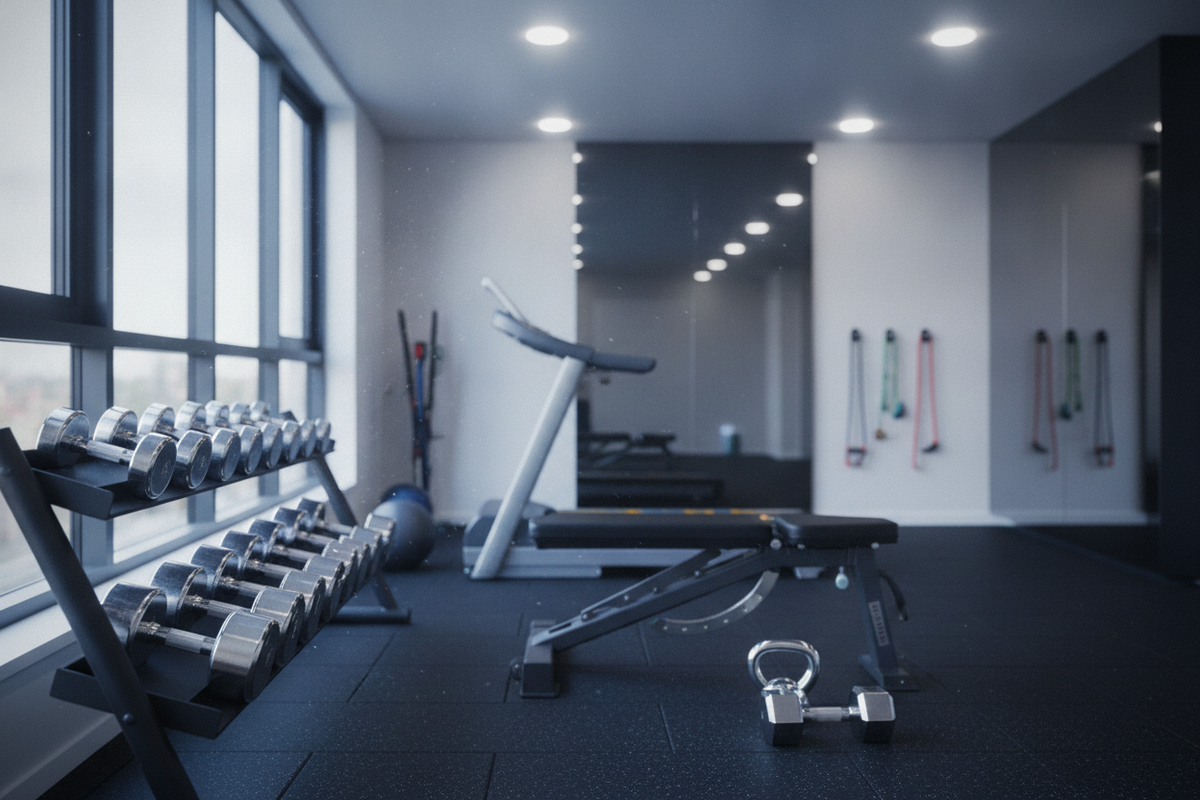
Performing dynamic lunges, lateral shifts, and heavy squats requires a dependable, stable surface. Hard subfloors like concrete or slick hardwood can cause foot slippage during wide Cossack squats or discomfort during rear-knee drop movements. Setting up a dedicated exercise collection mat foundation helps absorb repeated foot impacts and cushions sensitive joints during floor-based exercises.
For lateral drills and broad-stance movements, standard narrow mats often restrict your range of motion. Utilizing a wide workout footprint from a specialized exercise collection allows you to perform multi-directional lunges and wide squats without stepping off the padded boundary. For complete multi-purpose workout zones, a full-sized exercise product provides continuous floor protection under free weights while maintaining a textured, slip-resistant base underfoot.
Floor Maintenance and Grip Optimization for Dynamic Lifting
Maintaining high surface traction is critical when moving rapidly across multiple planes. Dust accumulation and perspiration can reduce friction between athletic shoes and gym flooring, potentially compromising footing during heavy unilateral squats.
To maintain maximum grip, clean your floor mat regularly with a damp microfiber cloth and mild soap. Avoid petroleum-based cleaning solutions or wax-containing sprays that leave slick residues behind. Storing equipment away from high-traffic household entryways also minimizes abrasive dust and prolongs the lifespan of your training space.


