Do Leg Strengthening Exercises at Home Actually Build Real Power?
I remember staring at my 50-lb adjustable dumbbells during the 2020 lockdowns, wondering how on earth I was going to maintain a 400-lb squat. It felt like trying to win a drag race with a Prius. But after six months of trial and error, I realized that leg strengthening exercises at home aren't about mimicking the power rack—they are about manipulating physics to make light weights feel miserable.
You don't need a thousand pounds of iron to build legs that can move mountains. You just need to stop thinking like a powerlifter and start thinking like a mechanic. If you can't increase the load, you have to increase the demand on the muscle through leverage and timing.
- Unilateral movements double the effective load on your working leg.
- Mechanical disadvantage (longer levers) creates more tension with less weight.
- Tempo control—specifically slow eccentrics—is the secret to hypertrophy without a rack.
- Surface traction is non-negotiable for safe force production.
The Big Problem With Chasing Heavy Squats in Your Living Room
Most home gym owners fall into the same trap. They try to do high-rep goblet squats with a 35-lb kettlebell and wonder why their legs aren't growing. The reality is that your grip or your lower back will usually give out before your quads even get a decent stimulus. Trying to replicate heavy barbell mechanics with small weights is a recipe for boredom and plateauing.
When you are training at home, your biggest enemy isn't a lack of weight—it's your own efficiency. Your body wants to find the easiest way to move a load. To build real power, you have to find the hardest way. This means moving away from bilateral (two-legged) squats and embracing the suck of single-leg training where every ounce of weight you own is concentrated on one quad.
How Mechanical Disadvantage Changes the Game
Mechanical disadvantage is just a fancy way of saying 'make the movement harder by making your levers less efficient.' Think about holding a sledgehammer at the very end of the handle versus right under the head. The weight hasn't changed, but the effort required to move it has skyrocketed. This is how you should approach leg strengthening at home.
By slowing down the eccentric (lowering) phase to a 4-second count and eliminating the bounce at the bottom, you force the muscle to stay under tension. When exploring exercises to build leg muscle at home, remember that tension is the primary driver of growth. If you can make a 20-lb dumbbell feel like 80 lbs through pure control, you're winning.
4 Brutal Movements for Your Next Strong Legs Workout at Home
Forget the air squats. If you can do 50 reps of something without breaking a sweat, you aren't building strength; you're just doing cardio. These four movements prioritize stability, deep ranges of motion, and maximum tension to ensure you're actually getting strong legs workout at home.
The 1.5 Rep Bulgarian Split Squat
This is the gold standard for home leg training. Elevate your back foot on a chair or couch. Go all the way down, come halfway up, go back down to the bottom, and then stand all the way up. That is one rep. This technique keeps the muscle in the most difficult part of the range of motion for twice as long. It is arguably the best upper thigh workout at home because it removes the 'rest' at the top of the rep.
Deficit Reverse Lunges
Stand on a thick book, a sturdy wooden block, or a bumper plate if you have one. Step back into a lunge, dropping your back knee lower than the level of your front foot. That extra two or three inches of travel might not seem like much, but it creates a massive stretch in the glutes and quads that you simply can't get on flat ground.
Sliding Hamstring Curls
You don't need a $3,000 leg curl machine. Put on some socks and find a hardwood floor, or use furniture sliders on carpet. Lie on your back, bridge your hips up, and slowly slide your feet out until your legs are straight, then curl them back in. Your hamstrings will scream. It’s a pure isolation move that builds the posterior chain strength most home lifters ignore.
Why Your Floor Is Secretly Sabotaging Your Force Production
I spent years trying to do home exercises to strengthen legs on a cheap rug. Every time I tried to drive out of the bottom of a lunge, my foot would slide an inch. That might not sound like a big deal, but it's a 'power leak.' If your brain senses an unstable surface, it will literally throttle your muscle output to prevent you from snapping an ACL.
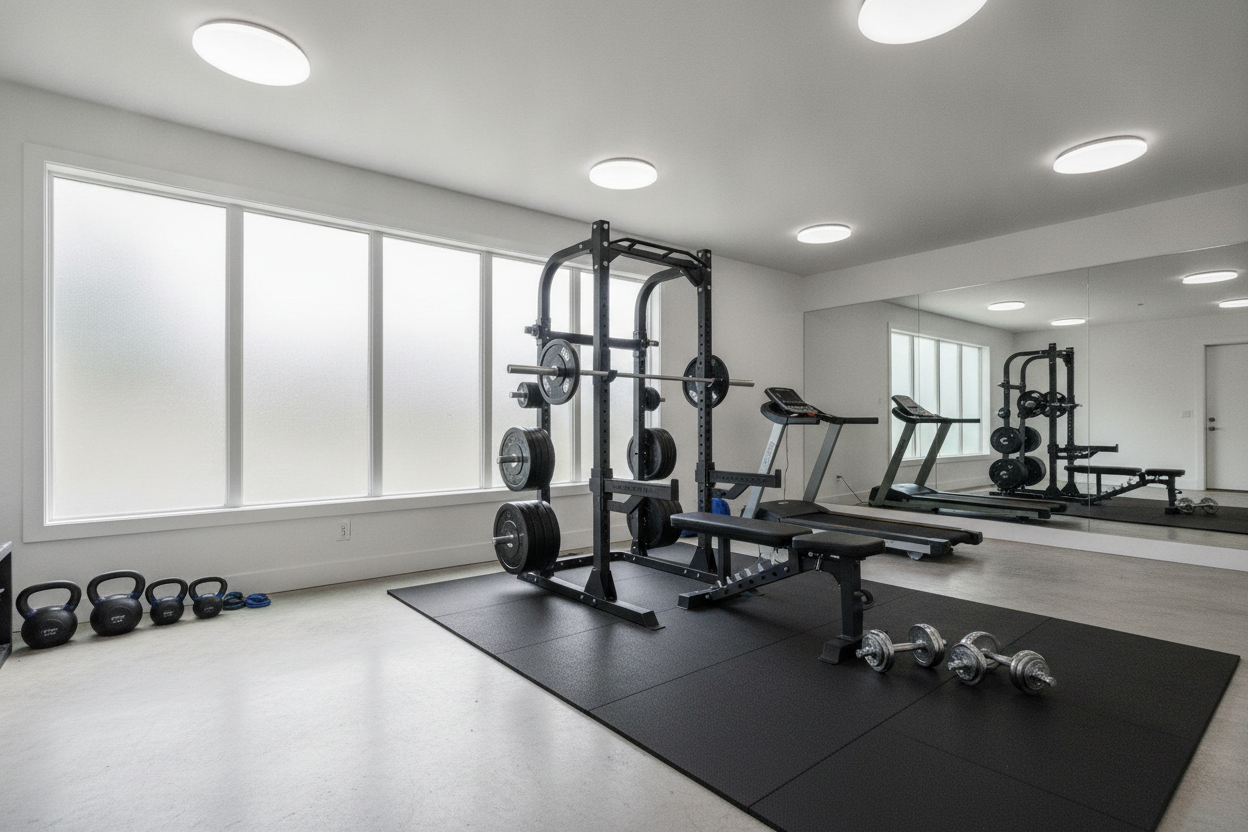
You need a high-density surface that grips both the floor and your shoes. I eventually threw out the rug and put down a 6x8ft exercise mat. The difference in stability was night and day. If you're working in a larger garage or basement, looking at a large exercise mat for home gym is the best investment you can make for your joints. You can't build a house on sand, and you can't build power on a slippery floor.
Putting It Together: A Simple Routine You Can Do Today
If you want to know how to strengthen legs at home, stop overcomplicating the reps. Focus on quality over quantity. Try this circuit three times a week with at least one day of rest in between:
- 1.5 Rep Bulgarian Split Squats: 3 sets of 8-12 reps per leg (3-second descent).
- Deficit Reverse Lunges: 3 sets of 12 reps per leg.
- Sliding Hamstring Curls: 3 sets of 15 reps (focus on a slow 5-second eccentric).
- Sissy Squats (holding a doorframe for balance): 2 sets to failure.
My Honest Take on Home Leg Days
Full disclosure: I used to hate training legs at home. I missed the clank of the plates and the safety of the rack. For a long time, I just did high-rep bodyweight squats and my legs shrank. The mistake I made was thinking I could just 'get by' until I got back to a real gym. It wasn't until I started using deficits and 1.5 reps that my measurements actually started moving again. The downside? These movements are mentally draining. It’s a lot easier to zone out during a set of 10 back squats than it is to stay tight during a 4-second eccentric split squat.
FAQ
Can you really build leg muscle without weights?
Yes, but you have to be creative. Use exercise to build leg muscles at home that focus on unilateral work and increased range of motion. Eventually, you'll want to grab a heavy backpack or a kettlebell to keep the progress coming.
How many times a week should I do leg strengthening at home?
Two to three times is the sweet spot. Because you aren't crushing your central nervous system with 500-lb squats, you can actually recover faster and hit the muscles with more frequency.
What is the best exercise for leg muscles at home if I have bad knees?
Step-ups and reverse lunges are generally easier on the knees than forward lunges or deep squats. Focus on keeping your shin vertical to reduce shear force on the patella.