How to Build Powerful Legs With An Upper Thigh Workout at Home
You do not need a squat rack or a leg press machine to build impressive, functional legs. In fact, relying solely on heavy machinery often masks imbalances that bodyweight training exposes immediately. The problem is that most people approach an upper thigh workout at home with high reps and zero focus, treating it like cardio rather than strength training.
If you want actual muscle definition and strength, you need to manipulate leverage and tension, not just bounce up and down. This guide breaks down exactly how to target the quadriceps, hamstrings, and adductors using nothing but gravity and biomechanics.
Key Takeaways for Home Leg Training
- Prioritize Unilateral Movements: Single-leg exercises double the load on the working muscle without needing external weights.
- Control the Tempo: Slow down the eccentric (lowering) phase to 3-4 seconds to increase time under tension.
- Target All Angles: Effective upper leg workouts at home must hit the quads (front), hamstrings (back), and adductors (inner thigh).
- Mind the ROM: Full Range of Motion recruits more muscle fibers than partial reps, which is crucial when loading is limited.
The Anatomy of a Complete Leg Workout
To get results, you have to understand what you are working on. Flailing around with random squats won't cut it. Your upper leg is comprised of three main compartments that require specific attention.
The Quadriceps (The Powerhouse)
These are the large muscles on the front of your thigh. At home, standard squats often become too easy too quickly. To stimulate growth here, we need to push the knee forward over the toe (safely) to stretch the muscle fibers under load.
The Hamstrings (The Brake System)
Located on the back of the thigh, these are often neglected in home routines. Squats do very little for hamstrings. You need exercises that involve knee flexion (bending the knee) or hip extension to properly engage them.
The Adductors (The Stabilizers)
The inner thigh muscles provide width to the leg and stability to the knee. If you ignore these, your legs will look incomplete and your squats will feel shaky.
The Core Routine: Intensity Over Volume
Forget doing 100 air squats. That builds endurance, not structure. We are going to focus on mechanical disadvantage to make light weight feel heavy.
1. The Bulgarian Split Squat (Quad Focus)
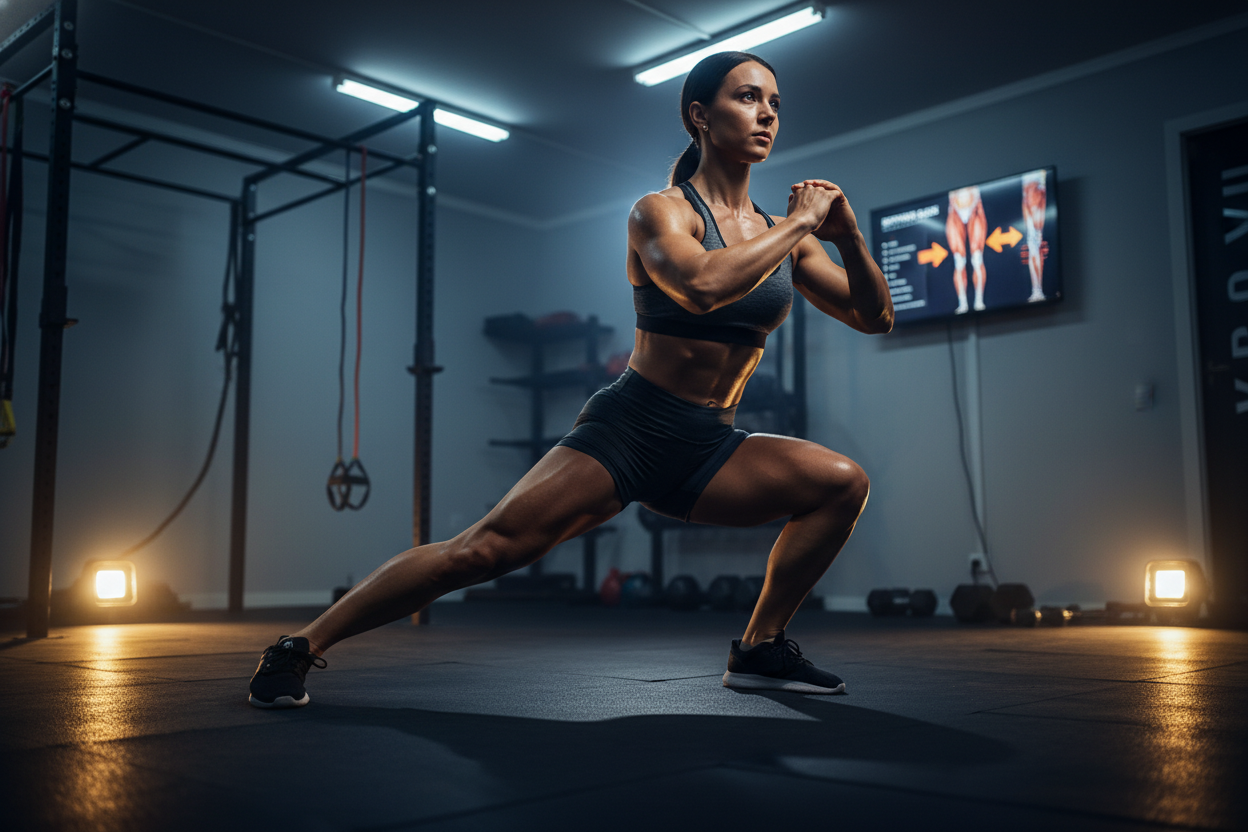
This is the king of upper leg workouts at home. By elevating your rear foot, you force the front leg to handle the entire load.
The Form: Place your rear foot on a couch or chair. Step the other foot out. Lower your hips until your back knee almost touches the floor. Keep your torso upright to hit the quads, or lean forward slightly to engage the glutes.
2. Sliding Hamstring Curls (Hamstring Focus)
You don't need a curl machine. You just need a slick floor and a towel (or paper plates on carpet).
The Form: Lie on your back, heels on the towel. Lift your hips into a bridge. While keeping hips high, slide your heels out until legs are straight, then drag them back in forcefully. This lights up the posterior chain harder than most gym machines.
3. Copenhagen Plank (Adductor Focus)
This is a non-negotiable for complete thigh development. It isolates the inner thigh isometrically.
The Form: Side plank position. Place your top foot on a chair or bench. Lift your bottom leg up to meet the top leg. Hold. Gravity tries to push your hips down; your adductors fight to keep them up.
Progressive Overload Without Weights
How do you get stronger without adding plates? You change the physics.
- Pause Reps: Hold the bottom position of your split squat for 2 seconds. This kills momentum and forces the muscle to contract harder.
- 1.5 Reps: Go all the way down, come halfway up, go back down, then come all the way up. That counts as one rep.
- Decrease Rest: Cap your rest periods at 45 seconds to induce metabolic stress.
My Training Log: Real Talk
I want to be transparent about the reality of this routine. The first time I swapped heavy barbell squats for high-volume Bulgarian Split Squats in my living room, I assumed it would be a "deload" week. I was wrong.
The hardest part wasn't the strength aspect—it was the balance and the foot cramping. When I set up for the split squat, I initially used a dining chair with a hard edge. Big mistake. The top of my foot was bruised by the third set. I switched to the edge of my sofa, but then my foot sank in too deep, throwing off my stability.
I eventually found the sweet spot by placing a firm pillow on the coffee table. Also, the "burn" is different. In the gym, you feel the crushing weight of the bar. At home, doing these slow-tempo reps, the burn is an intense, localized acidity in the muscle belly—specifically the vastus medialis (the teardrop muscle just above the knee). You will wobble, and your non-working hip flexor might cramp up before your working quad fails. That’s normal. Shake it out and keep going.
Conclusion
Building legs at home isn't about finding a secret exercise; it's about executing basic movements with extreme prejudice. If you focus on unilateral training and strict tempo, an upper thigh workout at home can be just as grueling—and effective—as a gym session. Consistency with these high-tension movements is what separates those who spin their wheels from those who make progress.
Frequently Asked Questions
Can I actually build mass with just bodyweight leg workouts?
Yes, but only if you approach failure. You must perform exercises that are difficult enough to fatigue the muscle within the 8-20 rep range. Unilateral exercises like pistol squats or split squats are essential for this.
How often should I do this upper thigh routine?
Since bodyweight training causes less systemic nervous system fatigue than heavy spinal loading, you can train legs more frequently. 2 to 3 times per week is optimal for most people.
Why do my knees hurt during home leg workouts?
Knee pain often stems from poor ankle mobility or weak hips. Ensure your knee tracks in line with your toes and doesn't collapse inward (valgus). If pain persists, reduce the range of motion and focus on strengthening the glutes first.